
Crematogaster gryllsi
- Tud. név
- Crematogaster gryllsi
- Nemzetség
- Crematogastrini
- Alcsalád
- Myrmicinae
- Szerző
- Sharaf & Hita Garcia, 2019
- Elterjedés
- 0 országban megtalálható
Bevezetés
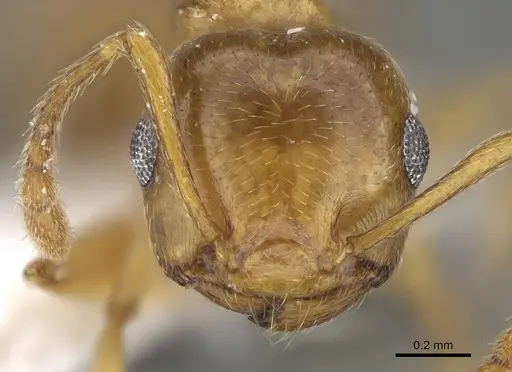
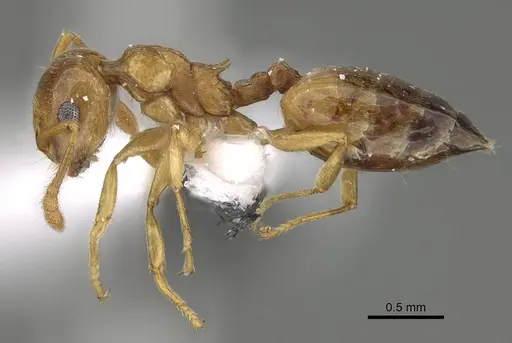
Crematogaster gryllsi is a tiny yellow ant species recently described from the Asir Mountains of Saudi Arabia. Workers measure approximately 2.5-3mm in total length, with a uniform yellow body and brown-yellow coloration on the rear half of the abdomen. This species is distinctive among Arabian Crematogaster ants because it has an undivided (single-lobed) postpetiolar node, unlike other regional species which have a bilobed postpetiole. The propodeal spines form a smooth concave curve when viewed from the side. The species was named in honor of Bear Grylls, the survival instructor . This ant lives in the humid leaf litter of the Fayfa and Raydah mountain forests in southwestern Saudi Arabia, typically under Acacia and Calotropis procera trees at elevations between 837-1851 meters. The species was collected by sifting through leaf litter and using pitfall traps, indicating it forages at ground level in moist microhabitats. As a newly described species, captive husbandry information is limited, but its habitat suggests it prefers humid conditions with moderate temperatures.
Quick Summary
- Difficulty: Medium
- Origin & Habitat: Asir Mountains, Saudi Arabia, specifically Fayfa Mountains (837m elevation) and Raydah (1614-1851m elevation). Found in humid leaf litter under Acacia and Calotropis procera trees [1].
- Colony Type: Colony structure is unconfirmed. Only known from worker specimens collected in the wild, no queen or colony size data available.
- Size & Growth:
- Queen: Unknown, no queen described yet
- Worker: Approximately 2.5-3mm total length, inferred from genus patterns [1]
- Colony: Unknown, only known from 39 type specimens collected individually
- Growth: Unknown
- Development: Unconfirmed (Development timeline has not been directly studied for this species.)
- Antkeeping:
- Temperature: Moderate warmth needed. Based on the mountain habitat (837-1851m elevation) in southwestern Saudi Arabia, aim for roughly 22-26°C with a gentle gradient. Avoid extremes.
- Humidity: High humidity is essential. These ants live in humid leaf litter, so keep nest substrate consistently moist but not waterlogged. Provide a gradient from damp to slightly drier areas.
- Diapause: Unknown, likely a mild winter slowdown given the subtropical mountain habitat, but this has not been studied.
- Nesting: Prefers tight, humid chambers. A Y-tong (AAC) nest or moist plaster nest works well. The tiny worker size means chambers should be appropriately scaled. Avoid dry, airy setups.
- Behavior: Temperament is unconfirmed, but Crematogaster species are generally defensive and may raise their gaster when threatened (the 'acrobat ant' posture). Workers are small but active foragers. Escape prevention is critical due to their tiny size, use fine mesh barriers. They likely forage in leaf litter and may tend aphids for honeydew. Defense mechanism involves smearing venom using a modified stinger.
- Common Issues: tiny size means escapes are likely without fine mesh barriers, high humidity requirements can lead to mold if ventilation is poor, limited data means husbandry is largely experimental, be prepared to adjust conditions, wild-caught colonies may be difficult to obtain as the species has limited range
Nest Preferences
In the wild, Crematogaster gryllsi lives in humid leaf litter on the forest floor, specifically under Acacia and Calotropis procera trees in the Asir Mountains. The Fayfa location sits at 837m elevation while Raydah sites reach 1851m, suggesting they prefer cooler, more humid conditions than typical lowland Arabian ants. For captive care, provide a moist nest environment, either a Y-tong (AAC) formicarium with water chamber or a plaster/soil nest that holds humidity well. Chambers should be appropriately sized for their tiny workers. A naturalistic setup with moist soil and leaf litter can also work, though it makes observation harder. Avoid dry setups entirely. [1]
Feeding and Diet
Feeding habits are unconfirmed for this specific species, but Crematogaster ants are typically omnivorous with a preference for sugar sources and protein. In the wild, they likely forage for honeydew from aphids and scale insects in the leaf litter layer, plus small insects. For captivity, offer sugar water or honey as a constant energy source. For protein, provide small prey items appropriate to their tiny size, fruit flies, small mealworms, or other micro-insects. Given their small size, prey items should be appropriately scaled.
Temperature and Care
Keep the nest at moderate temperatures around 22-26°C. The mountain habitat (800-1800m elevation) in southwestern Saudi Arabia suggests they experience moderate temperatures year-round with cooler conditions at higher elevations. A heating cable on one side of the nest can create a temperature gradient, allowing ants to self-regulate. Avoid temperatures above 30°C or below 18°C. Room temperature in most homes (22-24°C) should work well as a starting point. Monitor colony activity, if workers become sluggish, slightly increase temperature, if they avoid the heated area, reduce it. [1]
Behavior and Temperament
Crematogaster ants are known for their defensive behavior, when threatened, they raise their abdomen over their head in an 'acrobat' posture, ready to use their stinger or apply venom. This species is small but likely has similar defensive instincts. Workers are probably active foragers that search through leaf litter. Escape prevention is critical due to their tiny size, even small gaps that larger ants cannot pass will allow these ants to escape. Use fine mesh on all openings and consider barrier methods like fluon on test tube rims. They are not aggressive toward humans but will defend the nest vigorously. [1]
Acquiring This Species
Crematogaster gryllsi is a recently described species with a very limited range, only known from the Asir Mountains of Saudi Arabia. Wild-caught colonies are likely extremely difficult to obtain due to the species' restricted distribution and the remote location. There is no established captive breeding population in the antkeeping hobby. If available at all, it would likely be from very specialized breeders or academic sources. This makes the species more suitable for experienced antkeepers who have the resources to maintain experimental conditions, rather than beginners. [1]
Seasonal Care
The seasonal requirements of this species are unconfirmed. The Asir Mountains experience mild winters with occasional frost at higher elevations, but the ants live in leaf litter which provides some insulation. A safe approach would be to provide a mild winter cooldown period (2-3 months at 15-18°C) simulating natural seasonal cycles, though this may not be strictly required. Observe your colony's behavior, if workers become less active in winter months, this suggests they benefit from a rest period. Do not allow temperatures to drop near freezing.
Frequently Asked Questions
How do I keep Crematogaster gryllsi ants?
Keep them in a moist nest (Y-tong or plaster works well) at 22-26°C with high humidity. They need tiny prey items and sugar water. Escape prevention is critical due to their very small size.
What do Crematogaster gryllsi eat?
Based on typical Crematogaster diet, they likely accept sugar water or honey and small protein sources like fruit flies or tiny mealworms. Their wild diet probably includes honeydew from aphids and small insects in leaf litter.
How big do Crematogaster gryllsi colonies get?
Unknown, this is a newly described species with no documented colony sizes. Based on related Crematogaster species, colonies likely reach dozens to a few hundred workers.
Do Crematogaster gryllsi ants sting?
Crematogaster ants can sting, though their small size means the sting is rarely painful to humans. They may raise their abdomen in a defensive 'acrobat' posture when threatened.
Are Crematogaster gryllsi good for beginners?
No, this is not a recommended species for beginners. It's a newly described species with extremely limited data on captive care, and wild colonies are essentially unavailable. The high humidity requirements and tiny size also add challenges.
Where is Crematogaster gryllsi found?
Only known from the Asir Mountains in southwestern Saudi Arabia, specifically the Fayfa Mountains (837m elevation) and Raydah (1614-1851m elevation).
How long do Crematogaster gryllsi take to develop?
Unconfirmed, development has not been directly studied for this species.
Do Crematogaster gryllsi need hibernation?
Unknown, the winter requirements have not been studied. The mountain habitat suggests they may benefit from a mild winter cooldown, but this is not confirmed.
Can I keep multiple Crematogaster gryllsi queens together?
Unknown, colony structure has not been documented. Multiple-queen colonies have not been confirmed or denied for this species.
Why is it named Crematogaster gryllsi?
The species was named in 2019 in honor of Bear Grylls, the British survival instructor and television personality, in recognition of his remarkable efforts in spreading survival culture globally.
Report an Issue
The current care sheet is based fully on literature. See inconsistencies, or something that's incorrect? Please , it will be resolved after review from an admin. Contributing to the blogs tab also helps providing information, to make us be able to further improve the caresheets. Thank you for your support!
References

Ez a tartási útmutató a következő licenc alatt áll: CC BY-SA 4.0 .
Közösségi blogok
CASENT0919794
Megtekintés az AntWeb-en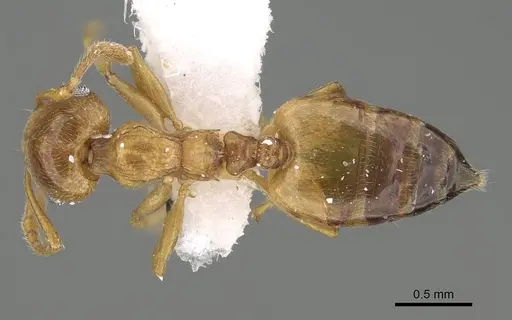
Irodalom
Elterjedési térkép betöltése...Termékek betöltése...