
Anochetus leyticus
- Tud. név
- Anochetus leyticus
- Nemzetség
- Ponerini
- Alcsalád
- Ponerinae
- Szerző
- Zettel, 2012
- Elterjedés
- 0 országban megtalálható
Bevezetés
Anochetus leyticus is a trap-jaw ant from the Philippines known only from seven worker specimens collected in 2005 . Workers measure 5.5-5.7 mm in total length and display the classic Anochetus appearance: long, spring-loaded mandibles, a slender body, and distinctive longitudinal striations running across the head and thorax . The species was discovered on Leyte Island near the Calbiga-a River, living on slopes at 50-100 meters elevation . Beyond this single collection event, nothing is known about their biology - no queens have ever been found, no nests observed, and no behavioral studies conducted . For antkeepers, this makes them one of the most mysterious species in the hobby, currently impossible to keep until more is discovered about their reproductive biology and colony foundation.
Quick Summary
- Difficulty: Expert
- Origin & Habitat: Leyte Island, Philippines, collected from tropical lowland river bank habitat at 50-100m elevation [1]
- Colony Type: Unknown, only the worker caste has ever been collected [1]
- Size & Growth:
- Antkeeping:
- Temperature: Likely tropical based on Leyte Island location, estimated 24-28°C, but unconfirmed
- Humidity: Likely high humidity based on river bank collection site, keep substrate moist, but unconfirmed
- Diapause: Unknown, probably not required given tropical origin, but unconfirmed
- Nesting: Unknown, natural nesting habits never observed [2]
- Behavior: Trap-jaw mandible structure suggests predatory hunting behavior typical of the genus, but specific temperament, aggression levels, and foraging style remain completely unobserved [1]. Their small size means escape prevention would be critical if ever kept in captivity.
- Common Issues: acquisition is impossible, only seven specimens exist in museum collections., founding behavior is unknown, no one knows if queens are claustral or require foraging., no captive husbandry records exist, any attempt would be experimental with high failure risk., wild-caught workers cannot start colonies, only queens can found colonies, and none are available.
Discovery and Type Locality
Anochetus leyticus was described in 2012 by Herbert Zettel based on specimens collected on March 20-21,2005 [1]. The collection site was on Leyte Island in the Philippines, specifically on the slopes of Mount Pangasugan behind Leyte State University, along the banks of the Calbiga-a River at 50-100 meters above sea level [1]. This single location represents the only known occurrence of the species. The habitat was tropical lowland forest near water, suggesting these ants may prefer humid, shaded environments near rivers, but this is speculative based on just one collection point. The species name refers to Leyte Island, its only known home [1].
Physical Appearance and Identification
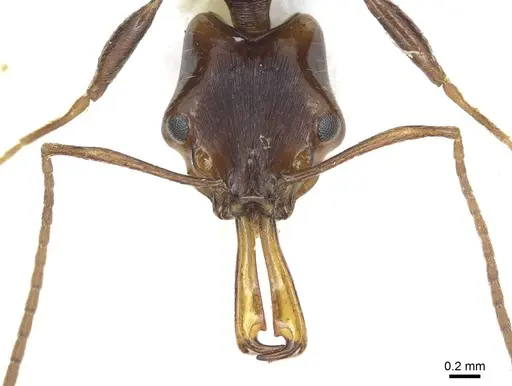
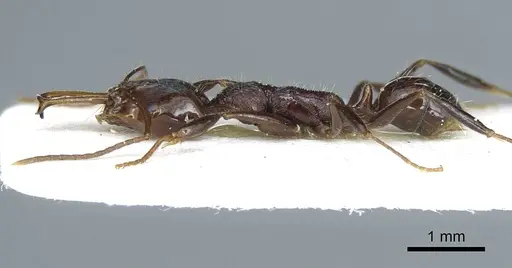
Workers of Anochetus leyticus are medium-sized trap-jaw ants measuring 5.5-5.7 mm in total length [1]. They are medium brown in color, with the center of the head, the middle body section (mesosoma), and parts of the abdomen slightly darker [1]. The mandibles, antennae, leg tips (tarsi), and abdomen tip are pale brown [1]. The head shows distinctive longitudinal striations (grooves) running from the front almost to the back, and the vertex (top of head) is deeply notched [1]. The mandibles are moderately long and stout, featuring a smooth upper edge and a minutely serrated lower edge [1]. The petiole (waist segment) has a narrow node that appears narrowly rounded from the side and almost pointed from the front [1]. They belong to the Anochetus risii species group and can be distinguished from similar species like Anochetus tua by their smaller size (Anochetus tua reaches 7.6-8.2 mm) [1].
Biology - The Complete Unknown
Unlike most ants in the hobby, nothing is known about the biology of Anochetus leyticus beyond the fact that workers exist [2]. No queens have ever been collected, so whether colonies have one queen or multiple queens is a mystery. No nests have been found, so we do not know if they nest in soil, rotting wood, or leaf litter. No observations of foraging or hunting exist, though their trap-jaw mandibles suggest they are predators of small arthropods like other Anochetus species. No information exists about nuptial flights, colony founding, or development timelines. This complete lack of biological data makes them a species for scientific research rather than captive keeping at this time.
Why This Species Is Not Currently Suitable for Keeping
Anochetus leyticus represents a special case in antkeeping, a species that cannot currently be ethically or practically kept. Since only seven worker specimens exist in museum collections and no queens have ever been found, there is no source for founding a colony [1][2]. Even if a queen were discovered, the complete absence of data on founding type (whether she seals herself in or needs to forage), temperature requirements, diet, and nesting preferences would make successful rearing nearly impossible. Attempting to keep this species would require destroying wild colonies to obtain queens, which is not advisable for a species known from a single location. This species should remain in the realm of scientific research until comprehensive biological studies are conducted and captive breeding protocols can be established.
Frequently Asked Questions
Can I keep Anochetus leyticus in captivity?
No, this species is not currently available in the antkeeping hobby. Only seven worker specimens exist in museum collections, and no queens have ever been found [1][2]. Without queens, colonies cannot be founded.
How do I find a queen Anochetus leyticus?
Queens of this species have never been collected or described. They likely fly during nuptial flights at some point in the year, but the timing, location, and even the appearance of the queen are completely unknown [2].
What do Anochetus leyticus eat?
Their diet has never been observed. Based on their trap-jaw mandibles and related Anochetus species, they likely hunt small live prey such as springtails or tiny insects, but this is speculation [1].
What temperature do Anochetus leyticus need?
Their temperature requirements are unknown. Based on their tropical origin on Leyte Island, they likely prefer warm conditions around 24-28°C, but this is an estimate based on geography rather than direct observation.
Do Anochetus leyticus need hibernation?
Probably not, given their tropical origin, but this is unconfirmed. Tropical species typically remain active year-round without a winter rest period.
How long until Anochetus leyticus get their first workers?
The egg-to-worker timeline is completely unknown. No one has ever observed colony founding or brood development in this species [2].
Are Anochetus leyticus good for beginners?
No, this species is unsuitable for any keeper at present. The complete lack of biological data, absence of available queens, and extreme rarity make this a species for scientific research only, not hobby keeping [2].
How big do Anochetus leyticus colonies get?
Colony size is unknown. Only seven workers have ever been collected, and they may have come from one colony or multiple colonies [1].
Where do Anochetus leyticus nest?
Their nesting habits are unknown. They were collected from river banks on forest slopes, but whether they nest in soil, rotting wood, or under stones was never determined [1].
Are Anochetus leyticus dangerous?
They possess trap-jaw mandibles typical of the genus, which can deliver a painful bite. Additionally, as members of the Ponerini tribe, they have a functional stinger capable of injecting venom that is painful to vertebrates. However, given their extreme rarity, handling should never occur.
Report an Issue
The current care sheet is based fully on literature. See inconsistencies, or something that's incorrect? Please , it will be resolved after review from an admin. Contributing to the blogs tab also helps providing information, to make us be able to further improve the caresheets. Thank you for your support!
References

Ez a tartási útmutató a következő licenc alatt áll: CC BY-SA 4.0 .
Közösségi blogok
CASENT0915890
Megtekintés az AntWeb-en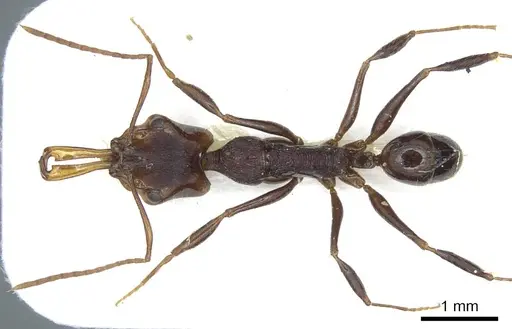
Irodalom
Elterjedési térkép betöltése...Termékek betöltése...