
Aenictus kadalarensis
- Tud. név
- Aenictus kadalarensis
- Alcsalád
- Dorylinae
- Szerző
- Sahoo <i>et al.</i>, 2023
- Elterjedés
- 0 országban megtalálható
Bevezetés
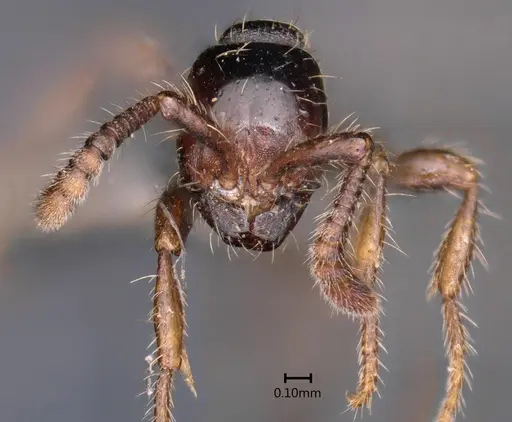
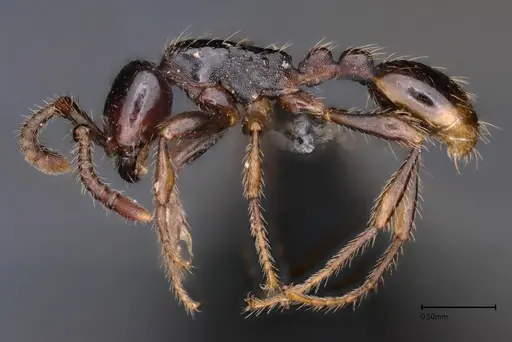
Aenictus kadalarensis is a tiny army ant discovered in 2023 from the Western Ghats of India. Workers measure 3.2-3.4 mm in total length and are dark reddish-brown to black with a distinctive yellowish tip on the gaster . They belong to the Aenictus pachycerus species group and can be recognized by their smooth pronotum, seven mandibular denticles, and the presence of a subpetiolar process . This is a newly described species known only from the type locality. The queen and male castes remain undiscovered . The only known specimens were collected in May from a rotting log in a tea plantation surrounded by evergreen forest at 1416 meters elevation in Kerala, India .
Quick Summary
- Difficulty: Expert
- Origin & Habitat: Southern Western Ghats, India, evergreen forest at 1416m elevation in tea and cardamom plantations near Munnar [1]
- Colony Type: Army ant, colony structure unconfirmed, queen and male castes unknown [1]
- Size & Growth:
- Antkeeping:
- Temperature: Unknown, likely warm based on tropical habitat in Southern India
- Humidity: Likely high, collected from damp rotting wood in evergreen forest [1]
- Diapause: Unlikely, tropical species from Kerala, India where temperatures remain warm year-round
- Nesting: Unknown, army ant nesting behavior unconfirmed for this species
- Behavior: Army ant, workers are small, fast-moving, and possess a sting [1]. As an army ant, they likely hunt prey cooperatively, though specific behavior is unstudied.
- Common Issues: queen caste is unknown, colony founding is impossible with current knowledge, army ant biology requires massive space and constant live prey supply that cannot be provided in standard ant keeping setups, only 65 specimens exist in collections, obtaining live specimens is effectively impossible, tiny worker size (3.2mm) makes escape prevention difficult even if housing were possible, nomadic lifestyle may make formicarium housing impossible if confirmed
Why Aenictus kadalarensis Cannot Be Kept in Captivity
You cannot keep Aenictus kadalarensis in a standard ant setup. This species is an army ant, and army ants have biological requirements that make captive keeping impractical with current technology and knowledge.
First, the queen caste remains completely unknown. Scientists have never collected a queen or male of this species, so you cannot start a colony even if you obtained workers [1]. Without a queen, colony founding is impossible.
Second, army ants typically require enormous quantities of live prey. A single colony might consume thousands of insects per day. You cannot provide this food supply in captivity.
Third, if this species proves to be nomadic like other army ants, they would not stay in one nest location, making formicarium housing impossible.
Identification Features
If you encounter these ants in the field in India, you can identify Aenictus kadalarensis by several key features. Workers have a head that is longer than broad with subparallel sides, and the surface is smooth and shiny except for the area between the parafrontal ridges [1].
Look at the mandibles: they have a large apical tooth followed by seven smaller denticles of similar size [1]. This distinguishes them from similar species like Aenictus eugeniianus, which has only five denticles.
The pronotum (the first segment of the middle body section) is smooth and shiny, not microreticulated like in Aenictus aitkenii and Aenictus dentatus [1]. They also possess a subpetiolar process, a small projection on the bottom of the petiole, which is absent in Aenictus eugeniianus [1].
The color pattern is distinctive: dark reddish-brown to black body with the gaster (abdomen) being black except for a yellowish tip, and legs that range from light yellow to black [1].
Natural Habitat and Collection
The only known population of Aenictus kadalarensis lives in the Southern Western Ghats biodiversity hotspot near Munnar, Kerala, India [1]. The type locality is a tea and cardamom plantation surrounded by evergreen forest at 1416 meters elevation.
The surrounding forest contains trees like Cullenia exarillata, Mesua ferrea, and Palaquium ellipticum, along with Diospyros sylvatica, Drypetes elata, Cinnamomum keralense, Syzygium gardneri, Dimocarpus longan, Aglain jainii, and Litsea oleoides [1].
The ants were collected in May, just before the monsoon season begins. Workers were found on and under a rotten log on the ground [1]. This suggests they forage in decaying wood and leaf litter in humid, shaded conditions.
Relationship to Other Army Ants
Aenictus kadalarensis belongs to the Aenictus pachycerus species group, which includes 17 species across Asia [1]. In India, this group includes Aenictus aitkenii, Aenictus dentatus, Aenictus pachycerus, and Aenictus punensis.
Like other Aenictus species, they are likely subterranean army ants that hunt soil and leaf litter arthropods. They probably use chemical trails to coordinate group foraging, though this specific behavior has not been observed in A. kadalarensis.
The genus Aenictus represents the Old World army ants, analogous to the New World army ants (Eciton, Labidus, etc.). They share the nomadic lifestyle and massive colony sizes, but evolved independently on different continents.
Frequently Asked Questions
Can I keep Aenictus kadalarensis in a test tube?
No. This is an army ant species with unknown biology and undiscovered queen caste. Even if you had workers, army ants require massive space, constant live prey, and potentially nomadic movement that makes test tube keeping impossible.
How do I found a colony of Aenictus kadalarensis?
You cannot. The queen has never been discovered by scientists. Without a queen, there is no method to start a captive colony of this species [1].
What do Aenictus kadalarensis eat?
Unknown specifically, but as army ants they likely prey on small soil arthropods, termites, and other insects. Army ants require massive quantities of live prey.
How big do colonies of Aenictus kadalarensis get?
Unknown for this specific species. Related Aenictus species typically have colonies with thousands to tens of thousands of workers.
Do Aenictus kadalarensis ants sting?
Workers have a distinct sting visible at the tip of the gaster, but at only 3.2mm long, they are too small to pose any danger to humans [1].
Where do Aenictus kadalarensis live?
They are only known from the Kadalar tea estate near Munnar in the Idukki District of Kerala, India, specifically in the Southern Western Ghats mountains at 1416 meters elevation [1].
Do Aenictus kadalarensis need hibernation?
No. They live in tropical India where temperatures remain warm year-round. They do not require diapause or winter rest [1].
Can I buy Aenictus kadalarensis?
No. Only 65 specimens exist in scientific collections (one holotype and 64 paratypes). This species is not available in the ant keeping trade and likely never will be due to their specialized army ant biology [1].
How can I tell Aenictus kadalarensis apart from other Indian army ants?
They have a smooth, shiny pronotum (the first part of the middle body) while similar species like A. aitkenii and A. dentatus have microreticulated (finely textured) pronota. They also have seven denticles on the mandible and a subpetiolar process present [1].
Report an Issue
The current care sheet is based fully on literature. See inconsistencies, or something that's incorrect? Please , it will be resolved after review from an admin. Contributing to the blogs tab also helps providing information, to make us be able to further improve the caresheets. Thank you for your support!
References

Ez a tartási útmutató a következő licenc alatt áll: CC BY-SA 4.0 .
Közösségi blogok
ANTWEB1060648
Megtekintés az AntWeb-en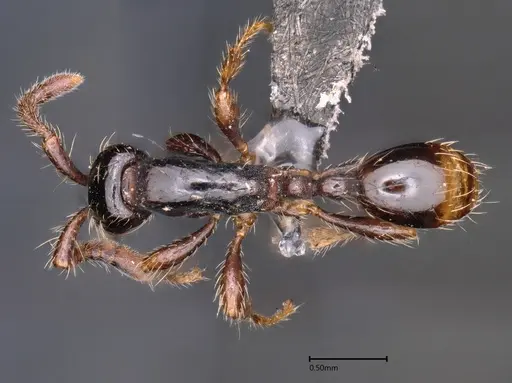
Irodalom
Elterjedési térkép betöltése...Termékek betöltése...