
Aenictus duengkaei
- Tud. név
- Aenictus duengkaei
- Alcsalád
- Dorylinae
- Szerző
- Jaitrong & Yamane, 2012
- Elterjedés
- 0 országban megtalálható
Bevezetés
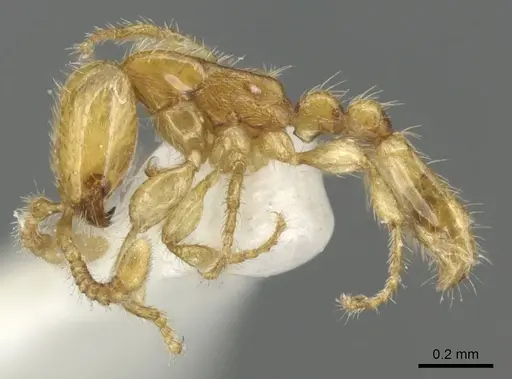
Aenictus duengkaei are tiny army ants found only in eastern Thailand. Workers measure just 1.5 to 1.9 millimeters long, with yellowish-brown heads, gasters, and legs contrasting against reddish-brown thoraxes and waist segments . They inhabit soil in lowland dry evergreen forests around 200 meters elevation, but also appear in disturbed agricultural areas, showing tolerance for modified habitats . Only workers have ever been collected - no queens or males are known, which means colony reproduction and founding behavior remain undocumented [AntWiki]. Based on typical Aenictus patterns, they likely live a nomadic lifestyle, moving through soil to raid prey rather than building permanent nests.
Quick Summary
- Difficulty: Expert
- Origin & Habitat: Eastern Thailand (Chacheongsao Province), soil in lowland dry evergreen forest (~200m) and agricultural areas [1][2]
- Colony Type: Unknown, only the worker caste has ever been found [3]
- Size & Growth:
- Antkeeping:
- Temperature: Likely 24-28°C based on tropical Thai climate and lowland dry forest habitat
- Humidity: Moderate humidity, natural habitat is dry evergreen forest rather than wet rainforest
- Diapause: No, tropical species likely active year-round
- Nesting: Not applicable, army ants are nomadic and do not build permanent nests
- Behavior: Presumably nomadic and predatory like other Aenictus, extremely small size creates extreme escape risk through minute gaps
- Common Issues: no queens are known, you cannot establish a colony without a reproductive individual., extremely small size means they escape through the tiniest gaps in any enclosure., army ants require massive amounts of live prey daily and specialized facilities., nomadic behavior is incompatible with standard nest setups and formicariums.
Identification and Appearance
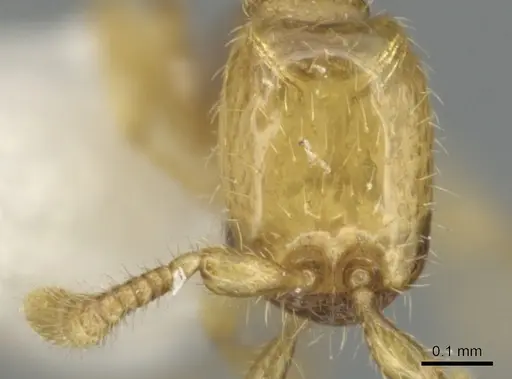
Aenictus duengkaei workers are among the smallest ants you will encounter, with even the largest individuals reaching only 1.9 millimeters [1][2]. The species shows clear worker size variation, with smaller workers measuring just 1.5 to 1.55 millimeters [1]. You can identify them by their distinctive color pattern: the head, gaster, and legs are yellowish-brown, while the thorax (mesosoma), petiole, and postpetiole are reddish-brown, with the mandibles darker still [1][2]. The mandibles have a diagnostic feature, a distinct denticle (small tooth) on the basal margin behind the large basal tooth, which separates them from the similar Aenictus piercei [1][2]. Their heads are longer than wide with a concave back margin, and their antennae are very short, not even reaching the middle of the head [1].
Natural History and Distribution
This species is known only from eastern Thailand, specifically from Chacheongsao Province [1][2]. The type series came from soil in a lowland dry evergreen forest at about 200 meters elevation, while another colony was found in an agricultural area, showing they can live in both primary forest and disturbed habitats [1]. They are soil-dwelling ants, suggesting they move through the substrate rather than foraging extensively on the surface. As members of the Aenictus javanus species group, they likely share the army ant lifestyle of their relatives, living in temporary bivouacs and moving frequently to exploit patchy food resources.
The Army Ant Reality: Why These Cannot Be Kept
You cannot keep Aenictus duengkaei in a standard ant setup, and likely cannot keep them at all outside of specialized research facilities. First, no queens have ever been found, without a queen or founding individual, you cannot start a colony [3]. Second, army ants are nomadic, they do not build permanent nests and instead form temporary bivouacs that move every few days or weeks. This means they need enormous spaces with soil substrates that allow natural movement patterns. Third, army ant colonies typically contain thousands to millions of individuals and require massive amounts of live prey daily, primarily other ants and termites. The food requirements alone make home keeping impossible. Finally, at under 2 millimeters, these workers will escape through any gap in mesh, lids, or tubing.
Housing Requirements (Theoretical)
If you were attempting to house these for research purposes, you would need a large naturalistic enclosure with deep soil substrate allowing for subterranean tunneling, not a standard formicarium. The setup would require excellent ventilation while maintaining humidity, and absolutely perfect escape prevention using fine mesh (under 0.5mm) and barriers like Fluon or talcum powder on all surfaces. However, because they are nomadic, they would not use a nest chamber in the traditional sense, instead requiring space to form temporary bivouacs. Without knowing the colony size or social structure, designing appropriate housing is impossible. [1]
Frequently Asked Questions
Can I keep Aenictus duengkaei in a test tube?
No. Army ants do not live in test tubes, and this species is only known from workers with no queens available to start a colony. They require specialized facilities with soil substrates and massive amounts of space for their nomadic lifestyle.
How long until first workers for Aenictus duengkaei?
Unknown. No queens have ever been documented for this species, so founding behavior and development timelines are completely unconfirmed.
What do Aenictus duengkaei eat?
Likely other ants, termites, and small soil arthropods based on typical Aenictus army ant behavior, but specific dietary preferences for this species are unstudied. Army ants require large amounts of live prey daily.
Do Aenictus duengkaei need hibernation?
No. They come from tropical eastern Thailand and likely remain active year-round. They do not require diapause or winter rest.
Are Aenictus duengkaei good for beginners?
Absolutely not. They are unsuitable for any antkeeper due to unknown colony founding, nomadic lifestyle, extreme escape risk from their tiny size, and massive food requirements. This is a species for specialized research only.
Can I keep multiple Aenictus duengkaei queens together?
Unknown. No queens have ever been found for this species, so colony structure and queen behavior are completely undocumented.
How big do Aenictus duengkaei colonies get?
Unknown. Based on other Aenictus species, colonies likely contain thousands of workers, but actual colony size for this specific species has never been documented.
Report an Issue
The current care sheet is based fully on literature. See inconsistencies, or something that's incorrect? Please , it will be resolved after review from an admin. Contributing to the blogs tab also helps providing information, to make us be able to further improve the caresheets. Thank you for your support!
References

Ez a tartási útmutató a következő licenc alatt áll: CC BY-SA 4.0 .
Közösségi blogok
CASENT0903678
Megtekintés az AntWeb-en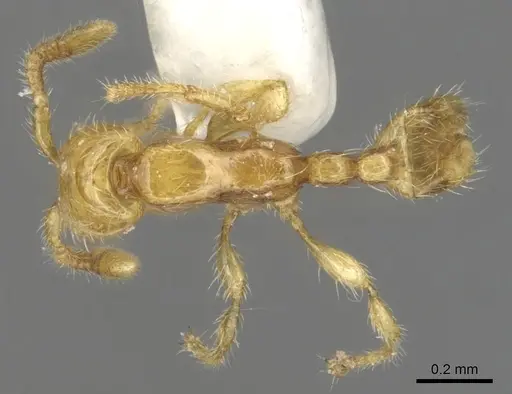
Irodalom
Elterjedési térkép betöltése...Termékek betöltése...