
Temnothorax arnoldii
- Nom sci.
- Temnothorax arnoldii
- Tribu
- Crematogastrini
- Sous-famille
- Myrmicinae
- Auteur
- Radchenko & Fedoseeva, 2015
- Distribution
- Trouvé dans 0 pays
Introduction
Temnothorax arnoldii is a tiny ant species described in 2015 from the North-West Caucasus region of Russia . Only workers are known; queens and males have never been documented . This species has a distinctly elongated head with parallel sides, a reddish-brown mesosoma, and a dark brown head . It was named in honor of Professor K.V. Arnoldi. The biology of this species remains completely undocumented - no observations on colony structure, diet, or nesting exist . This makes it one of the least known Temnothorax species.
Quick Summary
- Difficulty: Expert
- Origin & Habitat: North-West Caucasus, Russia [1][2][4]. Ecology is completely unknown, no habitat details have been recorded [1].
- Colony Type: Unknown, queens and males have never been documented [1]. No colony structure data exists.
- Size & Growth:
- Queen: Unknown, queens have not been described [1].
- Worker: Total body length not published, approximately 2-3 mm based on typical Temnothorax worker size (inferred from genus) [1].
- Colony: Unknown, no colony collections have been documented [1].
- Growth: Unknown
- Development: Estimated 6-10 weeks based on typical Temnothorax development at room temperature. (Development time is unconfirmed for this species, estimates based on related Temnothorax.)
- Antkeeping:
- Temperature: Unconfirmed. Start at room temperature (around 20°C) and observe your ants. Create a slight temperature gradient so they can choose their preferred zone.
- Humidity: Keep the nest substrate lightly moist and provide a water source. No specific data exists, use conditions typical for temperate forest-floor ants.
- Diapause: Likely required, most temperate Temnothorax need a winter rest period of 3-4 months at 5-10°C. However, this is inferred from the genus and geographic origin, not confirmed for this species.
- Nesting: Unknown. Based on genus patterns, they probably nest in small cavities under stones or in soil. Use test tubes for founding and Y-tong (AAC) nests with narrow chambers for established colonies.
- Behavior: Completely unstudied [1]. Based on typical Temnothorax temperament, they are likely peaceful and non-aggressive. Their tiny size (under 3 mm) makes them high escape risks, use very fine mesh (0.1 mm) and tight seals. Foraging style unknown, but likely individual foraging for small prey and honeydew. Defense mechanism: smears venom using a modified stinger (typical for tribe Crematogastrini).
- Common Issues: complete lack of biological data, you are pioneering captive husbandry with no confirmed care parameters., unknown founding behavior, queen may be claustral like many Temnothorax, but this is not confirmed., diet acceptance undocumented, start with sugar water and small insects, observe what is accepted., hibernation requirements are inferred, not confirmed, monitor colony response carefully., high escape risk due to tiny size and unstudied behavior., species is extremely rare in the hobby and may be difficult to acquire legally.
Discovery and Taxonomy
Temnothorax arnoldii was formally described in 2015 by Radchenko and Fedoseeva from specimens collected in the North-West Caucasus mountains of Russia [1]. The type specimens were collected by K. Arnoldi, after whom the species was named [1][2]. The species was described alongside two other new Caucasian Temnothorax species, with T. arnoldii being distinguished by its unusually elongated head shape [1]. The type locality is labeled "C-3 Кавказ" (C-3 Caucasus) with specimen number A 6141 held in the Zoological Museum of Moscow University [1]. This species remains known only from the original type series of seven workers, no additional specimens or biological observations have been published since its description [1][2].
Appearance and Identification
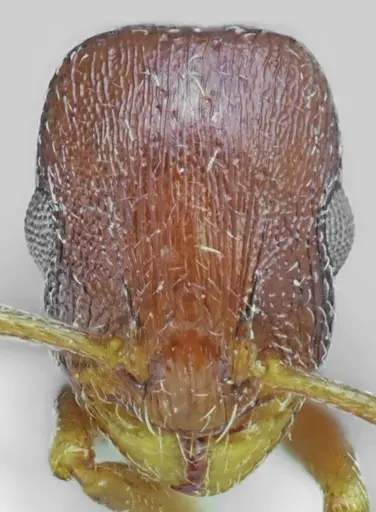
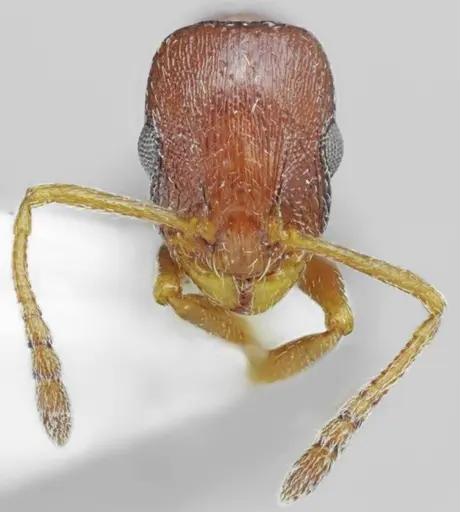
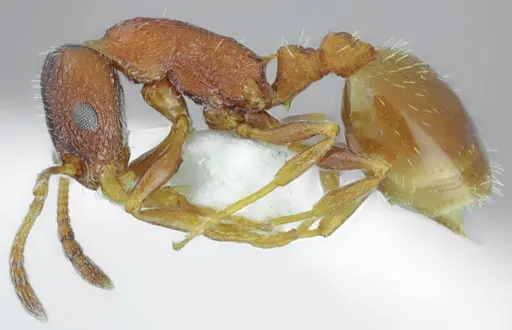
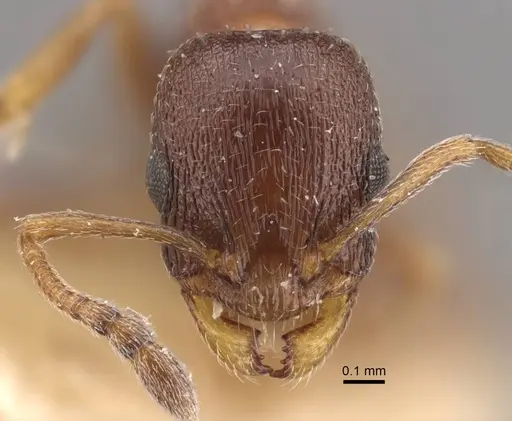
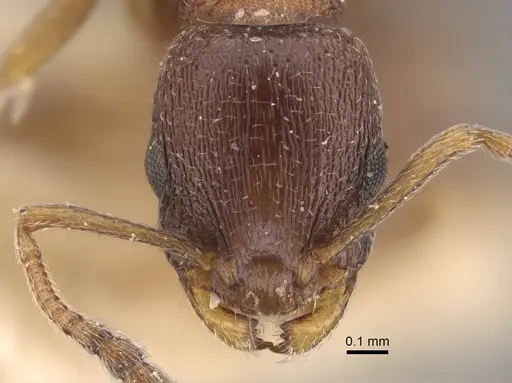
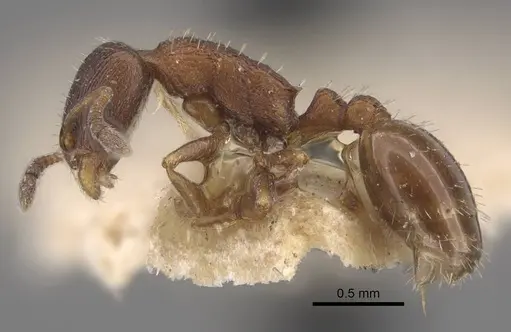
Workers of Temnothorax arnoldii are tiny, but no total body length has been published, only head measurements exist, which are not directly comparable to body size [1]. Their most distinctive feature is the distinctly elongated head with almost parallel sides, setting them apart from most other Temnothorax species [1][2]. The mesosoma (middle body section) is long and low, lacking a metanotal groove, with a somewhat flattened dorsum [1]. They have very short but distinct propodeal teeth, small spines pointing downward at the rear of the mesosoma [1]. The petiole (first waist segment) is relatively short with a distinctly truncated node bearing a horizontal dorsal plate [1]. Color pattern shows a reddish-brown mesosoma and waist, dark brown head dorsum, and lighter yellowish-brown appendages and mandibles [1][2]. Queens and males remain unknown, making worker-only identification necessary [1].
Known Distribution
Temnothorax arnoldii is currently known only from the North-West Caucasus region of Russia [1][2][4]. This represents a very restricted distribution compared to many other Temnothorax species that can span multiple countries. The Caucasus mountains create a diversity hotspot for Temnothorax, with numerous endemic species described from this region [1]. The species has been recorded in Russia's European part, specifically the North Caucasus [4]. No specimens have been reported from outside this limited geographic area, suggesting either a genuinely restricted range or simply limited sampling [1]. The exact elevation and microhabitat preferences are unknown, this is one of many biological mysteries surrounding this species.
Housing and Care Recommendations
Since no captive care information exists for this species, recommendations must be based on inferred needs from the genus and geographic origin [1]. Use a test tube setup for founding colonies, the small chamber size suits their tiny workers. A Y-tong (AAC) nest with narrow chambers also works well for established colonies. Keep at room temperature (around 20°C) as a starting point and observe your colony's preferences. Maintain the nest substrate lightly moist, typical for temperate ants, and provide a water tube for drinking access. For feeding, offer sugar water (honey or sucrose solution) and small protein sources like fruit flies or tiny crickets, start with small amounts and note what gets accepted. Given their Caucasus origin, plan for a winter hibernation period of 3-4 months at 5-10°C, but this is inferred from related species rather than confirmed for T. arnoldii specifically. Due to their tiny size (under 3 mm), use very fine mesh (0.1 mm) and tightly sealed lids to prevent escape.
Research Priorities
Anyone keeping Temnothorax arnoldii has the opportunity to document completely new biological information. Key observations to record include: founding behavior (does the queen seal herself in or leave to forage?), colony structure (monogyne or polygyne?), accepted foods, development time from egg to worker, response to hibernation conditions, and preferred temperature and humidity ranges. Taking detailed notes and photographs of all life stages contributes to scientific knowledge. This species represents a genuine frontier in ant biology, every observation has the potential to be the first documented information about T. arnoldii in captivity. [1]
Frequently Asked Questions
How do I care for Temnothorax arnoldii ants?
Care is unconfirmed since no biological data exists for this species [1]. Start with standard small ant husbandry: test tube founding setup, room temperature (around 20°C), lightly moist nest substrate, and offer sugar water plus small insects. Be prepared to experiment, this species has never been kept in captivity before, so you are pioneering its care.
What do Temnothorax arnoldii eat?
Diet is completely unstudied [1]. Based on typical Temnothorax feeding behavior, they likely consume honeydew from aphids and small insects. In captivity, offer sugar water (honey or sucrose solution) and small live or frozen prey like fruit flies, pinhead crickets, or springtails. Start with tiny amounts and observe what gets consumed.
Do Temnothorax arnoldii ants need hibernation?
Hibernation requirements are not confirmed but are highly likely based on their Caucasus mountain origin. Most temperate Temnothorax species require a winter rest period. Plan for 3-4 months at 5-10°C during winter, but monitor your colony's response, this is inferred from related species, not documented for T. arnoldii specifically.
How big do Temnothorax arnoldii colonies get?
Colony size is unknown, no colonies have ever been documented [1]. Based on typical small Temnothorax species, colonies likely reach a few hundred workers at most. Their small size suggests modest colony sizes, but this is purely an estimate.
Can I keep multiple Temnothorax arnoldii queens together?
Queen behavior is completely unknown, queens have never been documented for this species [1]. Do not attempt combining unrelated foundresses until more is known about their natural colony structure. Most Temnothorax are monogyne, but this is not confirmed.
How long does it take for Temnothorax arnoldii to raise first workers?
Development time is unconfirmed [1]. Based on typical Temnothorax development at room temperature, expect approximately 6-10 weeks from egg to first worker. This is an estimate only, actual timing for this species may differ significantly.
Are Temnothorax arnoldii good for beginners?
No, this species is not recommended for beginners. No captive care information exists, meaning you are conducting experimental husbandry. The species is also extremely rare in the antkeeping hobby. Consider starting with better-documented Temnothorax species like T. recedens or T. unifasciatus.
What temperature should I keep Temnothorax arnoldii at?
Temperature requirements are unconfirmed [1]. Start with room temperature conditions (around 20°C) typical for temperate ants. The Caucasus region experiences cool to moderate temperatures, so avoid overheating. Create a slight temperature gradient so your ants can choose their preferred zone.
Where is Temnothorax arnoldii found?
This species is known only from the North-West Caucasus mountains in Russia [1][2]. The exact localities are limited to the type collection site. No other countries or regions have documented specimens of this species.
Why is so little known about Temnothorax arnoldii?
This species was only described in 2015 and has never been studied in the wild since its discovery [1]. The type series consists of just seven workers, no queens, males, or colonies have ever been found or documented. The Caucasus region remains under-sampled for ants, leaving many species poorly known. Your observations could be the first biological data ever recorded for this species.
Report an Issue
The current care sheet is based fully on literature. See inconsistencies, or something that's incorrect? Please , it will be resolved after review from an admin. Contributing to the blogs tab also helps providing information, to make us be able to further improve the caresheets. Thank you for your support!
References

Cette fiche d'élevage est sous licence CC BY-SA 4.0 .
Blogs de la communauté
ANTWEB1008960
Voir sur AntWeb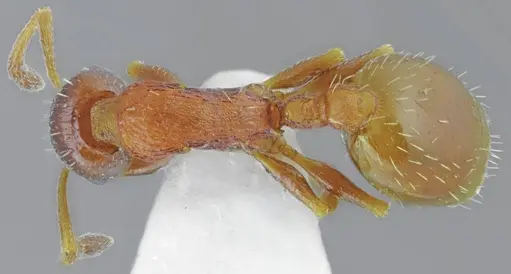
CASENT0917465
Voir sur AntWeb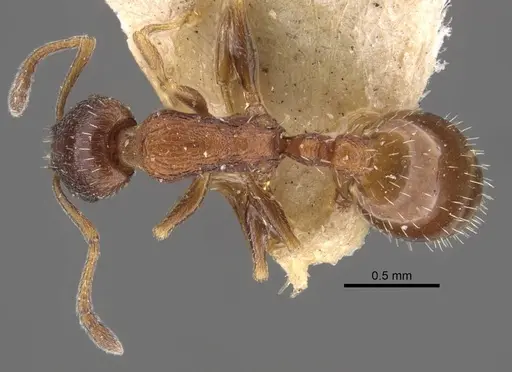
Littérature
Chargement de la carte de répartition...Chargement des produits...