
Syscia reticularis
- Nom sci.
- Syscia reticularis
- Sous-famille
- Dorylinae
- Auteur
- Jaitrong <i>et al.</i>, 2020
- Distribution
- Trouvé dans 0 pays
Introduction
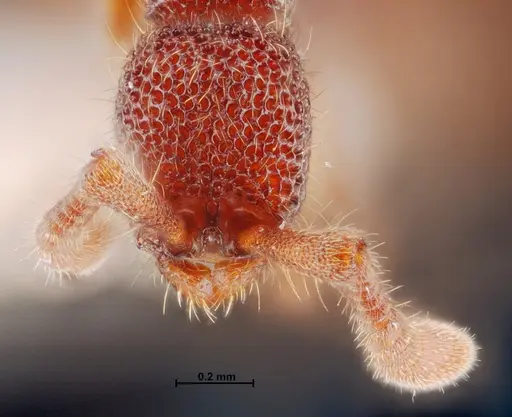
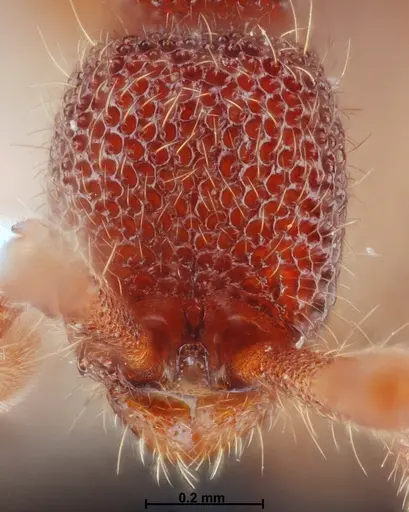
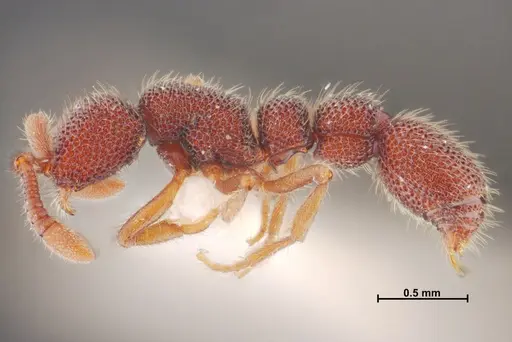
Syscia reticularis is a tiny Dorylinae (army ant) species described in 2020 from Thailand and Malaysia. Workers are extremely small - their head width is about 0.5 mm and mesosoma length about 0.75 mm, though total body length is not recorded in the literature . Their body is dark reddish brown and covered with a fine reticulate (net-like) sculpture pattern that gives them their species name 'reticularis' . They have 11-segmented antennae and completely lack compound eyes - they are blind . The type series was collected from rotting wood on the floor of a lowland rainforest in southern Thailand .
Quick Summary
- Difficulty: Expert
- Origin & Habitat: Lowland rainforests of southern Thailand (Nakhon Si Thammarat Province) and Malaysia (Selangor). They nest in rotting wood on the forest floor [1].
- Colony Type: Colony structure is unconfirmed. Only the worker caste has been described, queens and males remain unknown [1]. Based on related Dorylinae, single-queen colonies are possible but entirely speculative.
- Size & Growth:
- Queen: Unknown, queens have not been described [1]
- Worker: Head width about 0.5 mm, mesosoma length about 0.75 mm, total body length not published, estimated ~2-3 mm from related Syscia species [1]
- Colony: Unknown, no colony size data available
- Growth: Unknown
- Development: Unconfirmed, no development data exists for this species [1] (Based on typical Dorylinae patterns and small worker size, development may be relatively fast, but this is entirely speculative)
- Antkeeping:
- Temperature: Likely requires warm conditions similar to their lowland tropical rainforest habitat. Inferred: aim for 24-28°C [1].
- Humidity: Requires high humidity, rainforest floor microhabitat in rotting wood. Inferred: keep substrate consistently moist but not waterlogged [1].
- Diapause: Unlikely, being a tropical species from lowland Thailand, they probably do not require a diapause period. However, this is unconfirmed [1].
- Nesting: In nature they nest in rotting wood on the forest floor [1]. In captivity, use a small naturalistic setup with moist soil and rotting wood fragments, or a Y-tong/plaster nest with small chambers, do not use acrylic nests. Their tiny size requires very fine mesh (0.2 mm or smaller) and sealed gaps to prevent escapes.
- Behavior: As Dorylinae, they are likely predatory on small invertebrates, but this has not been observed directly [1]. They are completely blind, relying on chemical and tactile cues [1]. Workers are covered with long hairs and likely use tactile and chemical communication. Their tiny size means escape prevention must be excellent. Temperament is unknown but likely defensive like other army ants.
- Common Issues: completely blind ants, they may be stressed by excessive light and require dark nesting areas, tiny size means escapes are likely without fine mesh barriers and careful sealing, no established husbandry guidelines exist, this is one of the least-studied ant species in the hobby, high humidity requirements may promote mold if ventilation is inadequate, queens have never been collected, so captive colonies must be founded from wild colonies, which is extremely difficult, success is uncertain
Appearance and Identification
Syscia reticularis workers are extremely small, head width about 0.5 mm and mesosoma length about 0.75 mm, though total body length is not recorded in publications [1]. Their body is dark reddish brown with paler legs and antennae [1]. The most distinctive feature is their entirely reticulate body sculpture, a fine net-like pattern covering the entire body with deep bottoms, which gives them their species name 'reticularis' meaning 'reticulate' in Latin [1][2]. They have 11-segmented antennae with an enlarged apical segment, and notably lack compound eyes entirely, they are completely blind [1]. Their body is covered with long decumbent and standing hairs, giving them a somewhat fuzzy appearance under magnification [1][2].
Natural History and Habitat
This species is known only from lowland rainforests in southern Thailand and Malaysia [1][3]. The type series was collected from rotting wood on the forest floor in Nakhon Si Thammarat Province, Thailand [1]. This indicates they are a forest-floor species that nests in moist, decaying wood. Their distribution in Thailand and Malaysia places them in a tropical climate with year-round warmth and high humidity. The complete absence of eyes suggests they have adapted to a cryptic lifestyle in dark, humid microhabitats beneath the forest floor litter [1].
Housing and Nesting
In captivity, replicate their natural forest-floor habitat. A small naturalistic setup with moist substrate (a mix of soil and rotting wood fragments) works well, or use a small Y-tong or plaster nest with tight chambers scaled to their tiny size, do not use acrylic nests [1]. Because they are completely blind, provide dark nesting areas and minimize light exposure to the nest site. Their extremely small size means you must use excellent escape prevention: use very fine mesh (0.2 mm or smaller) and seal all gaps, even standard test tube cotton can be too loose. Keep the nest area humid but ensure some ventilation to prevent mold buildup.
Feeding and Diet
As a member of the Dorylinae (army ants), Syscia reticularis is likely predatory on small invertebrates, but no specific dietary observations exist for this species [1]. In captivity, offer small live prey appropriate to their tiny size such as springtails, tiny isopods, or freshly killed small insects cut into pieces. Given their blind workers and small size, they likely rely heavily on chemical trails to locate prey. Sugar sources may or may not be accepted, offer occasionally but do not rely on them. The complete absence of any feeding observations in the scientific literature means this advice is based entirely on genus-level inference.
Temperature and Seasonal Care
Based on their distribution in lowland tropical Thailand and Malaysia, Syscia reticularis likely requires warm, stable temperatures in the range of 24-28°C [1]. Being from a tropical lowland rainforest environment, they probably do not require any diapause or winter cooling period. Maintain consistent warmth year-round. The high humidity of their natural habitat should be replicated in captivity, keep the substrate consistently moist but never waterlogged. Avoid sudden temperature drops or drying out.
Challenges and Expert-Level Care
This is an expert-level species for several reasons. First, no established husbandry guidelines exist, this is one of the least-studied ant species in the hobby, with only the worker caste ever described [1]. Second, their extremely small size creates significant challenges for feeding, housing, and escape prevention. Third, being completely blind, they have specific behavioral needs that differ from typical ants. Fourth, there is no data on colony development, founding behavior, or reproductive biology, queens have never been collected or observed. You should only attempt this species if you have experience with other difficult Dorylinae and are prepared for a steep learning curve with uncertain outcomes. Captive breeding success is entirely unproven. To start a colony, you would need to locate a wild colony and collect workers or a queen, which is extremely difficult given their cryptic habitat.
Frequently Asked Questions
How big are Syscia reticularis workers?
Workers are extremely small, head width about 0.5 mm and mesosoma length about 0.75 mm. Their total body length is not published but is estimated at roughly 2-3 mm based on related Syscia species [1].
Do Syscia reticularis ants have eyes?
No, they are completely blind. Syscia reticularis lacks compound eyes entirely, which is unusual among ants [1]. They navigate using chemical and tactile cues instead of vision.
Where does Syscia reticularis come from?
They are found in lowland rainforests of southern Thailand (Nakhon Si Thammarat Province) and Malaysia (Selangor) [1]. The type locality is Krung Ching Waterfall in Thailand.
What do Syscia reticularis ants eat?
As Dorylinae (army ants), they are likely predatory on small invertebrates, but no specific feeding observations exist for this species. Offer small live prey like springtails or tiny insects. Sugar acceptance is unknown [1].
Are Syscia reticularis good for beginners?
No, this is an expert-level species. No captive husbandry guidelines exist, queens have never been described, and their tiny size creates significant practical challenges. Only experienced antkeepers should attempt this species.
What temperature do Syscia reticularis need?
Based on their tropical rainforest habitat in Thailand, aim for warm conditions around 24-28°C. They likely do not require any diapause period [1].
How do I house Syscia reticularis?
They naturally nest in rotting wood on the forest floor [1]. Use a small naturalistic setup with moist substrate and rotting wood fragments, or a small Y-tong/plaster nest with tight chambers scaled to their tiny size, avoid acrylic nests. Provide dark nesting areas and excellent escape prevention with fine mesh.
How long do Syscia reticularis live?
This is completely unknown, no colony development data exists for this species. Queens have never been described, so even basic lifespan information is unavailable [1].
Why are they called reticularis?
The species epithet 'reticularis' is Latin for 'reticulate' or 'net-like.' It refers to the distinctive fine network-like sculpture pattern covering their entire body [1].
Report an Issue
The current care sheet is based fully on literature. See inconsistencies, or something that's incorrect? Please , it will be resolved after review from an admin. Contributing to the blogs tab also helps providing information, to make us be able to further improve the caresheets. Thank you for your support!
References

Cette fiche d'élevage est sous licence CC BY-SA 4.0 .
Blogs de la communauté
THNHM-I-02624
Voir sur AntWeb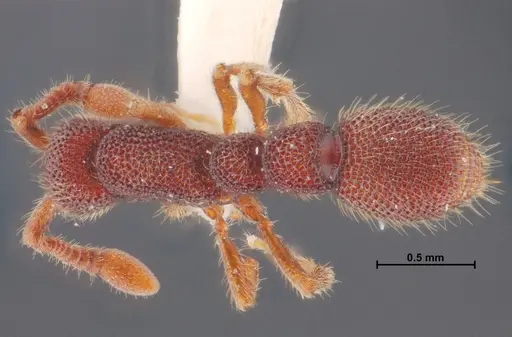
Littérature
Chargement de la carte de répartition...Chargement des produits...