
Strumigenys covina
- Nom sci.
- Strumigenys covina
- Tribu
- Attini
- Sous-famille
- Myrmicinae
- Auteur
- Fisher, 2000
- Distribution
- Trouvé dans 1 pays
Introduction
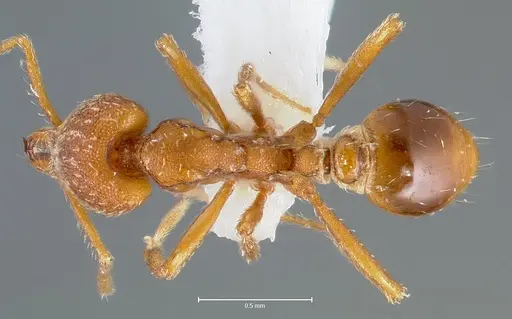
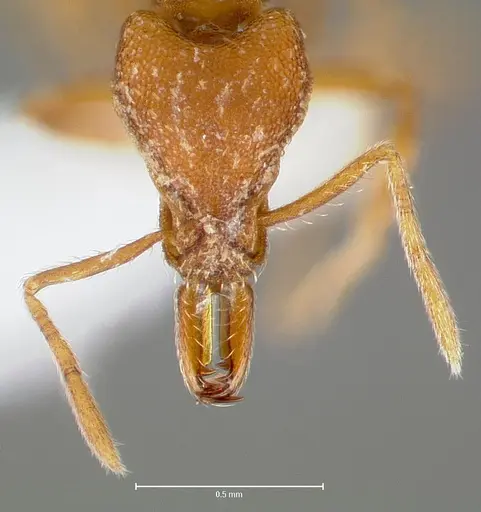
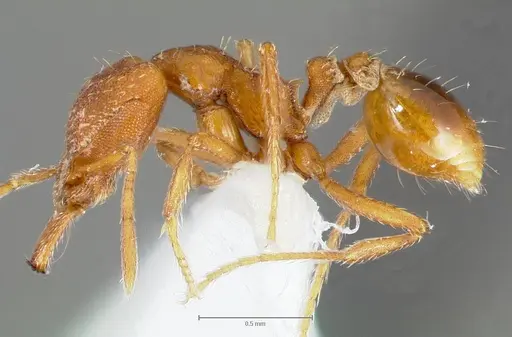
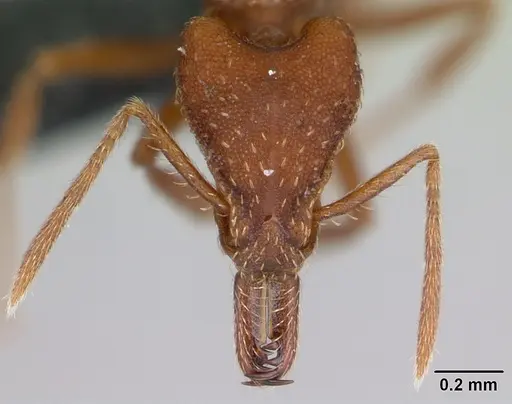
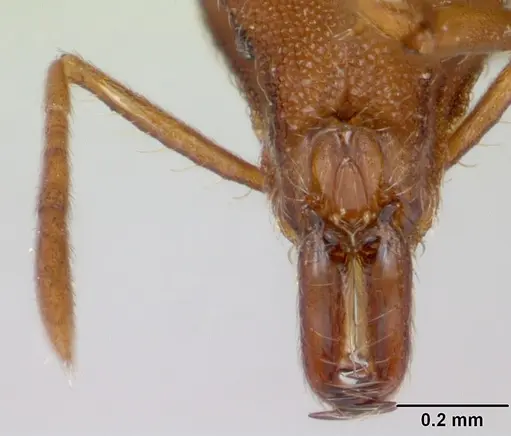
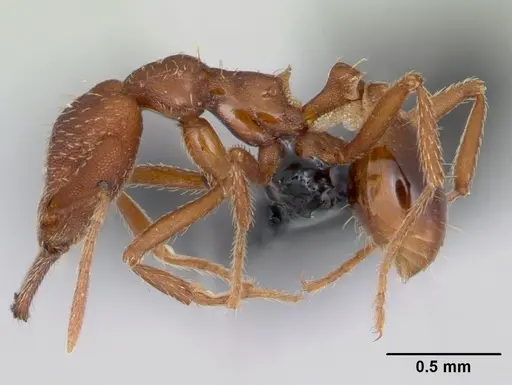
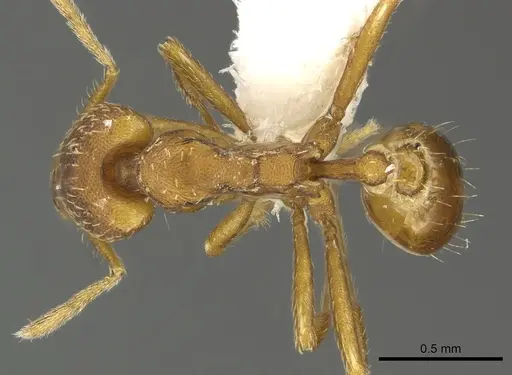
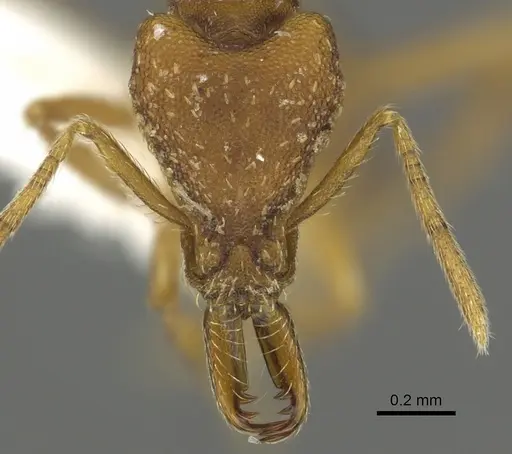
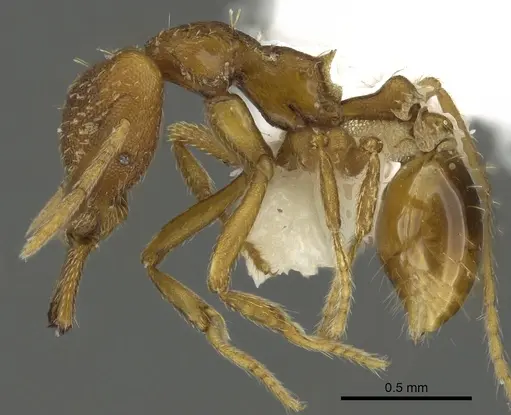
Strumigenys covina is a tiny predatory ant native to Madagascar, measuring 3mm in total length . Workers are dull yellowish-brown with a lamellate (thin plate-like) upper scrobe margin and slender filiform hairs on the pronotal humerus, petiole, postpetiole, and first gastral segment . They belong to the Strumigenys scotti group (chroa-complex) and live in humid rainforests at elevations between 425m and 1240m, where they nest in rotten logs, leaf litter, and decaying stumps . They are ground-dwelling hunters that also forage on vegetation, relying on their specialized mandibles to capture small prey like springtails .
Quick Summary
- Difficulty: Medium
- Origin & Habitat: Madagascar (Malagasy region). Occupies humid rainforest environments at elevations from 425m to 1240m, found in rotten logs, leaf litter, decaying stumps, and foraging on vegetation [2][1].
- Colony Type: Unconfirmed, social structure has not been studied. Likely single-queen based on related species, but no direct evidence.
- Size & Growth:
- Antkeeping:
- Temperature: Unknown. Based on elevation range (425-1240m) in tropical Madagascar, a stable temperature around 22-26°C is likely. Provide a gentle gradient with a heating cable on one side so workers can choose [2].
- Humidity: High humidity required. The species is terricolous and prefers humid conditions [3]. Keep the nest substrate consistently moist but not waterlogged. Provide a water source (e.g., small tube or damp cotton) [1].
- Diapause: Unknown, as a tropical species from Madagascar, true diapause is unlikely, but no research confirms. A slight winter temperature drop may be safe but is not necessary [1].
- Nesting: Naturalistic setups with moist substrate, Y-tong (AAC) nests, or plaster nests that hold humidity work well. In the wild they nest in rotten logs, leaf litter, and rotting stumps [1].
- Behavior: Peaceful and not aggressive. They have a functional stinger (subfamily Myrmicinae) but it is not medically significant and they prefer to flee rather than fight. Workers are slow-moving predators. Their tiny size (3mm) demands excellent escape prevention, use fine mesh and seal all gaps. They forage both on vegetation and through leaf litter [1].
- Common Issues: slow growth can frustrate beginners, colonies take a long time to establish., tiny size means escapes are likely without fine mesh barriers., high humidity requirements can lead to mold problems if ventilation is poor., predatory diet means they need live prey, they cannot survive on sugar alone., wild-caught colonies may have parasites that cause death in captivity.
Housing and Nest Setup
Set up a naturalistic enclosure that mimics their rainforest habitat. Use a moist substrate mix (soil, sand, decaying organic matter) that holds humidity. Y-tong (AAC) nests or plaster nests with a water reservoir also work well. Because the ants are only 3mm, seal all joints and connections between the outworld and nest with fine mesh, standard formicarium gaps are too wide. A small outworld is sufficient since they do not roam far. Add twigs, leaves, or bark to provide cover and foraging opportunities [1].
Feeding and Diet
These ants are specialist predators. Their natural prey includes springtails (collembola) and other tiny arthropods. Offer live springtails as a staple, along with micro-beetles or fruit fly larvae. They do not accept sugar water or honey, their diet is entirely protein-based. Feed 2-3 times per week in amounts that are consumed within 24 hours. Remove leftovers to prevent mold. Provide constant access to water via a small tube or damp cotton [1].
Temperature and Humidity
Maintain a stable temperature around 22-26°C, this is inferred from their elevation range (425-1240m) in Madagascar [2]. Use a heating cable on one side of the nest to create a gradient. Humidity is critical: keep the nest substrate consistently damp (not waterlogged) and mist the enclosure regularly. The species is classified as preferring humid conditions in research data [3]. Balance moisture with ventilation to avoid mold. If the substrate dries out, the colony will quickly perish.
Colony Establishment and Growth
Founding behavior is unconfirmed, no data exists for Strumigenys covina. If a queen is collected, provide a small, dark, humid chamber and leave her undisturbed for several months. Do not expect rapid growth, related Strumigenys are notoriously slow. The first workers may emerge after a long period, but exact timelines are unknown. Patience is essential. Once a few workers appear, establish a humid nest setup gradually. Stress from disturbance can cause the queen to abandon or eat brood [1].
Behavior and Temperament
These ants are docile and non-territorial. They possess a functional stinger (subfamily Myrmicinae), but it is weak and not medically important, they almost never use it on keepers. Instead, they rely on fleeing or hiding. Workers move slowly and methodically while hunting. In the wild they forage on vegetation and through leaf litter [1]. In captivity, they will hunt springtails near the nest entrance. Because of their minute size, they can escape through the tiniest cracks, use fine mesh (≤0.5mm openings) for all ventilation and outlets.
Frequently Asked Questions
How long does it take for Strumigenys covina to raise first workers?
This is unknown, there are no published data for this species. Based on related Strumigenys, it likely takes at least several weeks to months at warm temperatures, but exact timing is speculative. Patience is necessary [1].
What do Strumigenys covina ants eat?
They are strict predators. Their natural diet includes springtails (collembola) and other micro-arthropods. Offer live springtails as the primary food, they also accept fruit fly larvae and tiny beetles. They do not eat sugar sources like honey or sugar water [1].
Can I keep Strumigenys covina in a test tube?
A test tube can be used during founding, but it must be kept very humid (e.g., with a cotton reservoir). Once the colony has produced several workers (exact number unknown), transfer to a humid naturalistic setup or Y-tong nest. Test tubes dry out quickly and are not suitable long-term [1].
Are Strumigenys covina good for beginners?
They are rated Medium difficulty. Not ideal for complete beginners because of their slow growth, strict live-prey diet, and high humidity needs. However, they are peaceful and do not require hibernation, which simplifies care somewhat. Best for keepers with some experience [1].
How big do Strumigenys covina colonies get?
This is unknown, no published data exists for this species. Related Strumigenys species often have colonies under 100 workers, but this is conjecture. Do not expect a large colony [1].
Do Strumigenys covina need hibernation?
Probably not. As a tropical Malagasy species, true diapause is unlikely. You may reduce temperatures slightly in winter, but a full hibernation is not necessary and could be harmful [1].
Why are my Strumigenys covina dying?
Common causes: insufficient humidity (substrate must stay damp), lack of live prey (they cannot survive on sugar), escape (their tiny size lets them slip through gaps), and disturbance during founding. Check your setup carefully [1].
When should I move Strumigenys covina to a formicarium?
No precise recommendation due to lack of data. Move when the colony appears too large for the founding container and shows active foraging. Use a humid naturalistic nest or Y-tong nest. Early moves stress the colony, wait until you see several workers and brood [1].
Can I keep multiple Strumigenys covina queens together?
This has not been documented. The species is likely monogyne (single queen) based on related species, but this is unconfirmed. Combining unrelated queens is risky and may lead to fighting. If you acquire a colony with multiple queens, keep them together only if they already coexist [1].
Report an Issue
The current care sheet is based fully on literature. See inconsistencies, or something that's incorrect? Please , it will be resolved after review from an admin. Contributing to the blogs tab also helps providing information, to make us be able to further improve the caresheets. Thank you for your support!
References

Cette fiche d'élevage est sous licence CC BY-SA 4.0 .
Blogs de la communauté
Littérature
Chargement de la carte de répartition...Chargement des produits...