
Stictoponera fontana
- Nom sci.
- Stictoponera fontana
- Tribu
- Ectatommini
- Sous-famille
- Ectatomminae
- Auteur
- Lattke, 2004
- Distribution
- Trouvé dans 0 pays
Introduction
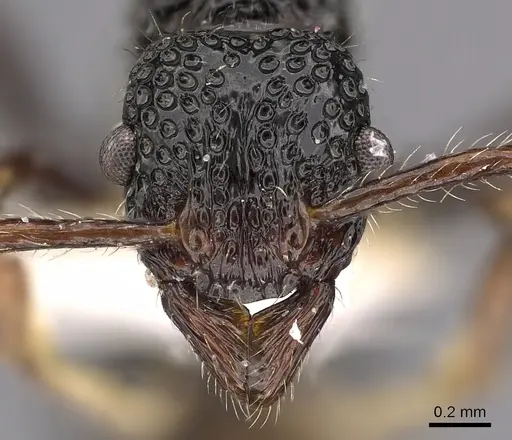
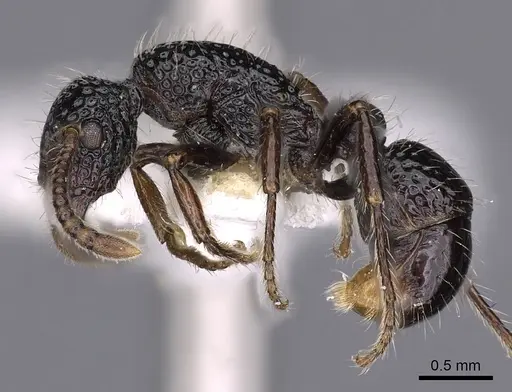
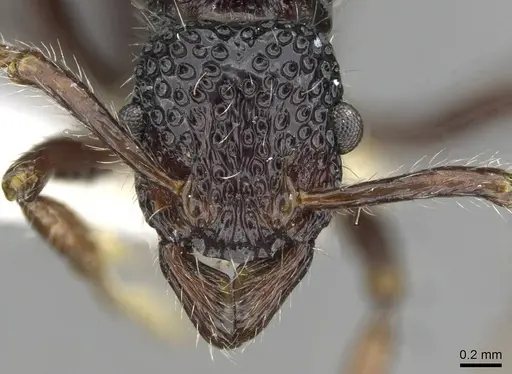
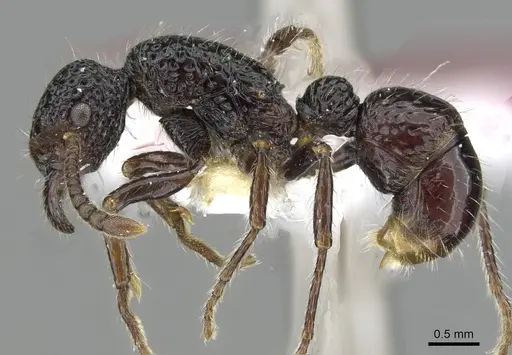
Stictoponera fontana is a small predatory ant native to the rainforests of Borneo and Malaysia, known only from a single collection at Poring Hot Springs at 900m elevation. The queen and male castes have never been described, only two worker specimens (holotype and paratype) are known . Workers are dark colored with a jet black head, mesosoma, petiole, and gaster, while the mandibles, antennae, and legs are brown . They have notably protuberant eyes and a broad occipital lamella at the back of the head, and the body surface is covered in small pits (foveolae) giving a textured appearance . Originally described as Gnamptogenys fontana in 2004,it was reclassified to Stictoponera in 2022 based on phylogenomic analysis . They belong to a predatory lineage with a functional stinger, as confirmed by recent stinger morphology studies .
Quick Summary
- Difficulty: Expert
- Origin & Habitat: Borneo and Malaysia (Sabah), specifically Poring Hot Springs at 900m elevation, collected from wet forest leaf litter [1]. This is a tropical rainforest species from the Indomalaya region.
- Colony Type: Unknown, only workers have been described, queens and males remain undocumented [1].
- Size & Growth:
- Queen: Undescribed, queen caste has never been observed [1]
- Worker: Size data unavailable, only mesosomal length (WL) has been recorded, not total body length [1]
- Colony: Unknown, only two workers (holotype and paratype) have ever been collected [1]
- Growth: Unknown, no colony development data exists
- Development: Unknown, no data exists. Related tropical Ectatomminae may take 6–10 weeks, but this is speculative. (Development timeline is entirely unconfirmed, the queen caste is unknown.)
- Antkeeping:
- Temperature: Tropical species from lowland/lower montane rainforest, expect 24–28°C [1]. Room temperature may suffice in warm homes, otherwise use a heating cable on one side of the nest.
- Humidity: High, they live in wet forest leaf litter [1]. Keep nest substrate consistently moist but not waterlogged. This species is sensitive to drying out.
- Diapause: Unlikely, as a tropical species from Borneo, winter dormancy probably not required. No seasonal data exists.
- Nesting: In nature they inhabit wet forest floor debris and leaf litter [1]. In captivity, a naturalistic setup with moist substrate or a Y-tong/plaster nest with narrow chambers works well. Chambers must be scaled to their tiny size.
- Behavior: These are small, cryptic, predatory ants with a functional stinger [2]. They likely hunt small invertebrates in leaf litter. Their small size makes escape prevention critical, they can squeeze through tiny gaps. Workers are dark and relatively slender. Activity level is probably moderate, foraging through substrate. Queen biology is unknown.
- Common Issues: tiny size means escape is nearly impossible without fine mesh (, high humidity requirements: drying out kills colonies quickly, predatory diet obligates a constant supply of live prey (springtails, fruit flies), hard to sustain long-term, virtually no captive care information exists, this species is almost unknown to antkeeping, only two wild specimens have ever been collected, any captive attempt is entirely experimental
Housing and Nest Setup
Stictoponera fontana is a tiny leaf-litter ant that needs high humidity and narrow spaces. A naturalistic setup with moist substrate (soil mixed with leaf litter) works best, it mimics their wet forest floor habitat [1]. Alternatively, a Y-tong or plaster nest with small chambers scaled to the workers' size can be used. The substrate must stay consistently damp: use a water reservoir or moisture source connected to the nest area. Escape prevention is critical: use fine mesh (pore size
Feeding and Diet
As a predatory ant in the Ectatomminae subfamily, Stictoponera fontana requires live protein prey. They likely hunt small soil arthropods like springtails, mites, and tiny insects [2]. In captivity, offer fruit flies, pinhead crickets, small mealworms, and especially springtails. Sugar sources are probably not a major dietary component, their relatives are primarily predatory. Offer small live prey every 2–3 days, adjusting based on consumption. Remove any uneaten prey after 24–48 hours to prevent mold. A constant supply of clean water is essential.
Temperature and Humidity
Keep these ants warm: aim for 24–28°C, matching their tropical Borneo origin [1]. Room temperature in most homes may be adequate, but use a thermometer to confirm. If needed, a heating cable on one side of the nest creates a gentle temperature gradient. Humidity is the most critical factor: maintain consistently moist substrate without waterlogging. Their natural habitat is wet forest floor, think damp, not drenched. A hygrometer helps monitor conditions. Ensure ventilation to prevent mold, but don't let humidity drop. Avoid both drying out and stagnant air.
Behavior and Handling
This species has a functional stinger [2], but at the workers' tiny size, it is unlikely to penetrate human skin significantly. They are probably cryptic foragers that stay within the substrate rather than climbing much. Their small size makes them excellent escape artists: any gap larger than 1mm is a risk. Observe behavior through the nest instead of handling them. They are likely not aggressive toward humans but may sting if threatened. Since the queen caste is unknown, handling wild-caught colonies (if found) would require extreme caution.
Frequently Asked Questions
How long does it take for Stictoponera fontana to develop from egg to worker?
The development timeline is unknown, no scientific data exists. The queen caste has never even been described [1]. Based on related tropical Ectatomminae, a rough guess is 6–10 weeks from egg to worker at optimal temperatures. This is purely speculative.
Can I keep Stictoponera fontana in a test tube?
A test tube can work for potential founding colonies, provided humidity is maintained extremely high. Keep the water end in a humid outworld or enclosure to slow evaporation. However, because they need live prey and high humidity, a naturalistic setup with moist substrate is more practical. Escape prevention must be excellent in either case.
Do Stictoponera fontana ants sting?
Yes, they have a functional stinger, as confirmed by stinger morphology studies [2]. However, at the workers' small size, the sting is extremely mild and unlikely to penetrate human skin or cause significant discomfort.
What do Stictoponera fontana eat?
They are predatory ants that need live protein prey. Offer small insects like fruit flies, springtails, tiny crickets, and small mealworms. Sugar sources are likely unimportant. Remove uneaten prey after 24–48 hours to prevent mold.
Are Stictoponera fontana good for beginners?
No, this species is not at all suitable for beginners. It is one of the least studied ants: only two workers have ever been collected. There is no captive breeding history or established care protocol. They require high humidity, a constant live prey supply, and escape-proof housing. Expert keepers only.
How big do Stictoponera fontana colonies get?
Maximum colony size is unknown. Only two workers have ever been documented in scientific literature [1]. Based on related Ectatomminae, colonies are likely small (probably under 100 workers), but this is speculation. The species appears to be rare.
Do Stictoponera fontana need hibernation?
No, they likely do not need hibernation. They come from equatorial tropical Borneo where temperatures remain warm year-round. There is no evidence of diapause. Keep them at warm tropical conditions year-round.
Why are my Stictoponera fontana dying?
The most likely causes are: drying out (they need constant high humidity), lack of live prey (they are obligate predators), or escape. Since no captive protocols exist, colonies may fail for unknown reasons. Ensure high humidity, provide live prey frequently, and seal all gaps smaller than 1mm.
When will queens be available for Stictoponera fontana?
It is unclear. The queen caste has never been scientifically described, only two worker specimens exist from a 1987 collection [1]. Any captive colonies would need wild-collected queens, but none have ever been found. Availability in the hobby is uncertain.
Can I keep multiple queens of Stictoponera fontana together?
This is completely unknown. Colony structure has never been studied, the queen is undescribed. Without knowing whether they are monogyne or polygyne, combining queens is not recommended. Wait for more research.
Report an Issue
The current care sheet is based fully on literature. See inconsistencies, or something that's incorrect? Please , it will be resolved after review from an admin. Contributing to the blogs tab also helps providing information, to make us be able to further improve the caresheets. Thank you for your support!
References

Cette fiche d'élevage est sous licence CC BY-SA 4.0 .
Blogs de la communauté
CASENT0900558
Voir sur AntWeb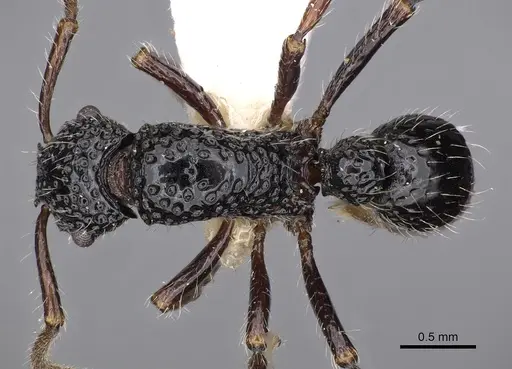
CASENT0911163
Voir sur AntWeb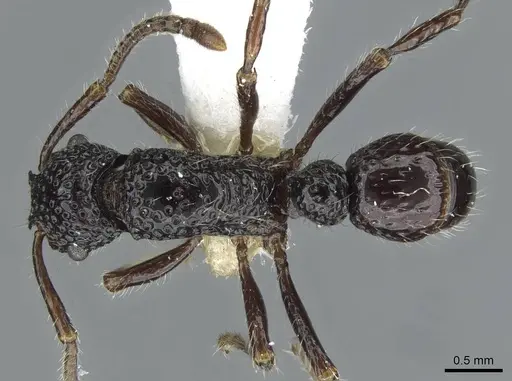
Littérature
Chargement de la carte de répartition...Chargement des produits...