
Solenopsis targuia
- Nom sci.
- Solenopsis targuia
- Tribu
- Solenopsidini
- Sous-famille
- Myrmicinae
- Auteur
- Bernard, 1953
- Distribution
- Trouvé dans 0 pays
Introduction
Solenopsis targuia is a small, slender fire ant species known only from the Sahara Desert in Algeria. Queens measure 4.5-4.9 mm in total length, with a reddish-brown head and thorax, yellow-orange mandibles and legs, and a pale yellow to light brown abdomen . The species was described from four queens collected at dusk in May near Djanet, in a humid meadow within a garden watered by 11 natural springs . Workers have never been found, making this one of the least documented Solenopsis species.
Quick Summary
- Difficulty: Unknown, insufficient data for reliable assessment
- Origin & Habitat: Central Sahara (Algeria), Tassili des Ajjer region near Djanet. Collected in a humid meadow within a garden (beylik) watered by natural springs, a rare moist microhabitat in an otherwise arid desert [1].
- Colony Type: Unknown, colony structure has not been documented. Many Solenopsis species form multi-queen colonies, but this is unconfirmed for S. targuia.
- Size & Growth:
- Queen: 4.5-4.9 mm total length [1], based on original type specimens
- Worker: Unknown, workers have never been scientifically described
- Colony: Unknown, no colony size data available
- Growth: Unknown, no development data exists
- Development: Unknown, no direct observations or studies exist (No data available for this species. Related Solenopsis species develop in 3-6 weeks at warm temperatures, but this is highly speculative.)
- Antkeeping:
- Temperature: Unknown, no data. Given the Saharan origin, warm temperatures are likely, but exact range is unconfirmed. Start around 26°C and observe.
- Humidity: Unknown, the type locality was a humid meadow, suggesting they can tolerate higher moisture, but desert origin implies dry periods. Provide a humidity gradient: keep one area moist and the rest drier.
- Diapause: Unknown, desert species may have reduced activity periods rather than true hibernation. The queens were collected in May, suggesting spring reproductive activity [1].
- Nesting: Unknown in captivity. Solenopsis typically nest in soil or under stones. The type specimens were found near ground level in a garden meadow [1].
- Behavior: Behavior is undocumented. As a member of the Solenopsidini tribe, S. targuia likely uses a sting to inject venom composed of piperidine alkaloids for defense and hunting. Exercise caution, all Solenopsis can deliver painful stings, though worker presence is unconfirmed.
- Common Issues: complete lack of documented care information makes proper husbandry extremely difficult, worker caste has never been described, so identifying this species in the wild is nearly impossible, no information on founding behavior or colony development timeline, desert origin with humid microhabitat creates contradictory humidity needs, providing a gradient is recommended but experimental, risk of keeping an undocumented species without established protocols
Species Identification and History
Solenopsis targuia was first described by F. Bernard in 1953 based on four syntype queens from the Tassili des Ajjer region of central Algeria. Two queens were winged (alates) and two were dealated (had shed their wings), indicating they were caught during or after their nuptial flight. The specimens were collected at dusk on May 24,1949 by Dr. Jacquemin in a humid meadow within a beylik garden at Adjahil near Djanet. This location was one of the richest biodiversity spots in the central Sahara, watered by 11 natural springs and containing several ant and beetle species not found elsewhere. Despite extensive searching under stones, workers could not be discovered, so the worker caste remains completely unknown to science [1].
Known Physical Characteristics
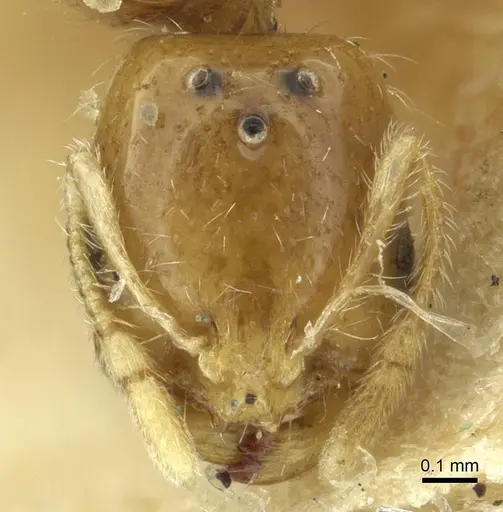
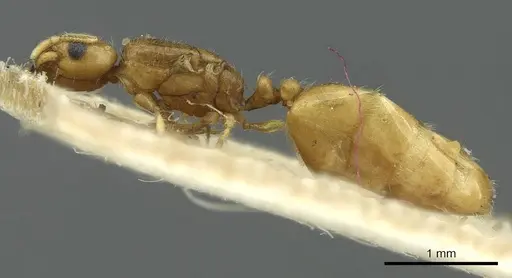
The queen caste has been carefully described. Queens measure 4.5-4.9 mm in total length, with a forewing length of 4.7 mm. The head is longer than wide (0.9 by 0.66 mm) and the thorax is narrower than the head (1.15 by 0.5 mm). The abdomen is voluminous (2.1 by 0.8 mm). Coloration: head and thorax are fairly clear reddish-brown, barely shiny. Petioles, sides of thorax, and mandibles are yellow-orange to yellow-brownish. Appendages and posterior borders of abdominal segments are very pale yellow. The main part of the gaster is very light brown, appearing yellow to the naked eye. Body hairs (pilosity) are yellowish, quite long and sparse, denser on the thorax. The head has large, round, shallow, well-spaced punctures similar to Solenopsis atlantis. Wings are colorless with pale yellowish-white veins. The clypeus has two strong teeth separated by a median depression with concave borders, plus a shorter dentiform angle on each side, a feature shared with Solenopsis longiceps var. barbara from Tunisia. The thorax in profile is longer and more depressed than in other Solenopsis of this group [1].
Distribution and Habitat
Solenopsis targuia is known only from the type locality in the Tassili des Ajjer mountain range in southern Algeria. This is one of the most arid regions in the world, yet the species was found in a humid meadow within a cultivated garden watered by natural springs. This suggests the species may be restricted to oases or watered areas within the desert, rather than being widespread across the Sahara. The only confirmed distribution is Algeria in the Palaearctic region [1][2].
Keeping Considerations
This is one of the least documented ant species in the hobby. No established care protocols exist because the species has never been kept in captivity. The complete lack of information on workers, colony size, founding behavior, temperature tolerance, humidity preferences, and diet means keeping this species successfully would be extremely challenging and not recommended for any experience level. Any attempt to keep S. targuia would be entirely experimental, with very low chances of success. If attempted, start with conditions similar to other Saharan Solenopsis: warm temperatures (26-30°C), a humidity gradient (moist area in nest, drier outworld), and a generalist protein-sugar diet. However, these are educated guesses based on genus-level patterns, not species-specific requirements. The extreme rarity of this species in both the wild and captivity makes acquisition unlikely and ethical collection questionable.
Frequently Asked Questions
How do I care for Solenopsis targuia ants?
Caring for Solenopsis targuia is not recommended due to complete lack of documented care information. This is one of the least known ant species in the world, workers have never been scientifically described, and no one has successfully kept this species in captivity. There are no established protocols, temperature guidelines, or diet recommendations specific to this species. Attempting to keep it would be essentially experimental with very low success probability.
What do Solenopsis targuia eat?
Diet is completely unstudied for this species. As a member of the Solenopsidini tribe, they likely are generalist omnivores like other fire ants, accepting protein sources and sugar. Without any documented feeding observations, this remains speculative. Related Saharan Solenopsis species typically feed on small insects and tend aphids for honeydew.
Are Solenopsis targuia ants dangerous?
All Solenopsis species can deliver painful stings, and this species should be considered potentially dangerous. The tribe Solenopsidini is known for venom composed of piperidine alkaloids. However, since workers have never been documented, the exact sting potency is unknown. Exercise extreme caution when handling any Solenopsis, they can sting repeatedly and some species cause severe allergic reactions.
How big do Solenopsis targuia colonies get?
Colony size is completely unknown. No wild colonies have ever been documented or studied. Other Solenopsis species can form colonies ranging from hundreds to tens of thousands of workers, but there is no data to estimate what this desert species might achieve.
Do Solenopsis targuia need hibernation?
Diapause requirements are completely unknown. As a Saharan species from a hot desert environment, they may not require true hibernation but could have reduced activity periods during cooler months. The type specimens were collected in May, suggesting reproductive activity during spring [1].
Can I keep multiple Solenopsis targuia queens together?
Colony social structure is unconfirmed. Many Solenopsis species have polygynous (multi-queen) colonies, but this species' structure has never been studied. Without data, combining unrelated queens is not recommended.
How long does it take for Solenopsis targuia to develop from egg to worker?
Development timeline is completely unknown. No observations of founding colonies, brood development, or nanitic worker production exist for this species. Related Solenopsis species typically develop from egg to worker in 3-6 weeks at warm temperatures, but this is a rough estimate with no species-specific data.
What is the best nest type for Solenopsis targuia?
No captive nesting observations exist. In nature, Solenopsis typically nest in soil or under stones. Given the Saharan origin and humid meadow type locality, a naturalistic setup with a moisture gradient in the substrate and warm temperatures would be a reasonable starting point, but success is entirely speculative.
Are Solenopsis targuia good for beginners?
No, this species is absolutely not suitable for beginners or any keeper level. It is one of the most poorly documented ant species in the world with zero established care protocols. Keeping it would be essentially experimental guesswork with almost no chance of success.
Where can I find Solenopsis targuia ants?
This species is extremely rare in the antkeeping hobby and has never been documented in captivity. The only known specimens are the four type queens collected in 1949 from the Tassili des Ajjer region of Algeria. Ethical acquisition would be nearly impossible without wild collection, which would be difficult given the remote location and lack of known worker specimens to identify [1].
Report an Issue
The current care sheet is based fully on literature. See inconsistencies, or something that's incorrect? Please , it will be resolved after review from an admin. Contributing to the blogs tab also helps providing information, to make us be able to further improve the caresheets. Thank you for your support!
References

Cette fiche d'élevage est sous licence CC BY-SA 4.0 .
Blogs de la communauté
CASENT0913641
Voir sur AntWeb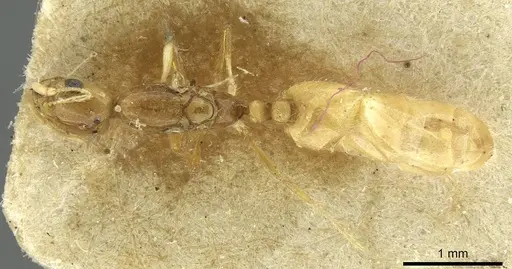
Littérature
Chargement de la carte de répartition...Chargement des produits...