
Probolomyrmex guanacastensis
- Nom sci.
- Probolomyrmex guanacastensis
- Tribu
- Probolomyrmecini
- Sous-famille
- Proceratiinae
- Auteur
- O'Keefe & Agosti, 1998
- Distribution
- Trouvé dans 0 pays
Introduction
Probolomyrmex guanacastensis is a tiny ant with an elongated head and long antennal scapes, measuring 0.79 mm in total length . It is known only from Costa Rica's Guanacaste province, where it was found in riparian forest leaf litter . The genus Probolomyrmex belongs to the Proceratiinae subfamily, which is characterized by large heads and long scapes . What makes this species unique is the discovery of an ergatoid queen, the first in Probolomyrmex, with fully developed eyes and ocelli, while workers are blind .
Quick Summary
- Difficulty: Expert
- Origin & Habitat: Guanacaste province, Costa Rica, riparian tropical forest habitat at low elevation [1].
- Colony Type: Unknown colony structure. An ergatoid (wingless) queen has been documented, but colony size is believed to be very small [1].
- Size & Growth:
- Queen: Size data unavailable, ergatoid queen morphology similar to workers, but total length not specified [1].
- Worker: 0.79 mm total length [1]
- Colony: Up to 30 workers based on related species [1]
- Growth: Unknown
- Development: Unknown, no data available (Development timeline has not been studied for this species.)
- Antkeeping:
- Temperature: Inferred from Costa Rican habitat: aim for 24-28°C, using a heating gradient [1].
- Humidity: Inferred from riparian forest: keep substrate consistently moist but not waterlogged [1].
- Diapause: Unknown, Costa Rica has minimal temperature variation, so diapause may not occur [1].
- Nesting: Inferred: forest floor leaf litter dwellers. Provide a small nest chamber with moist substrate scaled to their tiny size [1].
- Behavior: Based on genus patterns, they are likely cryptic floor-dwellers that avoid light and disturbance. Escape prevention is critical due to their extremely small size [1].
- Common Issues: escape prevention is critical, they are among the smallest ants in the world and can pass through microscopic gaps [1], no captive breeding information exists, this species has never been maintained in captivity [1], colony establishment may be extremely difficult given their presumed small colony size [1], stress from disturbance can likely kill colonies, they are adapted to cryptic, stable environments [1], humidity control is challenging, their tiny size means they dry out rapidly if conditions are too dry [1]
Why This Species Is Extremely Difficult to Keep
Probolomyrmex guanacastensis is one of the most challenging ants to keep, and it should not be attempted by anyone except professional researchers. This species has been documented exactly twice in scientific history, once in 1996 when the original two specimens were collected, and never since [1]. There is zero captive husbandry information available. No one has ever successfully established a colony of this species in captivity. The ergatoid queen is the first ever documented for the entire genus Probolomyrmex, meaning basic biology like colony founding, diet, or development speed is unknown [1]. You are essentially proposing to create husbandry protocols from scratch for an ant that scientists have barely studied in the wild. Unless you have access to professional research facilities, this species should remain a wishlist item, not a keeper's goal.
Natural History and What We Know
Everything known about Probolomyrmex guanacastensis comes from two specimens collected in Guanacaste, Costa Rica in 1996 [1]. The worker and ergatoid queen were found together in sifted leaf debris from a riparian tropical forest, essentially the forest floor along a river [1]. The ergatoid queen has eyes and ocelli, while the worker is completely blind, which is unusual in ants [1]. The associated vegetation, such as Ochroma pyramidale and Anacardium excelsum, indicates a humid, shaded lowland forest environment [1].
Inferred Care Requirements
Since no direct husbandry data exists, care advice must be inferred from related ants. Probolomyrmex belongs to Proceratiinae, a subfamily of cryptic leaf-litter ants that are typically predaceous [2][3][4]. For P. guanacastensis, you would need to replicate a tropical forest floor: high humidity, stable warm temperatures, and a tiny nest chamber scaled to their 0.8 mm body size [1]. They would likely accept small live prey like springtails, but this is speculation. The key point is that even getting specimens would be nearly impossible, this species has never been collected again since 1996 [1].
The Ergatoid Queen - A Unique Feature
The ergatoid queen of P. guanacastensis is scientifically significant as the first documented ergatoid in Probolomyrmex [1]. Ergatoid queens are wingless females that resemble workers but can reproduce. In this species, the ergatoid has fully developed compound eyes and three ocelli, while the worker has none [1]. This raises questions about how she founds colonies, whether she flies or walks away, but these remain unanswered. The body sizes of worker and queen are similar, which is unusual for ants [1].
Frequently Asked Questions
Can I keep Probolomyrmex guanacastensis as a pet ant?
No. This species should not be kept by hobbyists. It has never been maintained in captivity, has only been collected twice, and there is zero information on how to care for it [1]. Even professional myrmecologists have not succeeded with this species. Appreciate this ant in scientific literature only.
Where can I get Probolomyrmex guanacastensis?
You cannot. This species has never been available in the antkeeping hobby and likely never will be. The original collection in 1996 remains the only known specimens [1]. There are no breeding programs, no wild colonies to catch, and no documented attempts at captive propagation.
What do Probolomyrmex guanacastensis eat?
Unknown. Based on genus-level inference, they are likely predaceous on tiny soil arthropods like springtails or mites [1]. Proceratiinae ants typically probe through substrate rather than chase active prey [2][3][4]. No gut content analysis or feeding observations exist.
How big do Probolomyrmex guanacastensis colonies get?
Unknown, but likely very small. The only related species with documented colony size is Probolomyrmex boliviensis, which had fewer than 30 individuals [1]. This suggests P. guanacastensis also forms small colonies, possibly with just a handful of workers.
Do Probolomyrmex guanacastensis queens fly?
Unknown. The only known queen is an ergatoid (wingless) form, which suggests colony reproduction might occur through ergatoid dispersal rather than nuptial flights [1]. However, we cannot rule out the existence of normal winged queens that have never been collected.
Are Probolomyrmex guanacastensis dangerous?
No. At approximately 0.8 mm in length, these ants are completely harmless to humans. Their tiny size means they cannot sting, and they would likely flee from threats rather than defend [1].
What is an ergatoid queen?
An ergatoid queen is a wingless reproductive female that looks like a worker but can lay eggs. The P. guanacastensis ergatoid has eyes and ocelli while workers are blind, making the species scientifically interesting [1].
Why is Probolomyrmex guanacastensis so rare?
This species was collected once in 1996 and never again, making it one of the rarest ants in the world. This could be due to small, localized populations, cryptic coloration, or difficulty in detection [1].
What temperature and humidity do Probolomyrmex guanacastensis need?
Unknown specifically, but inferred from their Costa Rican riparian habitat: aim for 24-28°C and keep substrate consistently moist [1]. This is a lowland tropical species from a warm, humid region.
Can beginners keep Probolomyrmex guanacastensis?
Absolutely not. This species is not appropriate for any level of antkeeper, including experts. There is no care information, no established protocols, and no source for colonies [1]. This is a species for scientific study, not hobbyist keeping.
Report an Issue
The current care sheet is based fully on literature. See inconsistencies, or something that's incorrect? Please , it will be resolved after review from an admin. Contributing to the blogs tab also helps providing information, to make us be able to further improve the caresheets. Thank you for your support!
References

Cette fiche d'élevage est sous licence CC BY-SA 4.0 .
Blogs de la communauté
CASENT0104673
Voir sur AntWeb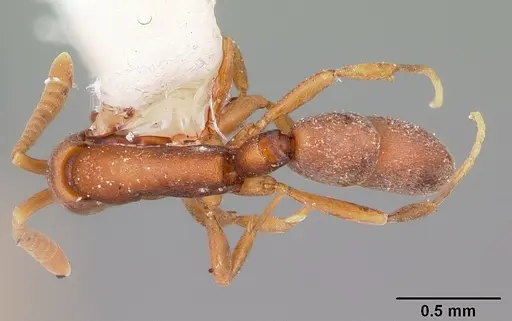
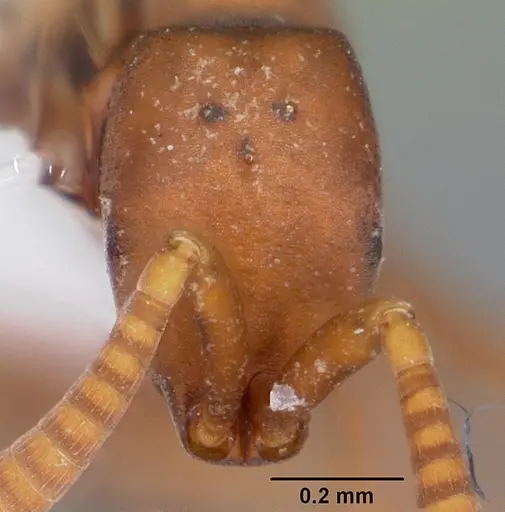
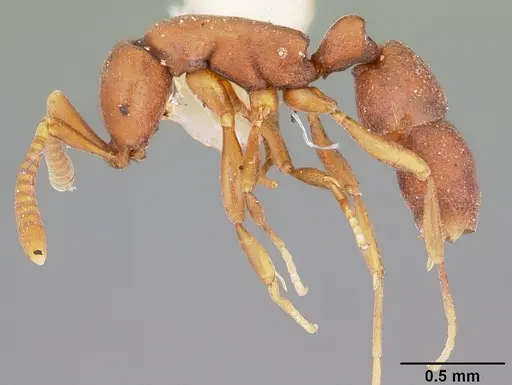
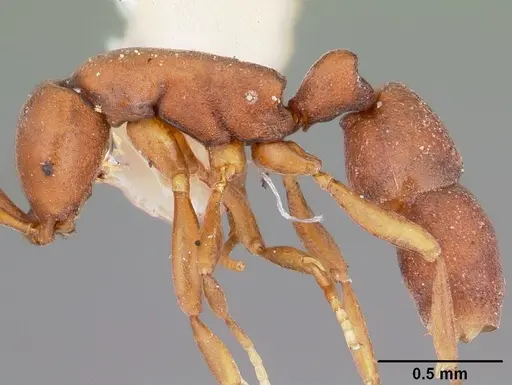
Littérature
Chargement de la carte de répartition...Chargement des produits...