
Polyrhachis levior
- Nom sci.
- Polyrhachis levior
- Sous-genre
- Cyrtomyrma
- Tribu
- Camponotini
- Sous-famille
- Formicinae
- Auteur
- Roger, 1863
- Distribution
- Trouvé dans 0 pays
Introduction
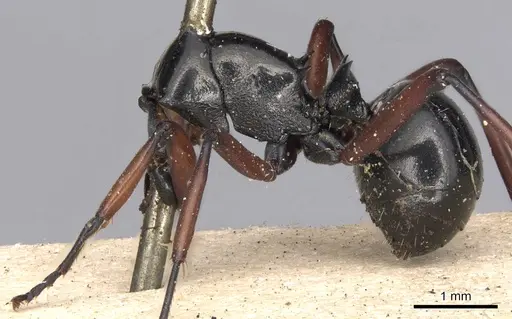
Polyrhachis levior is an ant with a smooth, shiny black body and distinctive rusty-colored legs. The worker has notably long propodeal spines and four sharp teeth on the petiole . This species belongs to the subgenus Cyrtomyrma, known for elaborately spined workers . The only known specimen was collected from Aru Island, Indonesia, and the species has been recorded in Australia, New Guinea, and parts of China . Nothing is known about this species' biology in the wild or in captivity, making it one of the most poorly documented ants in the hobby. The most intriguing aspect of Polyrhachis levior is that despite being described over 160 years ago, no biological information exists. It remains a complete mystery to ant taxonomists and keepers alike .
Quick Summary
- Difficulty: Unknown
- Origin & Habitat: Aru Island, Indonesia and surrounding Australasian regions. The natural habitat is unconfirmed [1].
- Colony Type: Unknown, only the worker caste has been described. The colony structure has not been documented [1].
- Size & Growth:
- Queen: Size data unavailable, no queen specimens have been described [1]
- Worker: Size data unavailable, only the holotype worker is known, but no modern body measurements are provided [1]
- Colony: Unknown, no colony samples have been recorded
- Growth: Unknown
- Development: Unknown, no developmental data exists. Based on related tropical Polyrhachis species, estimate 6-10 weeks at optimal temperature, but this is speculative [1]. (No direct observations, estimate based on genus patterns.)
- Antkeeping:
- Temperature: Unknown, no data. Based on tropical habitat, provide a gradient around 24-28°C, but this is inferred [1].
- Humidity: Unknown, no data. Based on tropical origin, provide humidity gradient, but this is inferred [1].
- Diapause: Unknown, tropical species typically remain active, but no data for this species [1].
- Nesting: Unknown, no nesting observations. Based on genus patterns, likely prefers arboreal setups with wood or vegetation [1].
- Behavior: Behavior is completely undocumented. Based on genus-level observations, Polyrhachis species are often docile, but no data for this species. Escape risk is moderate due to size, but no specific data [1]. Defense mechanism: As a Formicinae, they lack a sting and spray formic acid, but no specific data for this species.
- Common Issues: no captive husbandry information exists, this species has never been kept in captivity., the complete lack of biological data means all care recommendations are estimates based on related species., wild-caught colonies may be extremely difficult to obtain since the species is only known from a handful of specimens., growth and development timelines are entirely unknown, making colony management uncertain.
Species Overview and Identification
Polyrhachis levior is a mysterious species that has puzzled ant taxonomists since its original description in 1859. The holotype worker, collected by Alfred Russel Wallace on Aru Island, Indonesia, is missing its head, making detailed identification challenging [1]. The species was originally described as Polyrhachis laevissima but had to be renamed because that name was already taken. The current name 'levior' was established as a replacement [1]. Despite being known for over 160 years, absolutely no biological information exists about this species. Workers are distinctively glossy black with rusty legs, and the propodeal spines are relatively long and point backward and sideways, while the petiole has four equal-sized teeth [1]. These morphological features place it in the subgenus Cyrtomyrma, which includes other elaborately spined Polyrhachis species across Australasia [1].
Distribution and Range
The known distribution of Polyrhachis levior spans the Australasian and Indomalayan regions. The type locality is Aru Island, Indonesia, where the original specimen was collected [3][1]. Subsequent records indicate presence in Australia, New Guinea, and parts of China including Hainan Province [2][4][1]. This distribution pattern suggests the species is widespread but rarely encountered, which explains why so little is known about its biology.
Care Recommendations Based on Genus Patterns
Since no captive husbandry information exists for this species, care must be estimated from what we know about related Polyrhachis species in the Cyrtomyrma subgenus. These ants are typically tropical and likely prefer warm, humid conditions similar to their natural habitat in Southeast Asia and Australasia [1]. A naturalistic setup with rotting wood, bark, or live plants would likely suit them best, as most Polyrhachis species are at least partially arboreal [1]. Temperature should be maintained in the 24-28°C range with a gradient allowing workers to choose their preferred spot, but this is inferred [1]. Humidity around 70% with some drier areas would approximate their likely forest floor or canopy edge habitat, but this is speculative [1]. Feeding would likely follow the typical Polyrhachis diet of sugar sources and protein, but these are entirely speculative recommendations, successful keeping of this species would require careful observation and documentation to build husbandry knowledge [1].
Why This Species Remains a Mystery
Polyrhachis levior represents a significant gap in our ant-keeping knowledge. Despite being described in 1863 and having a distribution spanning multiple countries and regions, no researcher has ever documented its biology, colony structure, or behavior [1]. This is unusual even for rarely collected tropical species. The lack of specimens in ant collections suggests either the species is genuinely rare, it occupies microhabitats that are difficult to sample, or it has been confused with similar species over the years [1]. For antkeepers, this means P. levior remains a completely unknown entity, there are no established care protocols, no documented growth rates, and no confirmed successful captive colonies.
Frequently Asked Questions
Can I keep Polyrhachis levior in captivity?
It is theoretically possible but extremely difficult. No captive colonies have ever been documented, and the species has never been observed in the ant-keeping hobby [1]. You would need to locate a wild colony (which is rare), and then establish care protocols entirely from scratch based on genus-level estimates [1].
What do Polyrhachis levior ants eat?
Unknown for this specific species. Based on related Polyrhachis species, they likely accept sugar sources and small protein prey, but this is entirely speculative [1].
How long does it take for Polyrhachis levior to develop from egg to worker?
Unknown, no developmental data exists for this species. Based on typical tropical Polyrhachis development, estimate approximately 6-10 weeks at optimal temperature, but this is a rough guess [1].
What is the best nest type for Polyrhachis levior?
Unknown, no nesting observations exist. Based on genus patterns, they likely prefer naturalistic setups with wood, bark, or plant material [1].
How big do Polyrhachis levior colonies get?
Unknown, no colony samples have ever been studied. Related Polyrhachis species typically reach a few hundred to a few thousand workers, but this is speculative for P. levior [1].
Do Polyrhachis levior queens found colonies alone?
Unknown, no founding behavior has been documented for this species. Based on genus patterns, most Formicinae are claustral, but this has never been directly observed for P. levior [1].
Is Polyrhachis levior a good species for beginners?
No. This species is completely unknown in captivity with no established care protocols. It would be extremely challenging even for experienced antkeepers due to the complete lack of reference information [1].
Does Polyrhachis levior need hibernation?
Unknown, it is a tropical species from warm regions. No diapause or hibernation behavior has been documented, and tropical ants typically remain active year-round [1].
Where can I find Polyrhachis levior colonies to keep?
Extremely unlikely to find. The species is only known from a handful of specimens collected over 160 years. No recent field collections exist, and it appears to be either very rare or rarely encountered even by professional ant collectors [1].
Report an Issue
The current care sheet is based fully on literature. See inconsistencies, or something that's incorrect? Please , it will be resolved after review from an admin. Contributing to the blogs tab also helps providing information, to make us be able to further improve the caresheets. Thank you for your support!
References

Cette fiche d'élevage est sous licence CC BY-SA 4.0 .
Blogs de la communauté
CASENT0901809
Voir sur AntWeb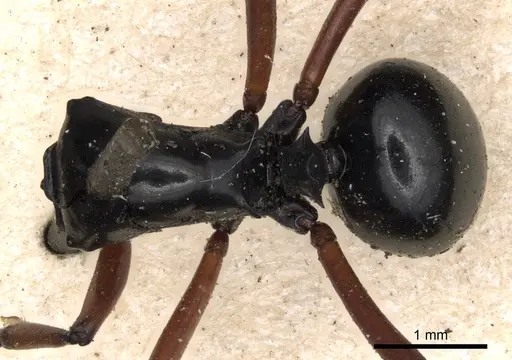
Littérature
Chargement de la carte de répartition...Chargement des produits...