
Polyrhachis alatisquamis
- Nom sci.
- Polyrhachis alatisquamis
- Sous-genre
- Myrma
- Tribu
- Camponotini
- Sous-famille
- Formicinae
- Auteur
- Forel, 1893
- Distribution
- Trouvé dans 0 pays
Introduction
Polyrhachis alatisquamis is a medium-sized ant measuring 5.49-6.00 mm in total length . It belongs to the subgenus Myrma and the aculeata species-group . Workers are black with dark reddish-brown antennae, legs, and gaster, and are covered in dense white to greyish pubescence . The most distinctive features are the very slender and acute pronotal spines and the strongly transverse petiole with paired spines . This species is closely related to Polyrhachis pubescens but is generally smaller and more slender . The biology of this species is completely unstudied - no information exists on colony structure, founding behavior, diet, or seasonal patterns . As a member of the aculeata species-group, it likely shares traits with related Polyrhachis species, which are typically arboreal or semi-arboreal nesters in tropical forests .
Quick Summary
- Difficulty: Hard
- Origin & Habitat: Native to Myanmar (type locality Ataran Valley), Thailand, and the Andaman Islands [2][4]. Likely inhabits tropical forest environments [2].
- Colony Type: Unconfirmed, no data on queen number or colony structure [3].
- Size & Growth:
- Antkeeping:
- Temperature: Unknown, but based on tropical distribution, keep warm around 22-28°C with a gradient [2][4].
- Humidity: Unknown, based on tropical habitat, keep substrate moderately moist but not waterlogged.
- Diapause: Unknown, tropical species may not require hibernation.
- Nesting: Likely arboreal or semi-arboreal based on related species [2]. Use Y-tong, plaster, or soil nests with vertical surfaces.
- Behavior: Behavior is unstudied. Polyrhachis species are generally docile, but this is not confirmed for P. alatisquamis [3]. Escape risk is moderate due to size around 6 mm. Defense mechanism: As a Formicinae, they lack a sting and spray formic acid.
- Common Issues: all care recommendations are estimates due to completely unstudied biology [3], founding behavior is unconfirmed, queen may be claustral, but this is not documented, colony size and growth rate are unknown, making long-term planning difficult, diet preferences are unconfirmed, offer sugar and protein and observe, temperature stability is important for tropical species
Appearance and Identification
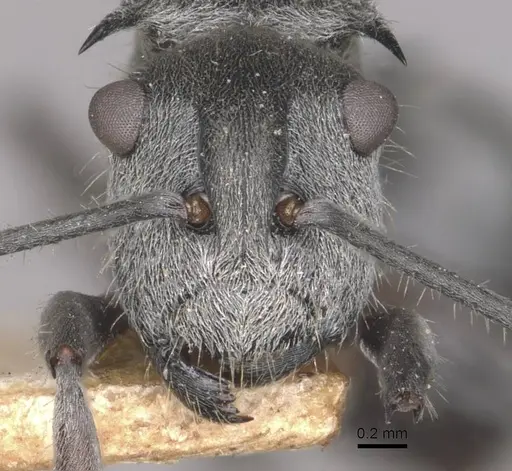
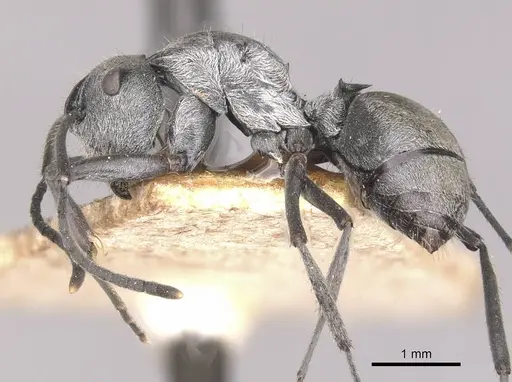
Polyrhachis alatisquamis workers measure 5.49-6.00 mm in total length, making them a medium-sized ant [1][2]. They are predominantly black with dark reddish-brown antennae, legs, and gaster [1]. The most distinctive physical features are the very slender and acute pronotal spines, these spines are about three times longer than their basal width and curve slightly downward [1]. The petiole has a strongly transverse dorsum armed with a pair of spines directed dorsolaterally and posteriorly [1]. The entire body is covered in dense, closely appressed white to greyish pubescence that almost completely hides the underlying sculpturation [1]. The eyes are convex and protrude posteriorly, clearly exceeding the lateral cephalic outline when viewed from above [1]. This species is very similar to its close relative Polyrhachis pubescens but can be distinguished by its generally smaller size, more slender body, less convex eyes, and more strongly transverse petiole dorsum [2].
Distribution and Habitat
Polyrhachis alatisquamis is known from three locations in the Indomalaya region: Myanmar (the type locality in the Ataran Valley), Thailand, and the Andaman Islands of India [2][4]. The type specimen was collected in March 1891 by C.T. Bingham from the Ataran Valley in Myanmar [2]. As a tropical Asian species, it likely inhabits forest environments typical of the Polyrhachis genus [2]. The Andaman Islands location suggests tolerance for island ecosystems, though specific microhabitat preferences remain unknown [4].
What We Do Not Know
Polyrhachis alatisquamis is one of the least studied ant species in cultivation, literally nothing is known about its biology [3]. No information exists on colony structure, founding behavior, diet preferences, development time, seasonal patterns, or any aspect of their behavior [3]. Sexual castes (queens and males) and immature stages (eggs, larvae, pupae) have never been documented [3]. This species was originally described as a variety of Polyrhachis pubescens and was only raised to full species status in 2013 based on morphological differences [2]. For antkeepers, this means all care recommendations are educated guesses based on related Polyrhachis species, not on direct observation.
Care Guidelines (Based on Genus Patterns)
Since direct care data does not exist for P. alatisquamis, recommendations are based on typical Polyrhachis husbandry. Provide a warm environment around 22-28°C with a gradient[4]. Humidity should be moderate, keeping substrate moist but not waterlogged. For nesting, use Y-tong or plaster nests with chambers. Feed sugar sources and protein, observing colony preferences [3]. Start with small prey items and sugar water, adjusting based on what the colony accepts.
Related Species and Context
Polyrhachis alatisquamis belongs to the aculeata species-group within the subgenus Myrma, which contains several similar spiny ants [1]. The genus Polyrhachis contains over 600 species worldwide, with the highest diversity in the Asia-Pacific region. Many Polyrhachis species are known for their ornamental spines and are sometimes called 'spiny ants' or 'Christmas tree ants' due to their elaborate dorsal projections. The aculeata group specifically includes species with well-developed pronotal spines and various petiolar modifications [1]. While P. alatisquamis remains poorly studied, its close relative Polyrhachis pubescens and other members of this group have been kept in captivity by ant enthusiasts, providing general guidance for husbandry.
Frequently Asked Questions
How long does it take for Polyrhachis alatisquamis to develop from egg to worker?
This is completely unknown, no research has ever studied their development [3].
What do Polyrhachis alatisquamis ants eat?
Diet is unconfirmed for this species. Based on related Polyrhachis species, they are likely omnivorous and would accept sugar sources and protein [3]. Start with small prey items and sugar water and observe what your colony accepts.
Are Polyrhachis alatisquamis good for beginners?
This species cannot be recommended for beginners because virtually nothing is known about its care requirements [3]. Beginners should choose species with well-documented care requirements instead.
Can I keep multiple Polyrhachis alatisquamis queens together?
No data exists on colony structure for this species [3]. Without specific data, combining unrelated queens is not recommended.
What temperature should I keep Polyrhachis alatisquamis at?
Temperature requirements are unstudied. Based on their tropical Asian distribution, aim for 22-28°C with a gradient [2][4].
Do Polyrhachis alatisquamis need hibernation?
Hibernation requirements are unknown. As a tropical species, they likely do not require a formal hibernation period.
How big do Polyrhachis alatisquamis colonies get?
Maximum colony size is unknown, no research has ever documented wild or captive colony sizes for this species [3].
What type of nest should I use for Polyrhachis alatisquamis?
Nesting preferences are unstudied. Based on typical Polyrhachis behavior, they likely prefer semi-arboreal setups. A Y-tong or plaster nest with appropriately sized chambers would be a reasonable starting point [3].
Where is Polyrhachis alatisquamis found?
This species is known from Myanmar (type locality Ataran Valley), Thailand, and the Andaman Islands (India), all in the Indomalaya tropical region of Southeast Asia [2][4].
Report an Issue
The current care sheet is based fully on literature. See inconsistencies, or something that's incorrect? Please , it will be resolved after review from an admin. Contributing to the blogs tab also helps providing information, to make us be able to further improve the caresheets. Thank you for your support!
References

Cette fiche d'élevage est sous licence CC BY-SA 4.0 .
Blogs de la communauté
CASENT0910941
Voir sur AntWeb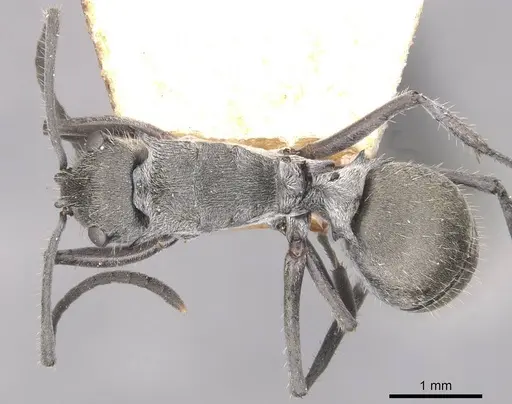
Littérature
Chargement de la carte de répartition...Chargement des produits...