
Pheidole poringensis
- Nom sci.
- Pheidole poringensis
- Tribu
- Attini
- Sous-famille
- Myrmicinae
- Auteur
- Eguchi, 2001
- Distribution
- Trouvé dans 0 pays
Introduction
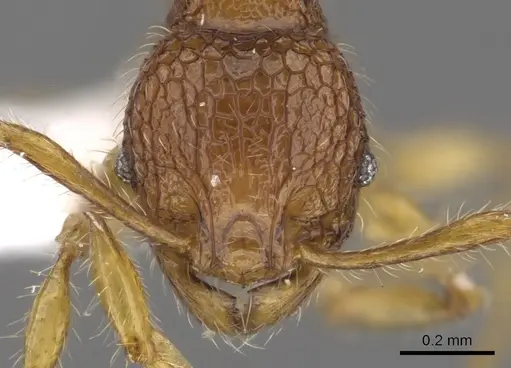
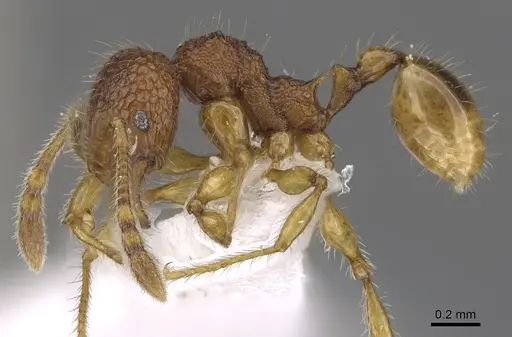
Pheidole poringensis is a small ant species with major workers measuring 2.6-2.8 mm and minor workers 1.5-1.6 mm . It is native to well-developed forests in Borneo, Indonesia, and Malaysia . The species was first described by Eguchi in 2001 and is closely related to Pheidole gombakensis, distinguished by petiole length and surface sculpturing. This species has been documented in undisturbed forest areas, as per a study on ground-dwelling ant diversity in Maliau Basin, Borneo .
Quick Summary
- Difficulty: Medium
- Origin & Habitat: Borneo, Indonesia, and Malaysia, found in well-developed tropical rainforest ecosystems [1]
- Colony Type: Based on Pheidole genus patterns, likely monogyne (single queen colonies) with distinct major and minor worker castes.
- Size & Growth:
- Queen: Size data unavailable, inferred from Pheidole genus patterns as ~5-8 mm
- Worker: Major: 2.6-2.8 mm, Minor: 1.5-1.6 mm [1]
- Colony: Colony size data unavailable for this species.
- Growth: Moderate, inferred from genus patterns
- Development: 6-8 weeks estimated based on typical Pheidole development at warm temperatures (Development time inferred from genus patterns, direct measurements not available for this species)
- Antkeeping:
- Temperature: Keep at 24-28°C, based on tropical habitat inference. A heating cable can create a gradient.
- Humidity: Keep nest substrate consistently moist but not waterlogged, based on forest floor habitat [1]
- Diapause: No, tropical species do not require hibernation. Maintain warm conditions year-round.
- Nesting: Use nests with moist substrate, such as Y-tong or plaster nests, scaled to their small size [1]
- Behavior: Pheidole poringensis is generally docile and non-aggressive. Escape risk is low due to their small size, but good husbandry practices should be followed.
- Common Issues: high humidity must be maintained to prevent colony death., constant warmth is required to prevent development slowdown., small colonies are vulnerable to stress, avoid disturbing founding colonies., wild-caught colonies may carry parasites that affect survival.
Nest Preferences
Pheidole poringensis is a ground-dwelling species that naturally nests in soil within well-developed forest habitats [1]. In captivity, they do well in Y-tong or plaster nests that can hold moisture. The nest chambers should be appropriately sized for their small body size. A water reservoir or moisture wick system helps maintain humidity. Simple test tube setups work for founding colonies, but larger colonies benefit from formicarium setups with multiple chambers.
Feeding and Diet
Pheidole poringensis is a generalist omnivore. They accept protein sources such as small insects and sugary foods like honey water. In the wild, they forage for seeds, dead insects, and honeydew. For captive colonies, offer protein prey 2-3 times per week and keep a constant sugar source available. Remove uneaten prey after 24-48 hours to prevent mold.
Temperature and Care
Being native to Borneo, this species requires warm, stable temperatures around 24-28°C. Temperatures below 22°C can slow development, while above 30°C may cause stress. A heating cable on one side of the nest creates a gradient. Unlike temperate species, they do not require cooling or hibernation.
Behavior and Temperament
Pheidole poringensis is docile and poses no threat to keepers. Colonies have distinct major and minor worker castes. Major workers have enlarged heads for defense, while minors handle foraging. Workers are active foragers but not particularly escape-prone.
Colony Founding
Founding behavior is unconfirmed for this species. If claustral, the queen would seal herself in a chamber and raise the first brood alone. Founding colonies should be kept in a quiet, dark location with stable conditions. Do not disturb the queen during this period.
Frequently Asked Questions
How long does it take for Pheidole poringensis to raise first workers?
Expect first workers to emerge in approximately 6-8 weeks after the queen lays eggs, based on typical Pheidole development at warm temperatures [1].
What do Pheidole poringensis ants eat?
They are generalist omnivores. Offer small insects for protein 2-3 times per week and keep a constant sugar source available [1].
What temperature do Pheidole poringensis ants need?
Keep them warm at 24-28°C based on tropical habitat inference. A heating cable can create a suitable gradient.
Do Pheidole poringensis ants need hibernation?
No, as a tropical species from Borneo, they do not require hibernation and need warm conditions year-round.
How big do Pheidole poringensis colonies get?
Colony size data is unavailable for this species, so estimates are based on genus patterns.
Can I keep multiple Pheidole poringensis queens together?
Based on Pheidole genus patterns, colonies are likely monogyne (single queen), so multiple queens would fight. Only keep one queen per colony.
What humidity level do Pheidole poringensis ants need?
Keep the nest substrate consistently moist but not waterlogged, based on their forest floor habitat [1].
Are Pheidole poringensis good for beginners?
They are moderate difficulty due to tropical temperature and humidity needs, but straightforward to meet if conditions are stable.
When should I move Pheidole poringensis to a formicarium?
Keep founding colonies in a test tube setup until they have a stable number of workers, then transfer to a formicarium with multiple chambers.
Report an Issue
The current care sheet is based fully on literature. See inconsistencies, or something that's incorrect? Please , it will be resolved after review from an admin. Contributing to the blogs tab also helps providing information, to make us be able to further improve the caresheets. Thank you for your support!
References

Cette fiche d'élevage est sous licence CC BY-SA 4.0 .
Blogs de la communauté
CASENT0901660
Voir sur AntWeb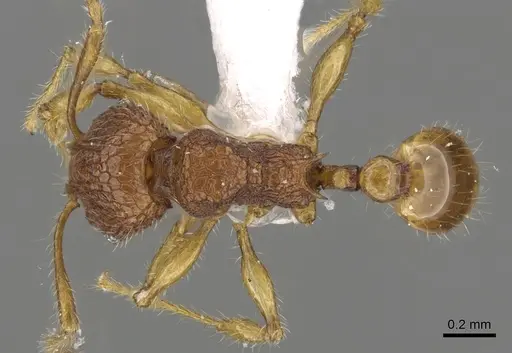
Littérature
Chargement de la carte de répartition...Chargement des produits...