
Paratopula sumatrensis
- Nom sci.
- Paratopula sumatrensis
- Tribu
- Crematogastrini
- Sous-famille
- Myrmicinae
- Auteur
- Forel, 1913
- Distribution
- Trouvé dans 0 pays
Introduction
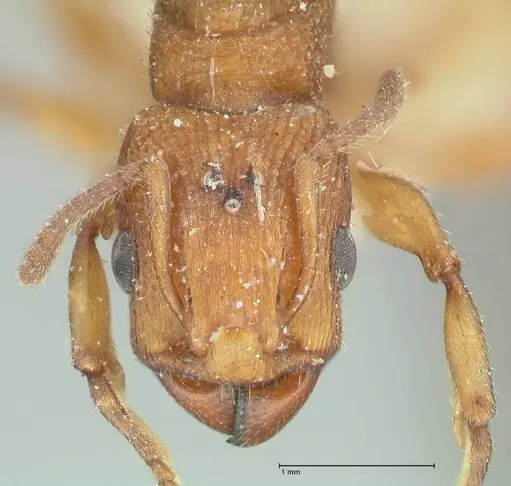
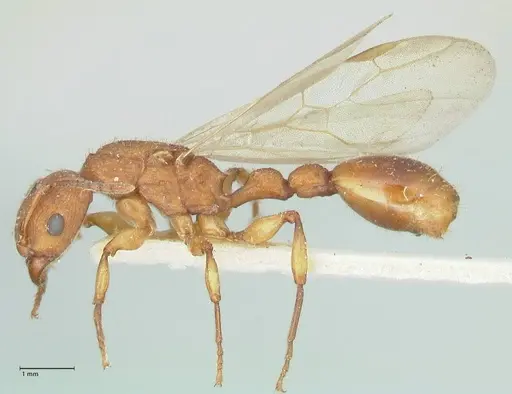
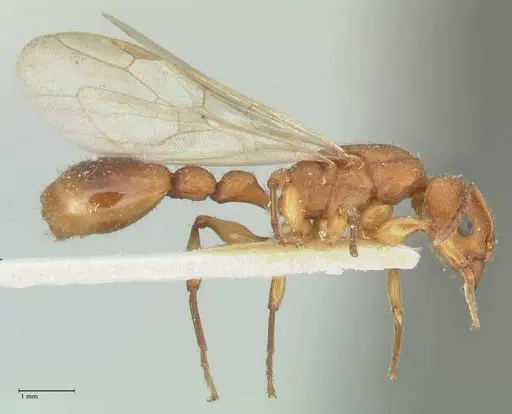
Paratopula sumatrensis is one of the rarest ant species in the world, known only from a single queen (described in 1913) and a single worker (described in 1924). Both specimens were collected in Sumatra, Indonesia, and the species is also recorded from the Philippines . It belongs to the myrmicine tribe Crematogastrini and is an arboreal ant. Because of the extreme lack of data, this species is only suitable for expert antkeepers who want to document and contribute to knowledge of a virtually unknown ant.
Quick Summary
- Difficulty: Expert
- Origin & Habitat: Tropical Southeast Asia – Indonesia (Sumatra) and the Philippines. As an arboreal species, it likely inhabits forest canopies in humid environments [1][2][3].
- Colony Type: Unknown – only a queen and a worker have ever been documented. Colony structure (single-queen or multi-queen) has not been studied.
- Size & Growth:
- Queen: Size data unavailable – no measurements exist for this species.
- Worker: Size data unavailable – no measurements exist for this species.
- Colony: Unknown – no colony size data exists.
- Growth: Unknown – no development data available.
- Development: Unknown – no data exists on development time. (No species-specific development data has been recorded.)
- Antkeeping:
- Temperature: Unknown – no direct data. Based on its tropical distribution, start with warm conditions around 24–28°C and adjust according to colony behavior.
- Humidity: Unknown – no direct data. As a tropical arboreal ant, likely needs high humidity. Keep the nest substrate consistently moist but not waterlogged.
- Diapause: Unknown – no data exists. As a tropical species, hibernation is not expected, but seasonal activity tied to wet/dry seasons is possible.
- Nesting: Arboreal – likely nests in tree hollows, under bark, or in rotting branches. In captivity, provide vertical climbing structures and use a Y-tong (aerated concrete), plaster, or 3D-printed nest with chambers scaled to the ants' size.
- Behavior: Unknown – no behavioral observations exist. As a member of the Crematogastrini tribe, it possesses a modified stinger used to smear venom onto enemies. Based on related myrmicine ants, it is probably moderately aggressive when defending its nest. Escape prevention must be excellent because the ants are likely small and arboreal.
- Common Issues: no established care protocols exist – you are pioneering husbandry from scratch., the only documented specimens are over a century old, so no modern ecological data is available., colony failure is highly likely due to the complete lack of species-specific knowledge., wild-caught colonies may carry parasites or diseases that cannot be identified without research., the arboreal nature means standard ground-level setups are likely inappropriate.
Species Overview and Rarity
Paratopula sumatrensis is one of the most poorly documented ant species. All scientific knowledge comes from a queen described in 1913 and a worker described in 1924. Both were collected in Sumatra, Indonesia, the queen was caught at a light source [3]. No additional specimens have been documented since. The genus Paratopula is rarely collected, and this species remains a mystery. For antkeepers, it represents an extreme challenge that requires experimenting and documenting everything [1][2].
Natural History and Distribution
This species is known only from the Indomalaya region: Indonesia (Sumatra) and the Philippines. The holotype queen was collected at Tandjong Slamat, Sumatra, in 1911–12 by von Buttel-Reepen. The worker was described by Crawley in 1924 from Sumatra. No ecological data exists – nesting habits, diet, colony size, and behavior in the wild are completely unknown [1][2][3].
Housing and Nest Setup
Because the genus is arboreal, you should provide an elevated nesting environment. A naturalistic terrarium with live plants, branches for climbing, and a moist substrate is ideal. Alternatively, use a Y-tong (aerated concrete), plaster, or 3D-printed nest with narrow chambers scaled to the ants' size. Include vertical climbing structures. Keep the nest humid but well-ventilated to prevent mold. Since there is no captive experience, you are pioneering the husbandry – experiment and document conditions the ants respond to best.
Feeding and Diet
No data exists on the diet of Paratopula sumatrensis. Based on related myrmicine ants, offer a variety of foods: sugar water or honey as a carbohydrate source, and small insects (e.g., fruit flies, pinhead crickets) for protein. Because they are arboreal, they may also tend honeydew-producing insects. Experiment with different foods and record what the colony accepts.
Temperature and Humidity Requirements
No specific data is available. As a tropical ant from Southeast Asia, start with warm conditions (24–28°C) and high humidity. Keep the nest substrate consistently moist but not waterlogged. Provide a temperature gradient using a heating cable on one side so the ants can self-regulate. Monitor their behavior and adjust accordingly.
Challenges and Expectations
You should expect major challenges. There is no established care protocol, no development timeline, and no information on triggering reproduction. If you obtain a queen (collected at light, suggesting nocturnal flights), she may need complete darkness during founding. Consider this a research project – document everything to help future keepers. Success is uncertain even for experienced enthusiasts.
Frequently Asked Questions
How do I care for Paratopula sumatrensis ants?
No established care protocol exists. Based on their tropical arboreal nature, provide a warm (24–28°C), humid environment with climbing structures. This is an experimental species – you will need to develop husbandry through careful observation and documentation.
What do Paratopula sumatrensis eat?
Their diet is unknown. Based on related myrmicine ants, they likely accept sugar sources (honey, sugar water) and protein (small insects). Offer variety and document what they consume.
How long does it take for Paratopula sumatrensis to produce workers?
Unknown – no development data exists. This species has never been documented in captivity, so any timeline would be entirely speculative.
Can Paratopula sumatrensis be kept in a test tube?
Not recommended as a long-term solution. As an arboreal species, they need vertical space and climbing structures. A naturalistic setup or a Y-tong nest with climbing elements is more appropriate.
Do Paratopula sumatrensis ants sting?
Unknown, but as a myrmicine ant they likely have a stinger. Their size is unconfirmed, so the effect on humans is uncertain. Based on related species, any sting would probably be mild.
Is Paratopula sumatrensis good for beginners?
No – this is an expert-level species. There is no established care protocol, no documented successful captive colonies, and essentially no biological information available. It is a species for experienced keepers willing to pioneer husbandry.
Where does Paratopula sumatrensis live in the wild?
They are known only from Sumatra (Indonesia) and the Philippines in tropical Southeast Asia. As an arboreal species, they likely inhabit forest canopies. No specific habitat data exists [1][2][3].
Do Paratopula sumatrensis need hibernation?
Unknown – no data exists. As a tropical species from near the equator, they likely do not require a true hibernation period. They may have seasonal activity patterns tied to wet/dry seasons rather than temperature-driven dormancy.
How big do Paratopula sumatrensis colonies get?
Unknown – no colony size data exists. Related arboreal myrmicines typically form colonies of several hundred to a few thousand workers, but this is entirely speculative.
Can I keep multiple Paratopula sumatrensis queens together?
Unknown – no data exists on colony structure. Do not attempt combining unrelated queens without documented evidence that this species accepts pleometrosis (multiple-queen founding). The risk of queen aggression is unknown.
Report an Issue
The current care sheet is based fully on literature. See inconsistencies, or something that's incorrect? Please , it will be resolved after review from an admin. Contributing to the blogs tab also helps providing information, to make us be able to further improve the caresheets. Thank you for your support!
References

Cette fiche d'élevage est sous licence CC BY-SA 4.0 .
Blogs de la communauté
FOCOL1968
Voir sur AntWeb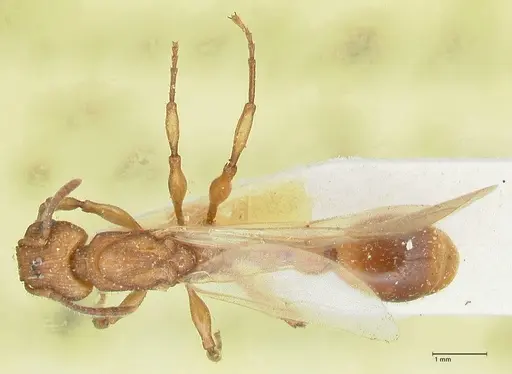
Littérature
Chargement de la carte de répartition...Chargement des produits...