
Odontomachus philippinus
- Nom sci.
- Odontomachus philippinus
- Tribu
- Ponerini
- Sous-famille
- Ponerinae
- Auteur
- Emery, 1893
- Distribution
- Trouvé dans 0 pays
Introduction
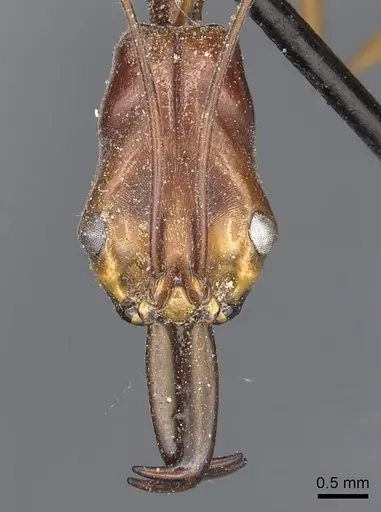
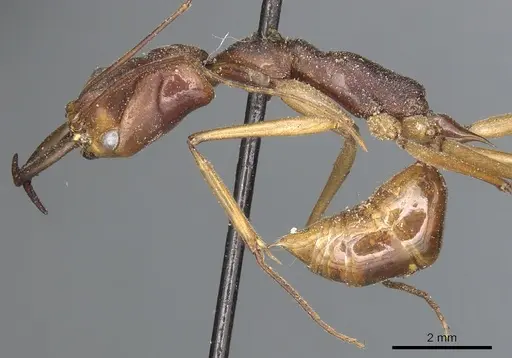
Odontomachus philippinus is a medium-sized trap-jaw ant endemic to the Philippines, specifically the western Visayas islands of Panay, Negros, and Siquijor. Workers reach up to 16 mm total length with a dark, glossy appearance - the entire body is very shiny with smooth areas contrasting with striated regions on the head and pronotum . The head has striations from the frontal lobes to the ocular ridge, the mesopleuron is smooth and shiny, and the petiole is S-shaped and strongly bent backwards . This species is endangered due to forest destruction in its limited range, living only in shaded, humid degraded primary forests or secondary forests .
Quick Summary
- Difficulty: Medium
- Origin & Habitat: Endemic to the Philippines, western Visayas islands of Panay, Negros, and Siquijor. Found only in shaded, humid places in degraded primary forests or secondary forests [1].
- Colony Type: Colony structure is unconfirmed. Based on typical Ponerinae patterns, likely single-queen colonies.
- Size & Growth:
- Queen: Size data unavailable, no total length measurements for queens in available literature.
- Worker: Up to 16 mm total length [1].
- Colony: Unknown, no colony size data in available literature.
- Growth: Moderate, estimated based on tropical species patterns.
- Development: Estimated 8-12 weeks based on typical Ponerinae development patterns. (Development time may vary with temperature and feeding conditions.)
- Antkeeping:
- Temperature: Keep warm, roughly 24-28°C, based on tropical habitat patterns [1].
- Humidity: Keep nest substrate consistently moist but not waterlogged, as this species lives in humid forests [1].
- Diapause: No, tropical species from the Philippines do not require hibernation.
- Nesting: Use Y-tong, plaster, or soil nests with moist substrate. Provide dark, enclosed spaces scaled to their medium size.
- Behavior: Odontomachus ants have trap-jaw mandibles that snap quickly for hunting and defense. They are predatory and will defend their nest vigorously. Escape risk is moderate due to their medium size and quick movement.
- Common Issues: high humidity requirements mean mold can develop if ventilation is poor, balance airflow carefully., predatory diet requires regular live prey, sugar alone will not sustain them., tropical species are sensitive to temperature drops, keep them warm year-round., wild-caught colonies may be stressed from habitat loss and have lower survival rates., their trap-jaw mechanism can startle handlers, handle gently to avoid snaps.
Housing and Setup
Use Y-tong, plaster, or soil nests with moist substrate for Odontomachus philippinus. Provide dark, enclosed spaces as they prefer shaded habitats [1]. For founding colonies, a test tube with a water reservoir works well. As the colony grows, move to a larger setup with multiple chambers. Keep the nest substrate damp to mimic their natural humid forest floor [1].
Feeding and Diet
Offer a protein-rich diet of live prey like fruit flies, pinhead crickets, and mealworms. Provide sugar water or honey for energy. Feed protein 2-3 times per week, removing uneaten prey to prevent mold. They are active hunters using their trap-jaw mechanism.
Temperature and Humidity
Keep temperatures around 24-28°C, as this species comes from tropical forests [1]. Use a heating cable on one side to create a gradient. Maintain high humidity with consistently moist nest substrate [1]. Avoid temperatures below 20°C.
Behavior and Defense
Odontomachus ants use trap-jaw mandibles for hunting and defense, snapping at high speeds. Their primary defense is a sting, as typical for Ponerinae ants. Workers are not aggressive toward humans but will defend the nest. Escape risk is moderate due to medium size.
Colony Development
Colony founding behavior is unconfirmed for this species. Based on typical Ponerinae patterns, queens may hunt during founding (semi-claustral). Initial growth is slow, with first workers taking several months. Once established, growth remains moderate.
Frequently Asked Questions
How long does it take for Odontomachus philippinus to get their first workers?
Expect 8-12 weeks from egg to first worker under optimal conditions, based on typical Ponerinae development patterns. Timing may vary with temperature and feeding.
What do I feed Odontomachus philippinus ants?
They need a predatory diet, offer small live insects like fruit flies and crickets, plus sugar water for energy. Feed protein 2-3 times per week.
Do Odontomachus philippinus ants sting?
They have a stinger as typical for Ponerinae ants, but their primary defense is trap-jaw mandibles. Stings are uncommon but can occur if threatened.
What temperature do Philippine trap-jaw ants need?
Keep them warm at 24-28°C, based on their tropical habitat [1]. Avoid cool temperatures below 20°C.
Are Odontomachus philippinus good for beginners?
This species is rated Medium difficulty due to specific humidity, temperature, and dietary needs. Better for antkeepers with some experience.
How big do Odontomachus philippinus colonies get?
Colony size is unknown, no data on maximum worker count in available literature.
Do they need hibernation?
No, as a tropical species from the Philippines, they do not require hibernation or winter cooling.
Can I keep multiple queens together?
Colony structure is unconfirmed. Based on typical Ponerinae patterns, they likely form single-queen colonies. Combining unrelated queens is not recommended.
Why are my Odontomachus philippinus dying?
Common causes include low temperature, low humidity, lack of live prey, mold from poor ventilation, or stress from wild-caught origin. Check all parameters.
When should I move them to a formicarium?
Move from a test tube when the colony reaches around 20-30 workers or when crowded. Ensure the new setup maintains humidity and has appropriate chambers.
Report an Issue
The current care sheet is based fully on literature. See inconsistencies, or something that's incorrect? Please , it will be resolved after review from an admin. Contributing to the blogs tab also helps providing information, to make us be able to further improve the caresheets. Thank you for your support!
References

Cette fiche d'élevage est sous licence CC BY-SA 4.0 .
Blogs de la communauté
CASENT0903995
Voir sur AntWeb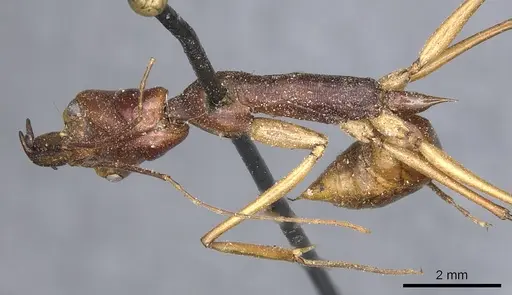
Littérature
Chargement de la carte de répartition...Chargement des produits...