
Monomorium buxtoni
- Nom sci.
- Monomorium buxtoni
- Tribu
- Solenopsidini
- Sous-famille
- Myrmicinae
- Auteur
- Crawley, 1920
- Distribution
- Trouvé dans 0 pays
Introduction
Monomorium buxtoni is a small ant with workers measuring 3.2-3.4mm in total length . They have a medium reddish-brown coloration, long hairs on the pronotum, petiole, and postpetiole, and a robust build compared to similar species like Monomorium abeillei . This species is found in the Middle East, including Iraq, Kuwait, Iran, Saudi Arabia, and the United Arab Emirates . Little is known about the biology of Monomorium buxtoni, as scientific literature only covers taxonomy and distribution .
Quick Summary
- Difficulty: Hard
- Origin & Habitat: Middle Eastern species found in Iraq, Kuwait, Iran, Saudi Arabia, and UAE [2][3][4]. Habitat preferences are unconfirmed, but members of the Monomorium salomonis group typically inhabit arid regions [1].
- Colony Type: Unconfirmed, no data on colony structure exists for this species.
- Size & Growth:
- Queen: Size data unavailable, queens have not been described [1].
- Worker: 3.2-3.4mm total length [1].
- Colony: Unknown, no colony size data exists.
- Growth: Unknown
- Development: Unconfirmed, no development data exists. Based on typical Monomorium patterns, expect 4-8 weeks at warm temperatures [1]. (Development timeline is entirely unstudied. Estimates based on genus-typical patterns only.)
- Antkeeping:
- Temperature: Unknown, no thermal studies exist. Based on typical Monomorium genus patterns, keep warm around 22-26°C [1].
- Humidity: Unknown, no humidity data exists. Members of the salomonis group are typically adapted to drier conditions. Provide a moisture gradient with a damp test tube section and dry outworld [1].
- Diapause: Unknown, no seasonal data exists.
- Nesting: Unconfirmed, no natural nesting observations exist. Related species in this group often nest in soil or under stones in arid environments. Test tubes or Y-tong nests with moderate humidity work as starting points [1].
- Behavior: Unconfirmed, no behavioral observations exist for this species. The genus Monomorium includes both peaceful and moderately aggressive species. Workers are small, so escape prevention should be moderate. Based on genus-typical behavior, expect active foraging with potential sugar and protein acceptance. Defense mechanism: Based on subfamily Myrmicinae and tribe Solenopsidini, primary defense is sting with piperidine alkaloids.
- Common Issues: no biological data exists, this species has never been kept in captivity and no care information is available, founding queens may be difficult to locate, queens have not been described and may not be readily distinguishable from workers, unknown temperature and humidity requirements mean careful observation is essential, no information on accepted foods, dietary requirements are entirely unstudied, diapause requirements unknown, seasonal care may require experimentation
Species Identification and Appearance
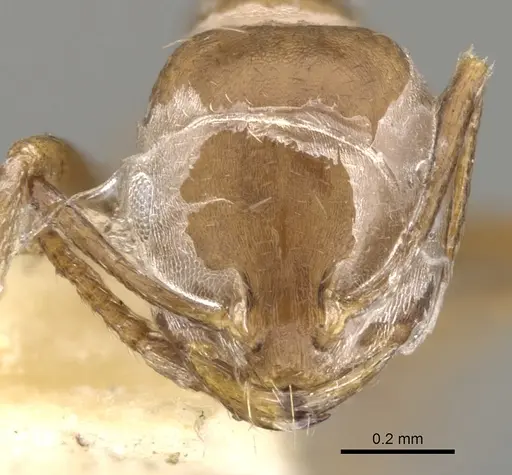
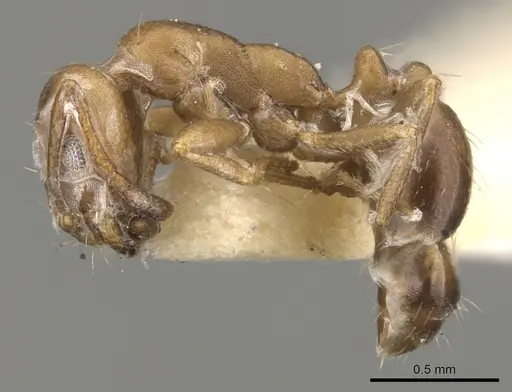
Monomorium buxtoni workers measure 3.2-3.4mm in total length, making them small but not tiny ants [1]. They have a medium reddish-brown coloration throughout the body. The most distinctive identification features include 1-2 pairs of long hairs on the pronotum, two pairs of hairs each on the petiole and postpetiole, and several hairs on the underside of the head [1]. The propodeal furrow is clearly distinct, and the petiole is wider than long in dorsal view, giving a robust appearance compared to similar species like Monomorium abeillei [1].
Distribution and Range
This species was originally described from Iraq in 1920,with the known distribution covering parts of the Middle East: Iraq, Kuwait, Iran, Saudi Arabia, and the United Arab Emirates [2][3][4]. It was first recorded in the UAE based on specimens collected near Alhala in March 2005 and in Al-Wagan in March 1995 [2][4]. The species appears to be distributed across both the Afrotropical and Palaearctic regions in this geographic area.
Taxonomic Context
Monomorium buxtoni belongs to the Monomorium salomonis species group, a collection of related ants primarily found in arid regions of Africa and the Middle East [5]. The genus Monomorium is part of the subfamily Myrmicinae and the tribe Solenopsidini. Within this group, M. buxtoni is considered a larger species with total length exceeding 3.0mm [5]. Key identifying features include the distinct anteromedian notch on the clypeus and the convex shape of the mesonotum [5].
Current State of Knowledge
The most important thing to understand about keeping Monomorium buxtoni is that virtually nothing is known about its biology [1]. The scientific literature contains only taxonomic descriptions of the worker caste and distribution records. No observations exist on colony size, queen behavior, founding methods, development time, diet preferences, temperature tolerance, humidity needs, or any other aspect of its natural history [1]. This makes M. buxtoni essentially an experimental species in ant keeping.
Approaching Care for Poorly Studied Species
When keeping ants with no documented care information, you must rely on genus-level patterns while being prepared to adjust based on your observations [1]. Most Monomorium species are claustral, meaning the queen seals herself in a chamber and raises the first workers entirely on stored body fat without foraging [1]. Workers are typically omnivorous, accepting both sugar sources and protein foods [1]. The genus generally prefers warm temperatures and drier conditions than many other ants [1]. Start with typical Monomorium care: a test tube setup, temperatures in the low-to-mid 20s Celsius, and a moisture gradient with access to both damp and dry areas. Offer sugar water and protein sources like small insects. Watch your colony closely and adjust based on behavior.
Frequently Asked Questions
Can I keep Monomorium buxtoni as a pet ant?
This species is not recommended for ant keeping at this time. No biological or ecological information exists for this species, meaning there are no established care guidelines [1]. Queens have not been scientifically described, so obtaining a founding colony would be extremely difficult. Even if you obtained workers, no one knows their temperature, humidity, or dietary requirements. Consider starting with better-studied Monomorium species like M. pharaonis or M. minimum, or other Middle Eastern species with documented care.
What do Monomorium buxtoni ants eat?
No dietary observations exist for this species [1]. Based on typical Monomorium genus behavior, they likely accept sugar sources like honey or sugar water and small protein items like insect parts [1]. However, without any documented feeding observations, this is speculative.
How long does it take for Monomorium buxtoni to develop from egg to worker?
No development data exists for this species [1]. There are no documented egg-to-worker timelines, and even the queen caste has not been described. Any timeline would be a pure guess. For comparison, related Monomorium species typically develop in 4-8 weeks at warm temperatures, but this may not apply to M. buxtoni [1].
What temperature should I keep Monomorium buxtoni at?
No thermal tolerance data exists for this species [1]. The safest approach is to start around 22-26°C and observe colony behavior. Since this species comes from the Middle East, it may tolerate higher temperatures than temperate species [1].
Do Monomorium buxtoni ants need hibernation?
Unknown, no seasonal behavior data exists [1]. Middle Eastern populations may experience cooler winters, but whether this triggers true diapause is unstudied. If keeping this species, monitor for seasonal slowdowns and adjust temperatures accordingly.
How big do Monomorium buxtoni colonies get?
No colony size data exists [1]. No one has documented wild colony sizes or captive colony limits. Related species in the salomonis group vary from small colonies of a few dozen to larger colonies of several hundred workers, but this is unconfirmed for M. buxtoni.
Is Monomorium buxtoni aggressive or dangerous?
No behavioral observations exist for this species [1]. The genus Monomorium contains both peaceful species and more aggressive ones. Without any documented aggression levels or stinging behavior, no assessment can be made. Related species in the salomonis group are not known for particularly painful stings, but this is not confirmed for M. buxtoni.
Can I keep multiple Monomorium buxtoni queens together?
Unknown, no data exists on colony structure or queen behavior [1]. The colony type has not been documented. Combining unrelated queens would be entirely experimental with unpredictable results.
Where can I find Monomorium buxtoni ants to start a colony?
This species has rarely been recorded and only from specific Middle Eastern locations [2][3]. Workers are not commonly collected, and queens have never been described. The practical likelihood of obtaining this species for ant keeping is extremely low.
Report an Issue
The current care sheet is based fully on literature. See inconsistencies, or something that's incorrect? Please , it will be resolved after review from an admin. Contributing to the blogs tab also helps providing information, to make us be able to further improve the caresheets. Thank you for your support!
References

Cette fiche d'élevage est sous licence CC BY-SA 4.0 .
Blogs de la communauté
CASENT0902220
Voir sur AntWeb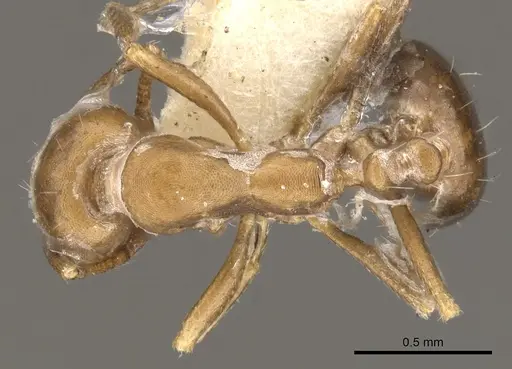
Littérature
Chargement de la carte de répartition...Chargement des produits...