
Formica dirksi
- Nom sci.
- Formica dirksi
- Tribu
- Formicini
- Sous-famille
- Formicinae
- Auteur
- Wing, 1949
- Distribution
- Trouvé dans 0 pays
Introduction
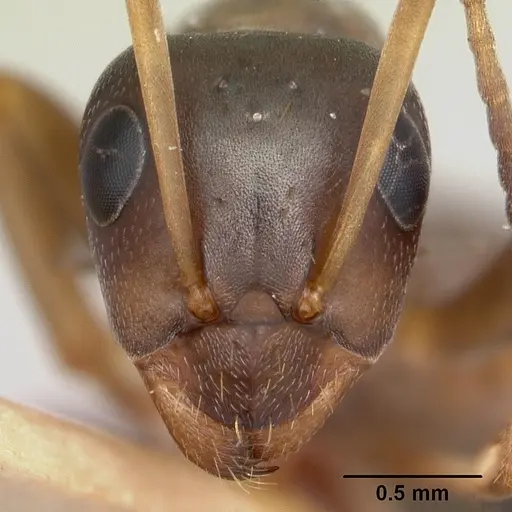
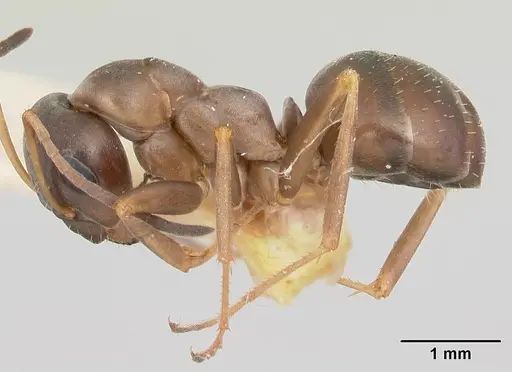
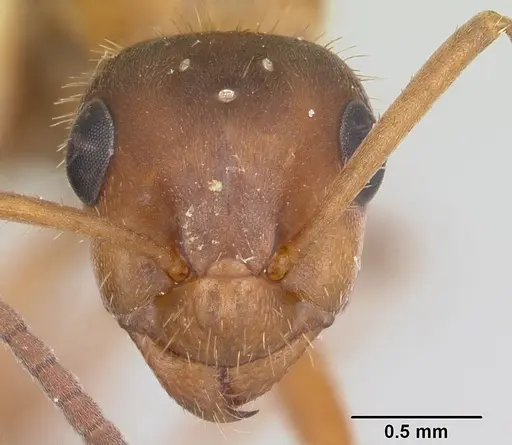
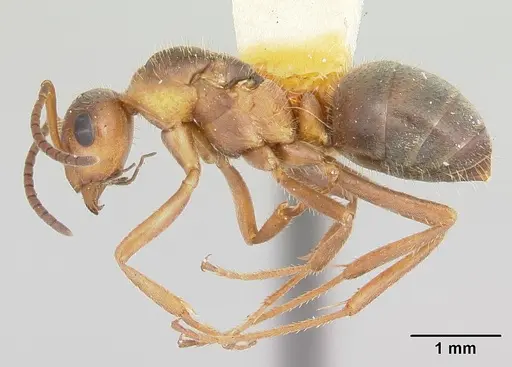
Formica dirksi is one of the rarest ants in North America, documented only from a single queen collected in Daigle, Maine in 1949. This tiny ant measures 5.1mm in total length and belongs to the Formica microgyna species group. It is distinctly darker than related species, with denser white pubescence that has a silvery tinge, and can be identified by its 7-toothed mandible (unlike the 8-toothed typical of similar species). The species is a workerless social parasite - an inquiline - that lives within colonies of its host species. The single known colony was found under loose bark in a partially decayed tree stump at the edge of a coniferous forest clearing. [AntWiki]
Quick Summary
- Difficulty: Not Recommended
- Origin & Habitat: Known only from Daigle, Maine, USA, found in mixed coniferous forest at the edge of a small clearing. Nests under loose bark in decaying wood stumps. [1]
- Colony Type: Workerless social parasite (inquiline), the queen lives permanently within host colonies and relies entirely on host workers for brood care. No worker caste exists. The specific host species is suggested to be Formica subaenescens but this has not been confirmed by natural history data. [2][3]
- Size & Growth:
- Queen: 5.1mm total length [1]
- Worker: No workers exist, workerless species [3]
- Colony: Unknown, only the host colony size was documented as several hundred workers [1]
- Growth: Unknown
- Development: Not applicable, this species produces no workers (As a workerless inquiline, this species cannot produce workers. The queen lays eggs that develop into sexuals (new queens and males) using host worker resources.)
- Antkeeping:
- Temperature: Unknown for this species. Based on related Formica parasites and the Maine habitat, likely tolerates cool to moderate temperatures.
- Humidity: Unknown. The original colony was found in a dry stump in mixed woods, suggests moderate, stable humidity rather than damp conditions.
- Diapause: Likely yes, based on Maine location and relation to other Formica species. Related Formica rufa group ants typically require winter hibernation.
- Nesting: Not suitable for antkeeping. This is a specialized inquiline parasite that requires a host colony to survive. Keeping it would require establishing and maintaining both parasite queen and host colony.
- Behavior: Extremely specialized social parasite. The queen invades host colonies, integrates without being attacked, and uses host workers to raise her own brood. She does not produce workers, only sexuals (new queens and males). The species has never been documented foraging or engaging in normal ant behaviors outside the host colony. Escape risk is minimal since the queen cannot survive independently. [2][3]
- Common Issues: this species cannot be kept without a host colony, it is an obligate social parasite that cannot found a colony independently, no captive breeding has ever been documented, only one wild queen has ever been found, the species may be extinct or extremely rare, it has not been observed since 1949, attempting to keep this species would require both finding a rare parasite queen and establishing a host colony, even if both were obtained, the complex host-parasite relationship makes captive success extremely unlikely, this species is listed as Vulnerable on the IUCN Red List due to its extreme rarity
Why This Species Cannot Be Kept
Formica dirksi is one of the most challenging ants to keep simply because it should NOT be kept. This is a workerless social parasite, an inquiline, that has evolved to live permanently within colonies of its host species. The queen cannot forage, cannot raise her own brood, and cannot survive without host workers. She lays eggs that develop into new sexuals (queens and males), but relies entirely on host workers to feed and care for the larvae. There are no documented cases of this species being successfully kept in captivity. Attempting to do so would require both locating an extremely rare parasite queen AND establishing a healthy host colony, a combination that has never been achieved. [2][3]
The Single Known Specimen
Everything we know about Formica dirksi comes from a single queen collected in Daigle, Maine in 1949 by M.W. Wing. This queen was found inside a very large colony of her host species, which contained several hundred workers and numerous pupae. The nest was located under loose bark in a large, partially decayed, dry tree stump at the edge of a small clearing in mixed (predominantly coniferous) forest. The fact that only one specimen has been collected in over 70 years suggests either extreme rarity, very specialized habitat requirements, or both. Some researchers have suggested the species may be extinct. [1]
Identification and Distinction from Relatives
Formica dirksi belongs to the microgyna species group and can be distinguished from its relatives by several key features. It is larger than typical microgyna (5.1mm total length), has a 7-toothed mandible (compared to 8-toothed in similar species), and possesses distinctly darker coloration with more dense, whiter pubescence that has a silvery tinge. The petiole is lower and more blunt than in related species, and the maxillary palp segments have different proportions. These differences, combined with its eastern Maine distribution (unlike the western distribution of typical F. microgyna), make identification relatively straightforward for trained myrmecologists. [1]
Conservation Status
Formica dirksi is listed as Vulnerable on the IUCN Red List, reflecting its extreme rarity and limited known distribution. The species has not been observed since its original collection in 1949, and there are no recent records from targeted surveys. This could indicate true rarity, difficulty in detecting inquiline parasites (which are often overlooked even when present), or potential extinction. The species' dependence on a specific host adds another layer of vulnerability, if host populations decline, the parasite would be even more threatened. Conservation efforts would benefit from targeted surveys in suitable Maine habitat to determine if the species still exists. [1]
Frequently Asked Questions
Can I keep Formica dirksi as a pet ant?
No. Formica dirksi is a workerless social parasite that cannot survive without a host colony. Even if you could find both species, the complex parasitic relationship has never been successfully replicated in captivity. This species should not be kept by hobbyists. [2][3]
Why is Formica dirksi so rare?
Only one queen has ever been documented, collected in 1949 in Maine. This could reflect true rarity, very specialized habitat requirements (only found in decaying wood stumps in coniferous forest edges), or simply that inquiline parasites are difficult to detect even when present. Some researchers believe the species may be extinct. [1]
Does Formica dirksi have workers?
No. Formica dirksi is a workerless inquiline, it produces no worker caste. The queen lives permanently within the host colony and produces only sexual offspring (new queens and males). She relies entirely on host workers for all brood care and foraging. [3]
What does Formica dirksi eat?
The queen does not forage. As an inquiline parasite, she is fed by host workers through trophallaxis (mouth-to-mouth food sharing). The host workers forage for the entire colony, including the parasite queen and her brood. [2]
Where does Formica dirksi live?
Only known from Daigle, Maine, USA. The single known colony was under loose bark in a partially decayed tree stump in mixed coniferous forest. This is the only documented location. [1]
Is Formica dirksi dangerous?
No. The species has no workers and the queen is tiny (5.1mm). Even if you could obtain one, she would be completely dependent on host workers and unable to defend herself or sting. [1]
Do I need to hibernate Formica dirksi?
Unknown for this specific species, but likely yes based on its Maine distribution and relation to other Formica rufa group ants. However, since this species cannot be kept, this question is moot. [1]
How do I identify Formica dirksi?
It is a tiny (5.1mm) Formica with distinctly darker coloration than relatives, 7-toothed mandibles, dense white pubescence with a silvery tinge, and a lower, blunter petiole. However, finding one is extremely unlikely, only one specimen has ever been documented. [1]
What is the host species for Formica dirksi?
The specific host species has been suggested to be Formica subaenescens, but there is no natural history data confirming this relationship. The single known queen was found inside a colony of what was identified as Formica subaenescens in Maine. [2]
Report an Issue
The current care sheet is based fully on literature. See inconsistencies, or something that's incorrect? Please , it will be resolved after review from an admin. Contributing to the blogs tab also helps providing information, to make us be able to further improve the caresheets. Thank you for your support!
References

Cette fiche d'élevage est sous licence CC BY-SA 4.0 .
Blogs de la communauté
CASENT0105596
Voir sur AntWeb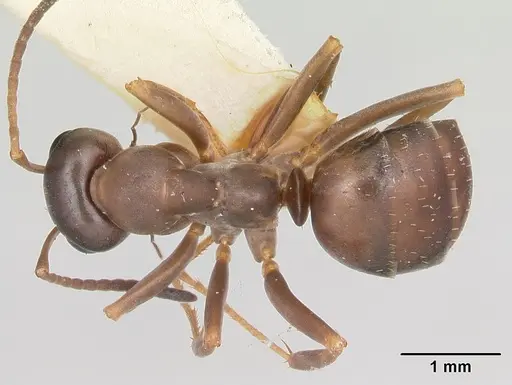
CASENT0105597
Voir sur AntWeb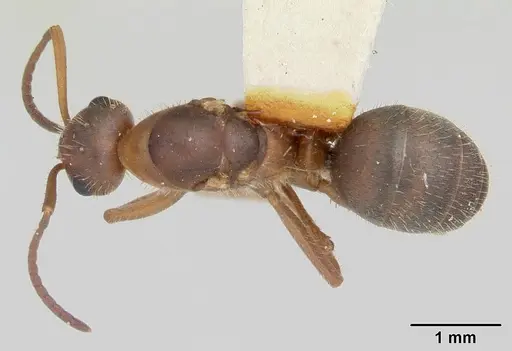
Littérature
Chargement de la carte de répartition...Chargement des produits...