
Dilobocondyla propotriangulata
- Nom sci.
- Dilobocondyla propotriangulata
- Tribu
- Crematogastrini
- Sous-famille
- Myrmicinae
- Auteur
- Bharti & Kumar, 2013
- Distribution
- Trouvé dans 0 pays
Introduction
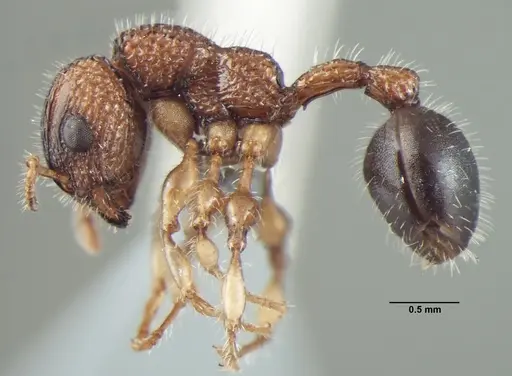
Dilobocondyla propotriangulata is a small Myrmicine ant measuring about 5mm in total length. Workers have a distinctive rusty orange (ferruginous) coloration on the head, mesosoma, petiole and postpetiole, with a dark brown patch on the middle of the head and a brownish-black gaster. The most striking identification feature is the broadly triangular propodeal lobes with rounded tips - unique among Dilobocondyla species which typically have rounded lobes. The body is covered in abundant long stiff whitish hairs, and the surface is relatively shiny due to reduced sculpturing. This species was described in 2013 from Vietnam and represents one of the rarest Dilobocondyla species, with records from Vietnam, Hainan Island (China), and Macao .
Quick Summary
- Difficulty: Expert
- Origin & Habitat: Known from evergreen forest habitats in northern Vietnam (Bac Giang, Yen Tu) at 400m altitude, with newer records from Hainan Province, China (823-1045m elevation) and Macao. This is an arboreal species found in tropical to subtropical forest environments [1][2][3][4].
- Colony Type: Colony structure is unconfirmed. Only a single holotype worker has been described, and no queen or colony-level observations exist in scientific literature.
- Size & Growth:
- Queen: Unknown, no queen has been described
- Worker: 4.99mm total length [1]
- Colony: Unknown, no colony data exists
- Growth: Unknown
- Development: Unconfirmed, no development data exists for this species (Based on typical Myrmicinae patterns, expect 6-10 weeks at optimal temperature, but this is an estimate only)
- Antkeeping:
- Temperature: Likely requires warm conditions similar to other Southeast Asian Myrmicines. Start around 24-28°C and observe colony activity. Being from tropical/subtropical Vietnam and Hainan, they likely prefer warmth and humidity [2].
- Humidity: Likely requires moderate to high humidity given the evergreen forest habitat. Keep nest substrate consistently moist but not waterlogged. Provide a humidity gradient so ants can self-regulate.
- Diapause: Unlikely, being from tropical Vietnam and southern China, they probably do not require a true hibernation. However, slight cooling during winter months may be appropriate if kept in a temperate climate.
- Nesting: An arboreal species, so they likely prefer nests with some vertical space and prefer to nest in rotting wood or hollow twigs in nature. In captivity, a Y-tong (AAC) nest or plaster nest with moisture retention works well. Avoid completely dry setups.
- Behavior: Behavior is unstudied in captivity. Based on genus-level patterns and being a Myrmicine, they are likely relatively docile and not aggressive. Their small size and arboreal nature suggest they may be active foragers. Escape prevention should be moderate, workers at ~5mm are not tiny but can still squeeze through small gaps. Use standard barrier precautions.
- Common Issues: extreme rarity, this species is rarely available in the antkeeping hobby, no captive husbandry data exists, all care recommendations are estimates based on related species, unknown colony structure makes it difficult to know proper founding and social requirements, potential humidity requirements may be higher than typical setups due to evergreen forest origin, very limited information on diet, unknown if they prefer sugars, proteins, or both
Species Discovery and Identification
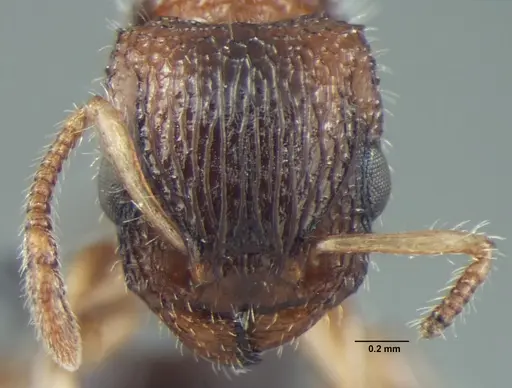
Dilobocondyla propotriangulata was formally described in 2013 by Himender Bharti and Rakesh Kumar from a single worker collected in Yen Tu, Bac Giang province, northern Vietnam. The species name refers to its most distinctive feature: the broadly triangular propodeal lobes (the rear-facing spines on the mesosoma) which have rounded tips, unlike all other known Dilobocondyla species which have rounded lobes. The species can be identified by the combination of 14 strong rugae (ridges) between the frontal carinae at eye level, the ferruginous (rusty orange) body coloration, and the shiny appearance due to reduced surface sculpturing [1].
Distribution and Habitat
This is an extremely rare species with a limited known distribution. The holotype was collected from Yen Tu in Bac Giang, northern Vietnam at 400m elevation in evergreen forest. Subsequent records have expanded the known range: one record from Hainan Province, China (from specimens collected in 1983 at Tian Chi and more recently from Bawangling Nature Reserve at 823-1045m), and a 2021 record from Macao representing the first record in China proper. The Macao specimens were collected at arboreal heights in two different sites, confirming this species is arboreal (tree-dwelling) in nature [2][3].
Appearance and Morphology
Workers measure approximately 5mm in total length. The head is almost as long as broad, slightly broader at the back than the front, with acutely dentate (tooth-like) posterior corners that point outward. The most distinctive feature is the broadly triangular propodeal lobes with rounded apices, this is the character that gives the species its name. The body is covered with abundant, long, stiff, erect whitish hairs. Color pattern: head, mesosoma, petiole and postpetiole are ferruginous (rusty orange), with the middle of the head being dark brown. The mandibles, antennae and legs are light yellowish brown, while the gaster (abdomen) is brownish black. The body surface is relatively shiny due to the reduced interrugal sculpturing [1].
Care Recommendations
Since this species has never been kept in captivity (as far as documented), all care recommendations are estimates based on the species likely requirements. Being an arboreal species from tropical Vietnam and southern China, they likely need warm and humid conditions. A Y-tong (AAC) nest or plaster nest with good moisture retention is recommended. Keep temperatures around 24-28°C initially and observe colony behavior, if workers cluster near a heat source, increase slightly, if they avoid it, reduce temperature. Maintain moderate to high humidity in the nest chamber. For feeding, offer a mix of sugar sources (honey water, sugar water) and protein (small insects like fruit flies, pinhead crickets, or mealworms). Since nothing is known about their specific dietary needs, variety is key. This species is extremely rare in the hobby and should be considered an expert-level species due to the complete lack of captive husbandry data [2][3].
Why This Species is Special
Dilobocondyla propotriangulata represents one of the rarest and most recently described Dilobocondyla species available in the antkeeping hobby. Its discovery highlights how little we still know about ant diversity in Southeast Asia, even in relatively well-studied regions like Vietnam. The species unique propodeal morphology (the triangular lobes) makes it a fascinating subject for ant morphology enthusiasts. For advanced antkeepers, the challenge of establishing this species in captivity represents a genuine frontier, whatever husbandry methods work for this species will be discoveries made by the hobby itself, not inherited knowledge. This makes it an exciting but risky choice, suitable only for those with extensive experience keeping difficult Myrmicines and who accept that they may be pioneering captive care for this species [1].
Frequently Asked Questions
Is Dilobocondyla propotriangulata available in the antkeeping hobby?
This species is extremely rare in the antkeeping hobby. It was only described in 2013 and has a very limited known distribution (Vietnam, Hainan, Macao). Unless you find a specialized breeder working with this specific species, it is essentially unavailable.
How do I care for Dilobocondyla propotriangulata?
Care recommendations are estimates only since no captive husbandry data exists. Based on its origin in tropical Vietnam and southern China, provide warm temperatures (24-28°C), moderate to high humidity, and an arboreal-appropriate nest like Y-tong or plaster. Feed a varied diet of sugars and proteins. This species should be considered expert-level due to the complete lack of documented captive care [2][3].
What does Dilobocondyla propotriangulata look like?
Workers are about 5mm long with a distinctive rusty orange (ferruginous) head and mesosoma, dark brown patch on the head, and brownish-black abdomen. The most unique feature is the broadly triangular propodeal lobes (rear spines) with rounded tips, unlike other Dilobocondyla species. The body is covered in long stiff whitish hairs and has a relatively shiny appearance.
Where is Dilobocondyla propotriangulata found?
This species is known from very limited locations: northern Vietnam (Bac Giang, Yen Tu at 400m), Hainan Province China (823-1045m elevation), and Macao. All records are from tropical to subtropical evergreen forest environments.
Is Dilobocondyla propotriangulata a good species for beginners?
No. This species is not recommended for beginners. It is extremely rare, has never been documented in captive husbandry, and all care recommendations are educated guesses based on related species. Only experienced antkeepers willing to experiment should consider this species [1].
How big do Dilobocondyla propotriangulata colonies get?
Unknown. No colony size data exists in scientific literature. Based on typical Myrmicinae patterns and the limited records, colonies are likely moderate in size (possibly dozens to a few hundred workers), but this is purely speculative.
Does Dilobocondyla propotriangulata need hibernation?
Unlikely. Being from tropical Vietnam and southern China, they probably do not require a true hibernation period. However, slight seasonal cooling may be appropriate if kept in a temperate climate, but this is unconfirmed [2].
What makes Dilobocondyla propotriangulata different from other Dilobocondyla?
The most distinctive feature is the broadly triangular propodeal lobes with rounded apices, all other Dilobocondyla species have rounded lobes. It also has 14 strong rugae (ridges) between the frontal carinae at eye level, and a ferruginous (rusty orange) body coloration that distinguishes it from related species.
Can I keep multiple Dilobocondyla propotriangulata queens together?
Unknown. No data exists on colony structure for this species. The colony type (single queen vs multiple queens) has not been documented. Without any captive experience or field observations on colony structure, combining queens is not recommended.
Is Dilobocondyla propotriangulata aggressive or does it sting?
Unknown. No behavioral observations exist for this species in captivity. Based on typical Myrmicine behavior and the genus, they are likely relatively docile and not particularly aggressive. Most Myrmicines can sting but are typically too small to cause significant discomfort to humans.
Report an Issue
The current care sheet is based fully on literature. See inconsistencies, or something that's incorrect? Please , it will be resolved after review from an admin. Contributing to the blogs tab also helps providing information, to make us be able to further improve the caresheets. Thank you for your support!
References

Cette fiche d'élevage est sous licence CC BY-SA 4.0 .
Blogs de la communauté
ANTWEB1008029
Voir sur AntWeb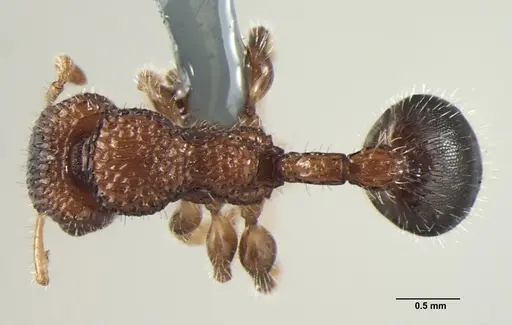
Littérature
Chargement de la carte de répartition...Chargement des produits...