
Basiceros browni
- Nom sci.
- Basiceros browni
- Tribu
- Attini
- Sous-famille
- Myrmicinae
- Auteur
- Probst & Brandão, 2022
- Distribution
- Trouvé dans 0 pays
Introduction
Basiceros browni is a recently described dirt ant from the tropical forests of Ecuador. Workers are relatively large for the genus at 6.55-7.59 mm, with a distinctive light brown to dark brown coloration . These ants belong to the manni species-group and are known for their remarkable cryptobiotic lifestyle - their bodies are covered in specialized hairs that adhere soil and litter particles, effectively camouflaging them as moving dirt fragments . This camouflage is so effective that workers collected inside rotting logs lacked the thick layer of particle coverage seen in older foragers outside the nest . The genus Basiceros is part of the Rhopalothrix genus-group within the Attini tribe, which includes fungus-growing ants, though Basiceros species are believed to be predatory rather than fungicultural . The queen (gyne), male, and larvae have never been documented .
Quick Summary
- Difficulty: Expert
- Origin & Habitat: Ecuador (Pichincha and Los Ríos provinces). Found in tropical forest habitats at the Río Palenque Research Station and Otongachi. Collections have come from rotting logs at forest trail edges and Winkler samples of leaf litter [1][2].
- Colony Type: Unknown, the queen (gyne), male, and larvae have never been documented. Based on related Basiceros species, colonies are likely small, but colony structure is unconfirmed.
- Size & Growth:
- Queen: Unknown, gyne has not been described [1]
- Worker: 6.55-7.59 mm [1]
- Colony: Likely small colonies based on genus patterns, related species have small colony sizes [2]
- Growth: Unknown
- Development: Unknown, no development data exists for this species (Development timeline has not been studied. Related Basiceros species suggest several months but this is purely speculative.)
- Antkeeping:
- Temperature: Unknown for this species. Start with 22-26°C as a baseline, typical for tropical forest ants. Monitor colony activity and adjust accordingly.
- Humidity: Based on their forest floor habitat, high humidity is likely required. Keep substrate consistently moist but not waterlogged [1].
- Diapause: Unknown, as a tropical species from Ecuador, they likely do not require formal hibernation but may have seasonal activity patterns related to wet/dry seasons.
- Nesting: In nature, they occupy rotting logs, soil cavities, and leaf litter [2]. They do not excavate their own nests. For captivity, a naturalistic setup with rotting wood pieces, moist soil, and leaf litter is recommended. A Y-tong or plaster nest with added organic debris could be suitable, but this has not been tested.
- Behavior: Virtually unknown due to the species' recent description and rarity. Based on genus patterns, they are likely cryptic and slow-moving, relying on camouflage rather than aggression. Workers were collected foraging at night in one instance. Their small size and cryptic habits suggest they are not escape artists, but excellent escape prevention is still recommended due to their specialized habitat requirements. They belong to a subfamily (Myrmicinae) that uses stinging as a primary defense, and the presence of a functional sting is confirmed in the morphology [1].
- Common Issues: almost no biological data exists, keepers will be pioneering captive husbandry, queen and colony founding behavior completely unknown, wild-caught colonies may be extremely difficult to locate and obtain, small colony size means colonies are fragile and sensitive to disturbance, specialized habitat requirements make captive setup challenging
Discovery and Taxonomy
Basiceros browni was only described in 2022 by Probst and Brandão, making it one of the most recently described ant species in the hobby. It was named in honor of Dr. William (Bill) Brown Jr., a renowned ant taxonomist and expert on basicerotine ants [1]. The species is known from only two collection events, the type series collected in July 1978 at the Río Palenque Research Station in Ecuador's Los Ríos province, and a paratype collected in 2009 at Otongachi in Pichincha province [1]. The original collection yielded four workers from a rotten log at the edge of a forest trail, with one additional worker collected the following day foraging about three meters from the original location, suggesting it belonged to the same colony [1]. The nest was never located. This extreme rarity and limited distribution make Basiceros browni one of the least-known ant species in captivity.
Identification and Morphology
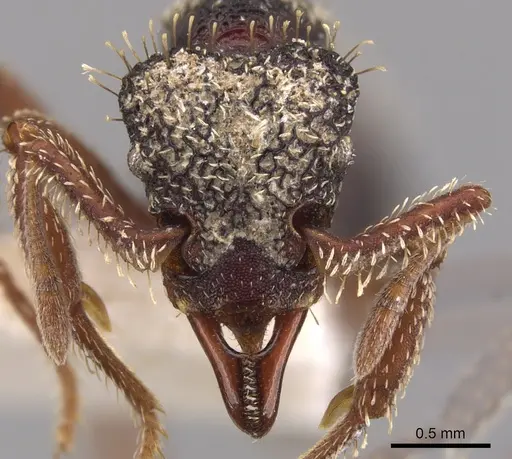
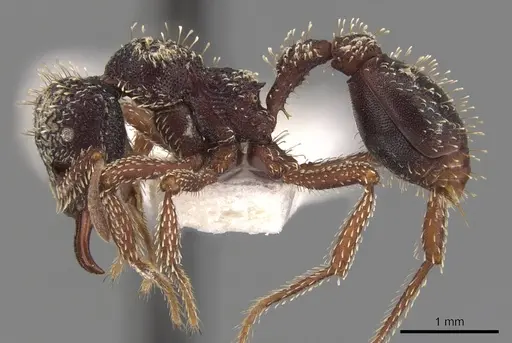
Basiceros browni workers are comparatively large for the genus, measuring 6.55-7.59 mm in total length [1]. They can be identified by several distinctive features: a tubuliform (tube-shaped) petiole without a projected node, long and pedunculate (stalk-like) mandibles with 12 teeth on each masticatory margin, a wide clypeomandibular space, and a unique bilobed labrum with lobes separated by a narrow cleft [1]. Their body is densely sculptured with rugose to areolar-rugose texture. The pilosity consists of two layers: a basal layer of flat, spatulate to subplumose decumbent curved hairs, and another layer of long erect and clavate hairs [1]. Coloration ranges from light brown to dark brown, with lighter appendages. The most remarkable feature is their specialized hairs that actively adhere soil and litter particles, creating effective camouflage, this is why they are called 'dirt ants' [2].
Natural History and Ecology
Basiceros browni is part of the manni species-group within Basiceros and shares the genus' cryptobiotic lifestyle [2]. These ants do not excavate their own nests but instead occupy pre-existing cavities in rotting wood, soil, and leaf litter [2]. The workers collected inside rotting logs lacked the thick layer of particle camouflage observed in older individuals found outside the nest, suggesting younger workers remain inside while older foragers venture out and accumulate debris [2]. The genus is believed to be predatory based on related species, though specific prey preferences for Basiceros browni are unknown [2]. The presence of a functional sting is noted in the species description [1]. The entire genus Basiceros is distributed from Honduras to Southern Brazil in the Neotropical region, though individual species like Basiceros browni have extremely limited ranges [2].
Housing and Captive Care
Since Basiceros browni has never been kept in captivity (as far as documented), all care recommendations must be inferred from related species and natural history. Provide a naturalistic setup with moist substrate, rotting wood pieces, and leaf litter material to mimic their forest floor habitat [2]. They do not excavate nests, so they need pre-existing cavities or dark, humid spaces to occupy. A plaster or Y-tong nest with added organic debris (small pieces of rotting wood, leaf litter) could be a starting point, but this is unproven. Maintain high humidity (likely 70-85%) and warm temperatures (22-26°C), monitoring the colony's response. Since they are believed to be predatory, offer small live prey like springtails, fruit flies, and other micro-arthropods. Sugar sources may or may not be accepted, experiment cautiously. The cryptic nature of these ants means they may be inactive for long periods, which is normal behavior.
Challenges and Limitations
Keepers considering Basiceros browni must understand they are attempting to keep one of the least-known ant species in the world. The queen, males, larvae, colony founding behavior, development timeline, and basic biology remain completely undocumented [1]. This species is best suited for advanced antkeepers who are comfortable with experimental husbandry and document their observations carefully. Obtaining colonies may be nearly impossible since the species is known from only a handful of specimens collected decades apart in Ecuador. Any captive colonies would likely be from the very rare wild collections or potentially from breeding programs that may develop. The small colony size typical of the genus means colonies are fragile and sensitive to disturbance. Success with this species would represent a genuine contribution to antkeeping knowledge.
Frequently Asked Questions
Is Basiceros browni available for purchase?
No. Basiceros browni is one of the rarest ant species in existence, known from only five worker specimens collected in two events over 30 years apart. There are no documented captive breeding programs, and the species has never been observed in the antkeeping hobby. Obtaining this species would require extraordinary circumstances.
How big do Basiceros browni workers get?
Workers measure 6.55-7.59 mm in total length, which is relatively large for the Basiceros genus [1].
What do Basiceros browni eat?
Their exact diet is unknown, but the genus is believed to be predatory [2]. Based on related species, they likely hunt small soil micro-arthropods. In captivity, you would need to offer small live prey like springtails, micro mites, and fruit flies. Sugar acceptance is uncertain.
Do Basiceros browni queens have wings?
Unknown, the gyne (queen) has never been described or documented [1].
How do Basiceros browni form colonies?
Completely unknown. The colony founding behavior, whether claustral or semi-claustral, has never been documented. The queen, male, and larvae remain unknown to science [1].
What is the ideal temperature for Basiceros browni?
Not specifically studied. Based on their tropical Ecuador habitat, aim for 22-26°C. Start in the middle of this range and adjust based on colony activity if you ever obtain a colony.
Do Basiceros browni need hibernation?
Unknown, as a tropical species from Ecuador, they likely do not require formal hibernation but may have seasonal activity patterns related to wet/dry seasons in their native habitat.
Are Basiceros browni aggressive?
Unknown. Based on genus patterns and their cryptobiotic lifestyle, they are likely docile and rely on camouflage rather than aggression. They possess a functional sting [1] but would rather hide than fight.
How long do Basiceros browni live?
Unknown, no life history data exists for this species. Related Basiceros species may live several years as established colonies, but this is entirely speculative.
Can beginners keep Basiceros browni?
No. This species is absolutely not suitable for beginners. It is one of the least-known ant species in the world with zero captive husbandry data. Even expert antkeepers would be pioneering completely new care techniques. The difficulty level is Expert solely due to the complete absence of biological information.
Report an Issue
The current care sheet is based fully on literature. See inconsistencies, or something that's incorrect? Please , it will be resolved after review from an admin. Contributing to the blogs tab also helps providing information, to make us be able to further improve the caresheets. Thank you for your support!
References

Cette fiche d'élevage est sous licence CC BY-SA 4.0 .
Blogs de la communauté
CASENT0900941
Voir sur AntWeb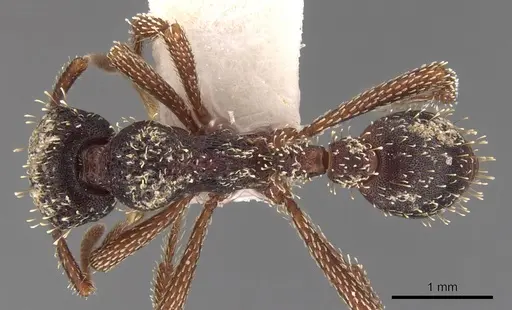
Littérature
Chargement de la carte de répartition...Chargement des produits...