
Acanthomyrmex malikuli
- Nom sci.
- Acanthomyrmex malikuli
- Tribu
- Crematogastrini
- Sous-famille
- Myrmicinae
- Auteur
- Jaitrong & Asanok, 2019
- Distribution
- Trouvé dans 0 pays
Introduction
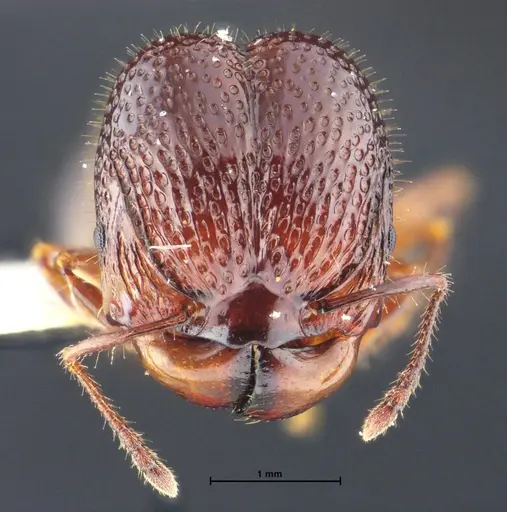
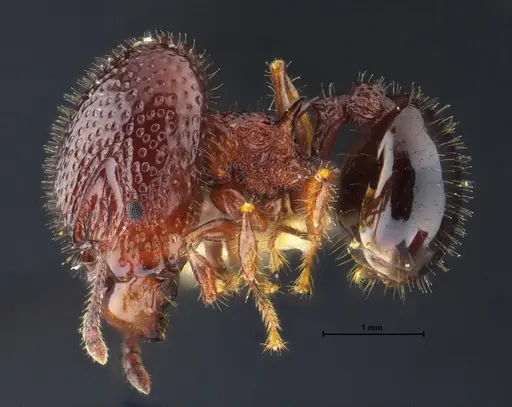
Acanthomyrmex malikuli is a dimorphic ant from the mountains of western Thailand. Major workers have massive, wrinkled heads with a deep central furrow running from front to back, while minor workers are smaller with sharp spines on their shoulders. Both castes are dark reddish-brown to black, with the abdomen (gaster) often darker than the rest of the body. They nest in preformed cavities inside hard dead wood on the forest floor at elevations of 800-1000 meters . What makes this species unusual is that it produces two types of queens: normal winged dealate queens and wingless ergatoid queens that look almost identical to major workers. These wingless queens serve as backup reproductives if the main queen dies, allowing the colony to continue . Described only in 2019,this species remains rare in captivity and challenging to keep due to limited knowledge of their biology.
Quick Summary
- Difficulty: Expert
- Origin & Habitat: Thailand (Tak and Uthai Thani Provinces), lower tropical mountain forest at 800-1000m elevation [1][2]
- Colony Type: Single-queen colonies with ergatoid replacement reproductives documented [1]
- Size & Growth:
- Queen: Approximately 3.5-4mm total length (inferred from head measurements) [1]
- Worker: Major workers ~4-5mm, minor workers ~1.5-2mm total length (inferred from head measurements) [1]
- Colony: Unknown, colony size data unavailable
- Growth: Unknown
- Development: Unknown (Development time unconfirmed for this species)
- Antkeeping:
- Temperature: 22-26°C stable, tropical mountain species that needs consistent warmth without overheating [1]
- Humidity: High humidity, keep nest substrate moist but not waterlogged, similar to forest floor conditions [1]
- Diapause: No, tropical species that remains active year-round [1]
- Nesting: Preformed cavities in hard dead wood, use Y-tong (AAC) nests or naturalistic setups with tight, enclosed chambers [1]
- Behavior: Slow-moving and cryptic, majors likely serve as soldiers while smaller minors forage. Minor workers are tiny and can escape through small gaps, so escape prevention must be excellent [1]
- Common Issues: extreme rarity in captivity means established care protocols do not exist., specific nesting requirements (hard wood cavities) can be difficult to replicate properly., minor workers are tiny and can escape through the smallest gaps in mesh or lids., lack of confirmed feeding guidelines may lead to colony starvation if not carefully observed.
Nest Preferences
In nature, Acanthomyrmex malikuli nests in preformed cavities in hard dead wood lying on the forest floor [1]. This means you need to provide tight, enclosed chambers rather than open spaces. Y-tong (AAC) nests with narrow tunnels work well, as do naturalistic setups with pieces of hard wood containing small cavities. The nest should feel secure and dark, with chambers sized to their small workers. Avoid tall, open spaces that leave them exposed.
Temperature and Care
These ants come from tropical mountain forests at 800-1000 meters elevation, where temperatures are warm but not extreme [1]. Keep your colony at 22-26°C with minimal fluctuation. A heating cable on one side of the nest can help maintain this, but avoid overheating as mountain species often tolerate cool nights. They do not require hibernation (diapause) and should remain active year-round.
Feeding and Diet
The diet of Acanthomyrmex malikuli has not been directly studied. Based on patterns from related species in the genus, they likely hunt small soft-bodied insects and collect sugary liquids like honeydew. In captivity, offer small live prey such as springtails, fruit flies, or tiny crickets. Provide sugar water or honey as a carbohydrate source. Watch carefully to see what they accept, as their exact preferences are unknown.
Behavior and Temperament
This species shows strong worker dimorphism. Major workers have massive heads with wrinkled surfaces and likely serve as soldiers for defense and food processing. Minor workers are smaller, more numerous, and have spines on their thorax (shoulders) [1]. Given their wood-nesting habits, they are likely cryptic and slow-moving, preferring to hide in tight spaces rather than forage openly in bright areas.
Colony Founding
Founding behavior is unconfirmed for this species. Queens should be monitored carefully and provided with both protein and sugar sources. The presence of ergatoid queens in established colonies suggests the colony can maintain reproductives without a winged queen, but the initial founding process has not been observed.
Frequently Asked Questions
Can I keep Acanthomyrmex malikuli in a test tube?
Yes for the founding stage, but move them to a wood-based nest with tight cavities once workers arrive. They naturally live in hard wood cavities and may stress in simple test tubes long-term [1].
How long until Acanthomyrmex malikuli gets first workers?
Unknown. Development time has not been documented for this species.
Do Acanthomyrmex malikuli need hibernation?
No. They come from tropical Thailand and remain active year-round without a winter rest period [1].
Can I keep multiple Acanthomyrmex malikuli queens together?
Not recommended. While the species produces ergatoid (wingless) replacement queens naturally, combining unrelated founding queens has not been documented and will likely result in fighting.
What do Acanthomyrmex malikuli eat?
Not directly studied. Likely small insects and sugary liquids based on genus patterns. Offer small live prey like springtails and fruit flies, plus sugar water or honey.
Are Acanthomyrmex malikuli good for beginners?
No. They are extremely rare, only described in 2019,and lack established care guidelines. Only expert keepers with experience in poorly documented species should attempt keeping them [1].
How big do Acanthomyrmex malikuli colonies get?
Unknown. Colony size data is unavailable for this species.
What is an ergatoid queen in Acanthomyrmex malikuli?
Ergatoid queens are wingless reproductive ants that look like workers. In this species, they resemble major workers with similar wrinkled heads, and serve as backup reproductives if the main winged queen dies [1].
Why do some Acanthomyrmex malikuli workers look so different?
They are strongly dimorphic. Major workers have massive, wrinkled heads for defense and processing food, while minor workers are smaller with spiny shoulders and do most of the foraging [1].
Report an Issue
The current care sheet is based fully on literature. See inconsistencies, or something that's incorrect? Please , it will be resolved after review from an admin. Contributing to the blogs tab also helps providing information, to make us be able to further improve the caresheets. Thank you for your support!
References

Cette fiche d'élevage est sous licence CC BY-SA 4.0 .
Blogs de la communauté
THNHM-I-00124
Voir sur AntWeb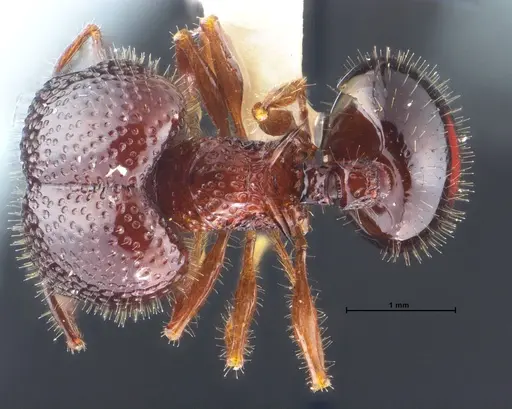
Littérature
Chargement de la carte de répartition...Chargement des produits...