
Strongylognathus koreanus
- Nom. cient.
- Strongylognathus koreanus
- Tribu
- Crematogastrini
- Subfamilia
- Myrmicinae
- Autor
- Pisarski, 1966
- Distribución
- Encontrado en 0 países
Introducción
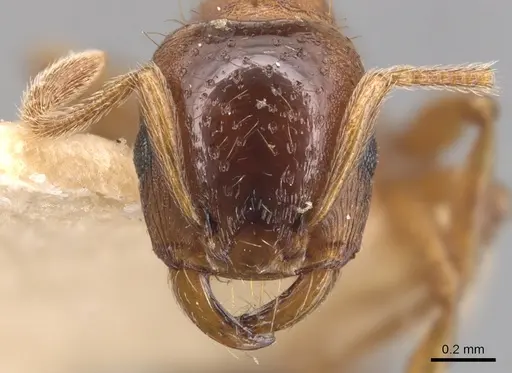
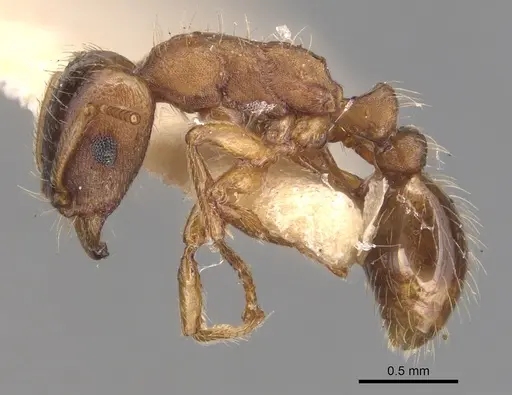
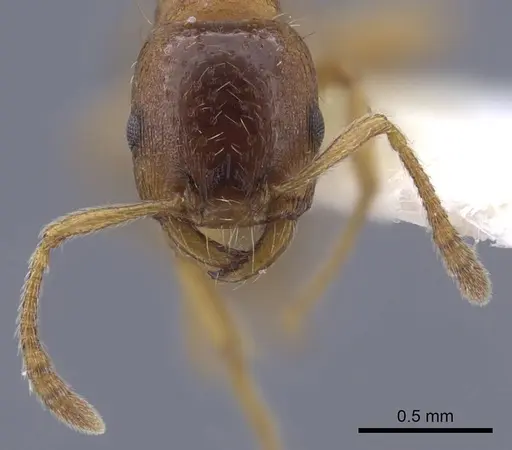
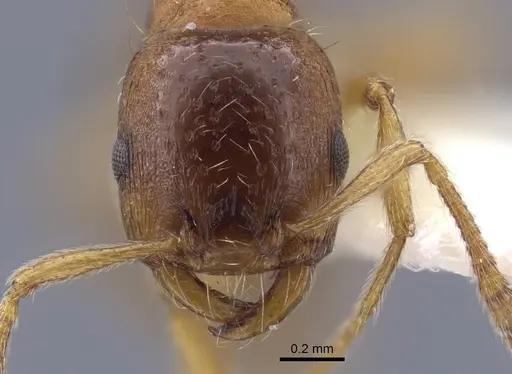
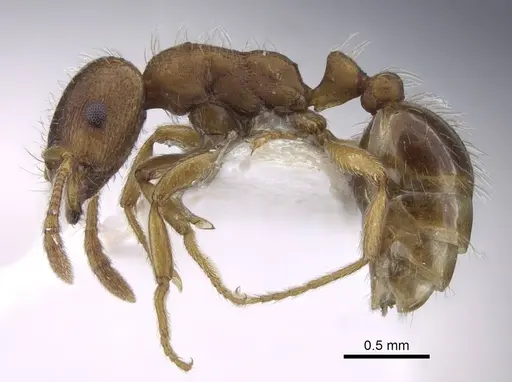
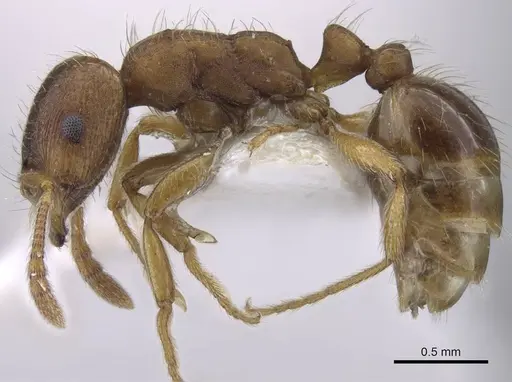
Strongylognathus koreanus is a tiny, rare social parasite in the Myrmicinae subfamily. Workers are 3-3.4 mm and have a yellowish-brown to reddish-brown body, with the head and gaster usually darker . The body is covered in relatively abundant yellow standing hairs, and the head is shiny with fine longitudinal striae on the sides and front . This ant belongs to the Strongylognathus huberi species-group and is known from only a handful of locations: the Korean Peninsula (type locality Myohyang Mountains), Japan (two records on Honshu), and northern China (Shaanxi Province) . It is an inquiline social parasite, living exclusively inside nests of Tetramorium tsushimae . Its extreme rarity and specialized parasitic lifestyle make it one of the most unusual ants in the region .
Quick Summary
- Difficulty: Expert
- Origin & Habitat: Eastern Asia, found in Korea, Japan (Honshu), and northern China (Shaanxi). Inhabits nests of its host species Tetramorium tsushimae in forested areas [2][1].
- Colony Type: Social parasite, lives exclusively within Tetramorium tsushimae colonies. The species has never been found in independent colonies and cannot establish without a host [2][1].
- Size & Growth:
- Queen: Unconfirmed, queens have not been described in detail [2]
- Worker: 3-3.4 mm [1][2]
- Colony: Unknown, likely small given parasitic lifestyle and extreme rarity
- Growth: Unknown
- Development: Unconfirmed, development tied to host colony (Development is entirely dependent on the host colony's resources and workers)
- Antkeeping:
- Temperature: Unknown, no captive studies exist. Based on host species Tetramorium tsushimae, likely tolerates moderate temperatures (18-25°C). No specific data [2].
- Humidity: Unknown, no captive data. Likely similar to host species requirements.
- Diapause: Unknown, likely similar to host species if kept in captivity.
- Nesting: Must be kept WITH host colony (Tetramorium tsushimae). This is not optional, the species cannot survive independently. Requires a setup that allows interaction between parasite and host [2][1].
- Behavior: As an inquiline social parasite, Strongylognathus koreanus is completely dependent on its host Tetramorium tsushimae. The parasite queen invades the host nest, integrates with the colony, and uses host workers to raise her brood. Workers are tiny (3 mm) and likely foraged alongside host workers. No specific defense or aggression data is available, based on its tribe (Crematogastrini), the primary defense mechanism is smearing venom, but this has not been confirmed for this species. Escape risk is low given their tiny size and dependence on host [2].
- Common Issues: obtaining host colony, you must first establish a healthy Tetramorium tsushimae colony [2]., establishing the parasite, introducing Strongylognathus koreanus to a host colony is extremely difficult and rarely successful., extreme rarity, this species is essentially unavailable in the antkeeping hobby due to its parasitic nature [2][5]., colony collapse, without a host colony, the parasite cannot survive., no captive breeding success, there are no documented cases of successful captive propagation of this species [2][5].
Understanding the Parasitic Lifestyle
Strongylognathus koreanus is an inquiline social parasite, meaning it lives permanently inside the nest of another ant species, specifically Tetramorium tsushimae [2][1]. This is fundamentally different from typical ant keeping, where you maintain an independent colony. The parasite queen cannot found her own colony, she must find and infiltrate an existing Tetramorium tsushimae nest. Once established, she uses the host workers to care for her brood, essentially borrowing the host colony's workforce. This relationship is obligate, S. koreanus cannot survive without a host [2]. The genus Strongylognathus contains several such social parasites, making them fascinating but extremely challenging to keep. In the wild, this species has only been collected from host nests, confirming its absolute dependence [2][1].
The Host Species: Tetramorium tsushimae
If you were to attempt keeping Strongylognathus koreanus (which is not recommended and the species is essentially unavailable), you would first need to establish a healthy Tetramorium tsushimae colony. Tetramorium tsushimae is a small, reddish-brown ant native to East Asia, commonly found in forested areas across Japan, Korea, and eastern China. Workers are around 3-4 mm and form moderate colonies typically with multiple queens (polygyne). They are generalist foragers, eating small insects, honeydew, and seeds. This species is relatively common in its range and is the confirmed host for Strongylognathus koreanus in both Japan and China [2][1]. Keeping Tetramorium tsushimae successfully is a prerequisite for any attempt with the parasite, though obtaining Strongylognathus koreanus itself is effectively impossible given its extreme rarity.
Why This Species Is Not Suitable for Keeping
Strongylognathus koreanus is one of the least suitable species for ant keeping for several critical reasons. First, it is extraordinarily rare, documented from only a handful of specimens in scientific literature spanning decades [2]. Second, being an obligate social parasite, it cannot be kept as an independent colony, you must maintain both host and parasite simultaneously, and the introduction success rate is essentially unknown but likely extremely low. Third, there is no captive breeding success documented anywhere in the scientific literature or hobby community. Fourth, the species has never been observed in the hobby trade due to its parasitic nature and extreme scarcity. For these reasons, antkeepers interested in unusual species should look at other, more accessible options. Even experienced antkeepers specializing in social parasites work with species that have documented captive success, not extremely rare field parasites [2][5].
Distribution and Rarity
Strongylognathus koreanus has one of the most restricted and sparse distributions of any ant species in the region. The species was originally described from the Korean Peninsula (Myohyang Mountains) [4], with only two records from Japan: Masutomi-onsen in Yamanashi Prefecture (1938) and Washu-zan in Okayama Prefecture (1976) [2]. In China, it has been recorded from Huangling County in Shaanxi Province [4][6]. Despite being known since 1938,fewer than 100 specimens have ever been collected. This extreme rarity makes any captive collection or trade virtually impossible. The species is considered highly threatened in its limited range, and any collection would be scientifically irresponsible given its conservation status [2][5].
Taxonomy and Identification
Strongylognathus koreanus belongs to the Strongylognathus huberi species-group within the genus Strongylognathus (Myrmicinae: Crematogastrini) [3]. Workers are small (3-3.4 mm) with a distinctive yellowish-brown to reddish-brown coloration, the head and gaster typically darker than the mesosoma [1]. Key identification features include: relatively abundant yellow standing hairs on the body (especially on the occipital margin), a shiny head with fine longitudinal striae on the sides and front half, a triangular petiolar node, and the characteristic sickle-shaped mandibles typical of the genus [1][2]. The species was long confused with other Strongylognathus species in Japan before being correctly identified by Terayama in 1988 as Strongylognathus koreanus, previously known only from Korea [2].
Frequently Asked Questions
Can I keep Strongylognathus koreanus as a pet ant?
No. This species is essentially unavailable in the antkeeping hobby due to its extreme rarity, obligate parasitic lifestyle, and the fact that it has never been documented in captive breeding. The species has been collected only a handful of times in the wild across decades of research. Additionally, as an obligate social parasite of Tetramorium tsushimae, it cannot survive without a host colony, making captive maintenance extraordinarily difficult even if you could obtain specimens [2][5].
What does Strongylognathus koreanus eat?
In the wild, Strongylognathus koreanus is fed by host Tetramorium tsushimae workers. The specific diet within the host nest is not documented, but it would likely consist of trophallaxis (food sharing from host workers), host brood, or food the host workers bring back to the nest. In captivity, even if you had both species, no feeding protocols exist. This is not a species that can be fed independently [2].
How do I find Strongylognathus koreanus in the wild?
Finding Strongylognathus koreanus would require locating Tetramorium tsushimae nests in its known range (Korea, Japan Honshu, northern China Shaanxi) and then searching meticulously through the host colony, and even then, the parasite would be extremely rare. Given its extreme rarity (known from only a handful of specimens), the chances of finding it are minuscule. Additionally, given its conservation status and scientific value, collection would be ethically questionable. This species is best appreciated through scientific literature rather than field collection [2][5].
Is Strongylognathus koreanus dangerous?
No. As a tiny (3 mm) social parasite living within host colonies, Strongylognathus koreanus poses no threat to humans. It has no specific defense mechanisms documented, and being dependent on a host colony, it would be unable to sting or otherwise harm a human even if handled. The genus Strongylognathus is not known for aggressive behavior [2].
Why is Strongylognathus koreanus so rare?
Strongylognathus koreanus is rare because it is an obligate social parasite with extremely specific requirements. It can only live within Tetramorium tsushimae colonies, and even within those, it likely exists in very low numbers. Social parasites by nature are always rarer than their hosts because they depend entirely on host colony resources. Additionally, the species has a very limited geographic range (Korea, Japan, northern China), and within that range, it has only been found in a few scattered locations across nearly a century of ant research [2][5].
Do Strongylognathus koreanus queens found colonies alone?
No. As an inquiline social parasite, Strongylognathus koreanus cannot found a colony independently. The queen must invade an existing Tetramorium tsushimae nest, survive the host workers' initial aggression, and then integrate into the colony to lay her eggs. This is fundamentally different from claustral founding (where a queen seals herself in and raises workers alone) or even temporary parasitic founding. The species is obligately dependent on a host from the moment the queen leaves her natal nest [2][1].
What is the difference between Strongylognathus and other social parasites like Anergetus?
Strongylognathus species are inquiline social parasites, they live permanently within the host colony and are integrated into the social structure. This is different from temporary social parasites (like some Lasius species) that invade a colony, kill the host queen, and then leave once their own workers emerge. Strongylognathus koreanus specifically is an obligate inquiline that has never been found outside a Tetramorium host nest. The genus is part of the tribe Crematogastrini and contains several such specialized parasites, making them fascinating from a biological perspective but extremely challenging to study, let alone keep [2][1].
Are there any similar ants that are easier to keep?
Yes. If you're interested in social parasites or unusual ant biology, consider starting with more accessible species. Strongylognathus species are extremely difficult, but other Myrmicinae with interesting biology are readily available. Alternatively, if you're specifically interested in parasitic ants, research species that have documented captive success, though even those are challenging. For most antkeepers, starting with species like Lasius niger, Camponotus species, or even other Myrmicinae like Tetramorium species is recommended before attempting any parasitic species [2].
Does Strongylognathus koreanus need hibernation?
Unknown. No captive observations exist for this species. However, since it lives within Tetramorium tsushimae colonies, and Tetramorium tsushimae is a temperate species found in regions with cold winters, it likely experiences seasonal cold periods. The host species likely undergoes some form of dormancy, and any parasite would be subject to the same conditions within the host nest. However, this is entirely speculative given the complete lack of captive data [2].
How big do Strongylognathus koreanus colonies get?
Unknown. No colony size data exists in the scientific literature. As a social parasite within host colonies, even if you found the species, you would not have an Strongylognathus koreanus colony, you would have a Tetramorium tsushimae colony with a few Strongylognathus koreanus individuals within it. The parasite likely exists in very low numbers relative to the host, perhaps just a few individuals. This is typical for inquiline parasites, which do not reach the large colony sizes of their hosts [2][5].
Report an Issue
The current care sheet is based fully on literature. See inconsistencies, or something that's incorrect? Please , it will be resolved after review from an admin. Contributing to the blogs tab also helps providing information, to make us be able to further improve the caresheets. Thank you for your support!
References

Esta ficha de cuidados está bajo licencia CC BY-SA 4.0 .
Blogs de la comunidad
CASENT0904871
Ver en AntWeb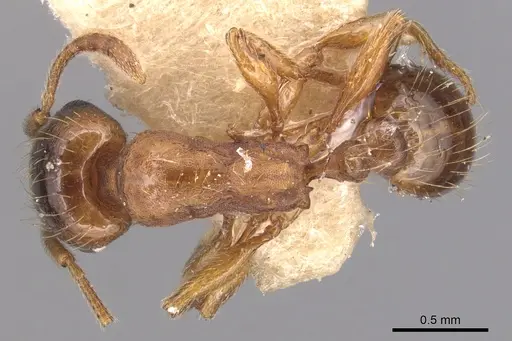
CASENT0916959
Ver en AntWeb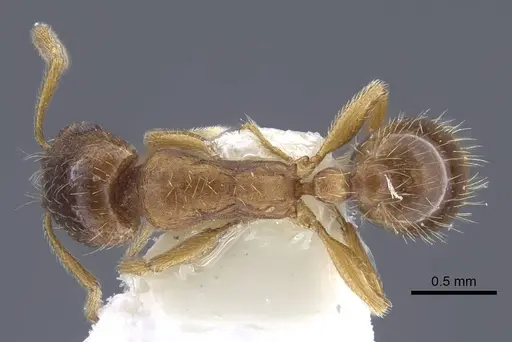
Literatura
Cargando mapa de distribución...Cargando productos...