
Simopelta laticeps
- Nom. cient.
- Simopelta laticeps
- Tribu
- Ponerini
- Subfamilia
- Ponerinae
- Autor
- Gotwald & Brown, 1967
- Distribución
- Encontrado en 0 países
Introducción
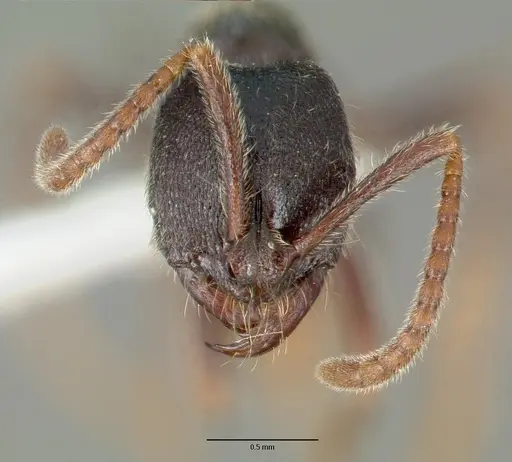
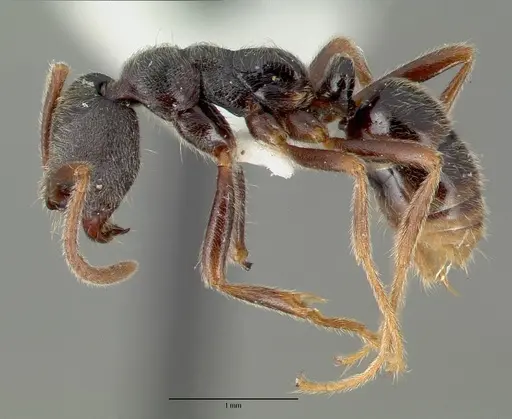
Simopelta laticeps is a medium-large predatory ant species native to the cloud forests of northern South America. Workers measure about 5.5 mm total length and have a distinctive reddish-brown to black body with reddish appendages . They can be recognized by their four mandibular teeth and a sharp spine on the front of the clypeus (the plate above their mandibles) . The back of their head is deeply concave with sharply pointed corners, giving them a unique look . This species is known from Colombia, Peru, Ecuador, and French Guiana, usually at elevations between 1400 and 2000 m in humid cloud forests . Only the worker caste has been formally described, but two queens were collected together with 80 workers in Ecuador in 2018,so queens do exist . Almost nothing else is known about their biology .
Quick Summary
- Difficulty: Expert
- Origin & Habitat: Cloud forests of Colombia, Peru, Ecuador, and French Guiana at elevations of 1400-2000 m [1][3]. Found in foothill forest off the Pacific coast in southern Ecuador [3].
- Colony Type: Unknown, only workers have been described, but two queens were collected with workers in Ecuador [3], so colony structure (single-queen or multi-queen) is unconfirmed.
- Size & Growth:
- Queen: Unknown, queen caste not formally described, but queens are likely similar in size to workers (approx 5.5 mm) or slightly larger [3].
- Worker: Approximately 5.5 mm total length [1]
- Colony: Unknown, no colony samples have been studied
- Growth: Unknown
- Development: Unknown, no development data exists for this species (This species has never been kept in captivity, so all development timelines are unconfirmed.)
- Antkeeping:
- Temperature: Cloud forest origin suggests they prefer cooler, stable conditions, likely in the range of 18-22 °C. No specific data exists [1].
- Humidity: Cloud forest habitat indicates high humidity needs, aim for 70-85% humidity. Keep substrate consistently moist but not waterlogged.
- Diapause: Unknown, no data on overwintering requirements. Given their high-elevation cloud forest origin, they may experience seasonal temperature changes and could benefit from a cool period, but this is speculative.
- Nesting: No specific nesting data exists. In captivity, a naturalistic setup with moist substrate or a plaster nest with good humidity retention would be appropriate. They likely nest in soil or rotting wood in the wild.
- Behavior: Simopelta laticeps has a functional stinger and is likely predatory (typical of Ponerinae ants). Their small eyes (0.06 mm diameter) suggest they rely more on chemical cues than vision [1]. Nothing specific is known about their aggression or colony defense, so assume they are capable of stinging if threatened. Their size (5.5 mm) makes escape prevention straightforward with standard barriers.
- Common Issues: no captive husbandry information exists, this is essentially an unstudied species in captivity, queens have only been collected once, so founding a colony from scratch is extremely difficult, their cloud forest origin means they likely have specific temperature and humidity requirements that may be hard to meet, very rare in the antkeeping hobby with no established care protocols, wild-caught colonies may carry parasites or diseases with no documented treatment
Species Identification and Distinction
Simopelta laticeps workers can be identified by several distinctive features. They have four well-developed teeth on their mandibles, and the front of their clypeus bears a sharp, short spine about 0.06 mm long [1][2]. The back of their head is deeply concave with sharply angular corners, this is one of their most recognizable features. They are relatively large ants at about 5.5 mm total length, with a reddish-brown to black body and reddish appendages [1]. This species could be confused with Simopelta mayri, which shares similar features, but S. laticeps has a thicker petiole and the distinctive concave head shape [1]. It was originally described from Peru in 1967 and has since been found in Colombia, Ecuador, and French Guiana [3].
Distribution and Habitat
Simopelta laticeps is known from four countries in northern South America: Colombia, Peru, Ecuador, and French Guiana [3]. In Colombia, it has been recorded in Nariño department [4][5]. The type locality is in Lambayeque, Peru, at about 2000 m elevation in a cloud forest zone on the west slope of a low Andean pass [1]. More recently, it has been found in El Oro province, Ecuador, at 1472 m elevation in foothill forest off the Pacific coast [3]. This distribution suggests they prefer cool, humid highland forest environments, roughly between 1400 and 2000 m [1][3].
What We Don't Know
This is one of the least-studied ant species in the hobby. Only the worker caste has been formally described, although two queens were collected with 80 workers in Ecuador in 2018 [3]. No males have ever been found. We do not know: how they found colonies, what their diet consists of, whether they are solitary or group hunters, if they have single or multiple queens, how they reproduce, what temperature and humidity they require, or how fast they develop. This makes them entirely unsuitable for beginners and even most experienced antkeepers. There are no established care protocols, and no one has successfully kept them in captivity [1][3].
Predatory Behavior and Foraging
Simopelta laticeps is a predatory ant with a functional stinger, as expected for a Ponerinae species [1]. Their small eyes (maximum diameter 0.06 mm) suggest they rely more on chemical and tactile senses than vision while hunting [1]. In the wild, they likely hunt small invertebrates like other ants, springtails, and tiny soil arthropods typical of cloud forest floor fauna. If kept in captivity, offer small live prey such as fruit flies, pinhead crickets, and other appropriately-sized insects. Whether they accept sugar sources is completely unstudied. Related Ponerinae species typically feed their larvae prey items but adults may drink honeydew or nectar. Without any data, start with small live prey and observe acceptance [1].
Legal and Ethical Considerations
Before any attempt to keep Simopelta laticeps, check its legal status in your country or region. This species is hardly traded and has never been documented in the antkeeping hobby. If wild-caught specimens are taken from Ecuador, Colombia, Peru, or French Guiana, you must follow that country's laws on insect collection and export. Many countries restrict collecting native ants, and international trade may fall under CITES or national wildlife laws. Additionally, given how rare and unstudied this species is, capturing wild colonies could harm wild populations with no scientific benefit. Consider supporting field researchers rather than collecting for personal collections [3].
Frequently Asked Questions
Can I keep Simopelta laticeps as a pet ant?
No. This species has never been kept in captivity and no care information exists. Only a few queens have been collected, and there are no established husbandry protocols. This is an expert-only species best left to field researchers [1][3].
What do Simopelta laticeps eat?
Unknown. As a Ponerinae ant, it almost certainly eats other small invertebrates. Their small eyes suggest they hunt using chemical cues rather than vision. In captivity, you would need to offer small live prey like fruit flies, springtails, and tiny crickets. Whether they accept sugar sources is completely unstudied [1].
How big do Simopelta laticeps colonies get?
Unknown. No colony has ever been studied. We do not know if they have 50 workers or 5000. The largest Simopelta colonies in the genus may reach several hundred workers, but this is pure speculation for S. laticeps [1].
What temperature do Simopelta laticeps need?
No specific data exists. Their cloud forest habitat at 1400-2000 m elevation suggests they prefer cooler conditions than typical tropical ants, likely around 18-22 °C. They probably need stable temperatures without major fluctuations. Start cool and observe any colony you might obtain [1].
Are Simopelta laticeps good for beginners?
Absolutely not. This is one of the least-known ant species in existence. No one has ever kept them successfully, there is no care guide, and queens have only been found once. If you want to keep Ponerinae ants, start with species that have established husbandry protocols like Odontomachus or Neoponera [1][3].
Where does Simopelta laticeps live?
They live in cloud forests in Colombia, Peru, Ecuador, and French Guiana at elevations between 1400 and 2000 m. The type locality is in Peru's Lambayeque region. They have also been found in Ecuador's El Oro province and Colombia's Nariño department [1][3].
How do I start a Simopelta laticeps colony?
You cannot easily do so. Queens have only been collected once (in Ecuador,2018), and no founding behavior is known. Even if you found a wild colony, there is no established protocol to keep them. This species remains for field researchers, not antkeepers [1][3].
Do Simopelta laticeps need hibernation?
Unknown. Their cloud forest habitat at high elevation suggests they experience seasonal temperature changes, so they may require a cool period. However, no one has ever kept a colony to observe this. Related Ponerinae species from similar habitats often do best with seasonal temperature drops [1].
What makes Simopelta laticeps different from other ants?
They have one of the most distinctive head shapes in the ant world, deeply concave with sharply angular corners. They have been rarely collected in over 50 years of study. The queen caste is still not formally described. They represent a frontier species where almost everything about their biology remains to be discovered [1][2].
Report an Issue
The current care sheet is based fully on literature. See inconsistencies, or something that's incorrect? Please , it will be resolved after review from an admin. Contributing to the blogs tab also helps providing information, to make us be able to further improve the caresheets. Thank you for your support!
References

Esta ficha de cuidados está bajo licencia CC BY-SA 4.0 .
Blogs de la comunidad
CASTYPE09451
Ver en AntWeb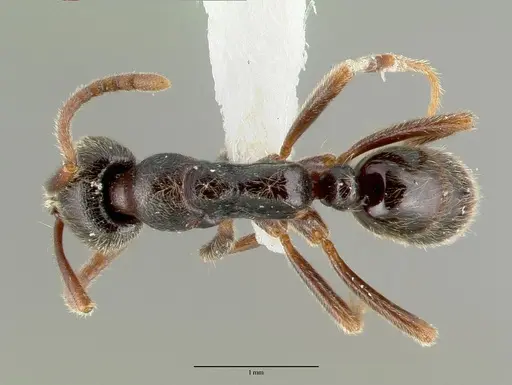
Literatura
Cargando mapa de distribución...Cargando productos...