
Pristomyrmex rugosus
- Nom. cient.
- Pristomyrmex rugosus
- Tribu
- Crematogastrini
- Subfamilia
- Myrmicinae
- Autor
- Zettel, 2006
- Distribución
- Encontrado en 0 países
Introducción
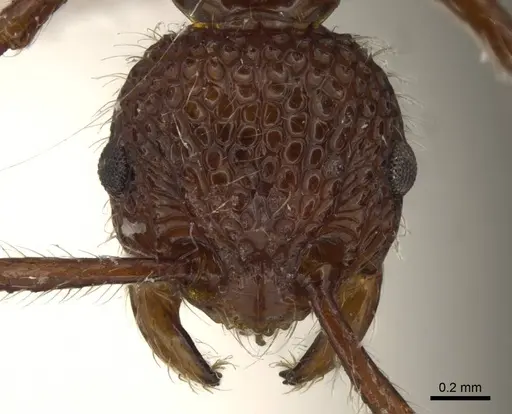
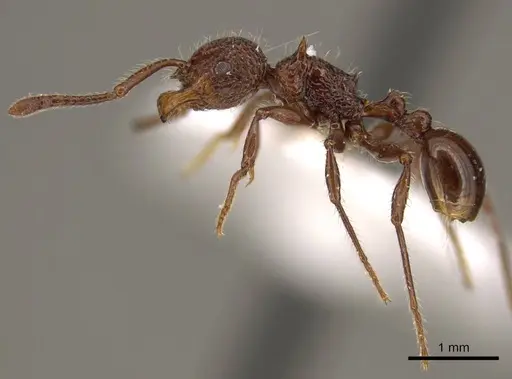
Pristomyrmex rugosus is a small, dark reddish-brown ant endemic to the Philippines, specifically found on Leyte Island. Workers measure approximately 4.01-4.26 mm in total length . The species has a prominent tooth on the ventral surface of the clypeus, long pronotal spines, and a coarse rugoreticulum on the head and alitrunk . It was described by Zettel in 2006 and is known from lowland areas near the Calbiga-a River at elevations of 50-200 meters . Its primary defense mechanism is smearing venom using a modified stinger, typical of its subfamily. This species is notable for having no documented biological information; nothing is known about its colony structure, founding behavior, or care requirements in the wild .
Quick Summary
- Difficulty: Hard
- Origin & Habitat: Endemic to Leyte Island, Philippines, found in lowland tropical areas near rivers at 50-200 meters elevation [1].
- Colony Type: Unconfirmed, colony structure has not been documented.
- Size & Growth:
- Antkeeping:
- Temperature: Unconfirmed, as a tropical species, likely prefer warm conditions around 24-28°C, but this is an estimate based on geographic origin [1].
- Humidity: Unconfirmed, no specific data, as a lowland tropical species, moderate to high humidity may be suitable, but substrate should be kept moist but not waterlogged.
- Diapause: No, tropical species from the Philippines do not require diapause [1].
- Nesting: Unconfirmed, natural nesting behavior unknown, genus typically nests in soil or rotting wood [2].
- Behavior: Behavior is unstudied. Based on genus patterns, workers may be ground-nesting and somewhat defensive. Due to small size (4 mm), escape prevention is important. Defense mechanism involves smearing venom, typical of Myrmicinae.
- Common Issues: lack of biological data makes care experimental and challenging., queen caste undescribed, making colony establishment difficult., founding behavior unconfirmed, so unsure if queens need to forage., diet preferences unknown, so feeding in captivity is speculative., no captive breeding records, so sustaining colonies may be hard.
Species Discovery and Taxonomy
Pristomyrmex rugosus was formally described in 2006 by Herbert Zettel based on worker specimens collected from Leyte Island in the Philippines. The species name 'rugosus' refers to the distinctive wrinkled sculpture on the head and alitrunk. It belongs to the Myrmicinae subfamily and Crematogastrini tribe. This ant is most similar to Pristomyrmex sulcatus but can be distinguished by its longer pronotal spines, more rounded petiolar node, larger eyes with more ommatidia, and the presence of numerous setae on the petiole and postpetiole. The type locality is near Baybay on Leyte, specifically along the Calbiga-a River at elevations between 50-200 meters [1].
Identification and Physical Characteristics
Workers of Pristomyrmex rugosus measure approximately 4.01-4.26 mm in total length. The head and alitrunk feature a distinctive coarse rugoreticulum, a network of wrinkles and pits. The pronotum bears a pair of relatively long spines, while the propodeum has only very short teeth. A key identifying feature is the prominent tooth on the ventral surface of the clypeus. The eyes are relatively large compared to similar species. The body is dark reddish-brown, and the dorsal surfaces bear numerous long erect hairs, though the first gastral tergite lacks such hairs [1].
Current State of Knowledge
Pristomyrmex rugosus is one of the least studied ant species in the hobby. The original description by Zettel (2006) provides only morphological measurements and the collection locality, absolutely no biological information exists. The AntWiki explicitly states that nothing is known about the biology of this species [2]. This includes unknown data on: colony structure, founding behavior, diet preferences, development timeline, temperature and humidity requirements, nuptial flight timing, and natural enemies. Any care advice for this species would be speculative at best [1].
Related Species and Generic Behavior
While specific biology of P. rugosus is unknown, the genus Pristomyrmex contains about 100 species distributed primarily in the Old World tropics and subtropics. Most Pristomyrmex species are ground-nesting ants that typically inhabit soil or rotting wood in forested areas. They are generally moderate-sized Myrmicine ants. Some related species are known to be predatory or omnivorous, but these are general observations that may not apply to P. rugosus [2].
Frequently Asked Questions
Is Pristomyrmex rugosus a good species for beginners?
No. This species is not recommended for beginners or even most experienced antkeepers because absolutely no biological data exists. There is no information on colony structure, founding behavior, diet, temperature/humidity requirements, or development timeline. Keeping this species would be experimental with no established care protocols to follow [2].
What do Pristomyrmex rugosus ants eat?
Unconfirmed, no dietary studies exist for this species. Based on genus-level observations, Pristomyrmex ants are likely omnivorous, potentially feeding on small insects, honeydew, and nectar, but specific acceptance in captivity is completely unknown [2].
What temperature should I keep Pristomyrmex rugosus at?
No specific thermal data exists. As a tropical species from Leyte Island, they likely prefer warm conditions around 24-28°C, but this is an estimate based on geographic origin [1]. Monitor colony activity and adjust as needed.
Do Pristomyrmex rugosus queens need to forage during founding?
Unknown, founding behavior has not been documented for this species. Most Myrmicinae are semi-claustral, but without data, it is impossible to determine the correct approach [2].
How long does it take for Pristomyrmex rugosus to develop from egg to worker?
Unconfirmed, no development data exists for this species. Specific egg-to-worker timeline is completely unknown [2].
Is Pristomyrmex rugosus monogyne or polygyne?
Unknown, colony structure has not been documented. The number of queens in wild colonies has not been studied [2].
Where is Pristomyrmex rugosus found in the wild?
This species is endemic to Leyte Island in the Philippines. The only known specimens come from the Baybay area near the Calbiga-a River, at elevations of 50-200 meters [1].
Can I keep Pristomyrmex rugosus in a test tube?
Unknown, no captive housing data exists. Test tube setups are commonly used for founding colonies of many Myrmicinae, but whether this works for P. rugosus is completely unconfirmed [2].
Does Pristomyrmex rugosus need hibernation?
No, as a tropical species from the Philippines, they do not require diapause [1].
Are Pristomyrmex rugosus ants aggressive?
Unknown, behavior has not been studied. Based on genus patterns, some species can be somewhat defensive when disturbed, but specific temperament is completely unknown [2].
Report an Issue
The current care sheet is based fully on literature. See inconsistencies, or something that's incorrect? Please , it will be resolved after review from an admin. Contributing to the blogs tab also helps providing information, to make us be able to further improve the caresheets. Thank you for your support!
References

Esta ficha de cuidados está bajo licencia CC BY-SA 4.0 .
Blogs de la comunidad
CASENT0919750
Ver en AntWeb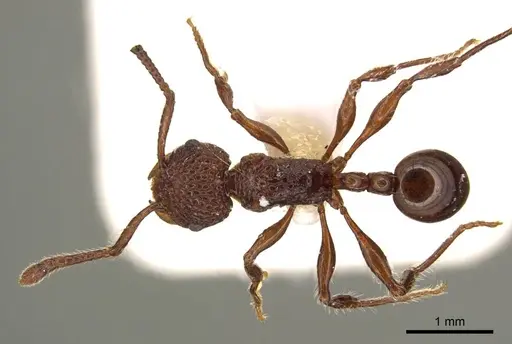
Literatura
Cargando mapa de distribución...Cargando productos...