
Paratopula zhengi
- Nom. cient.
- Paratopula zhengi
- Tribu
- Crematogastrini
- Subfamilia
- Myrmicinae
- Autor
- Xu & Xu, 2011
- Distribución
- Encontrado en 0 países
Introducción
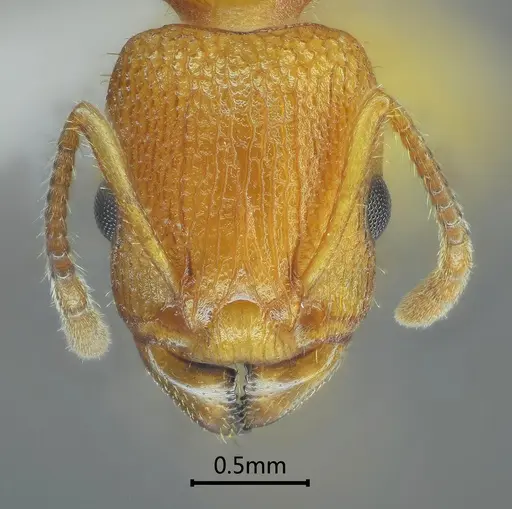
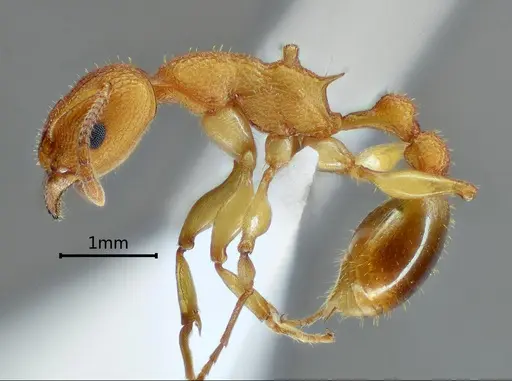
Paratopula zhengi is a rare ant in the subfamily Myrmicinae, tribe Crematogastrini. It was discovered in 2008 in Mêdog County, Tibet, China, at 1080m elevation in a secondary monsoon forest . Workers are 6.6mm in total length, with orange-yellow coloration, brown mandibles and gaster, and short blunt erect hairs . The species has a prominent stinger . This species is notable for being known from only a single worker specimen, making it one of the rarest ants documented .
Quick Summary
- Difficulty: Expert
- Origin & Habitat: Mêdog, Tibet, China at 1080m elevation in secondary monsoon forest [1][2].
- Colony Type: Unknown, only worker caste described [1].
- Size & Growth:
- Antkeeping:
- Temperature: Estimated based on montane habitat: start around 20-24°C with a gradient. No specific data.
- Humidity: Keep nest substrate consistently moist but not waterlogged, based on monsoon forest habitat.
- Diapause: Likely required due to cold winters in Tibet, keep colony cool for 2-3 months during winter if established.
- Nesting: Use a naturalistic setup with both vertical surfaces and ground-level chambers, as the genus is arboreal but the specimen was ground-foraging.
- Behavior: No behavioral observations documented. The species has an extruding stinger, indicating defensive capabilities, handle with caution [1]. Based on subfamily Myrmicinae, they likely use a smear defense mechanism with a modified stinger, but no species-specific data exists. Escape risk is moderate given worker size [1].
- Common Issues: this species is virtually unknown in captivity, no established care protocols exist., only a single worker specimen has ever been collected, making wild colonies extremely unlikely to be available., no queen has been described, so captive breeding from wild-caught colonies is not possible., montane origin suggests specific temperature requirements that are poorly understood., risk of purchasing misidentified ants if specimens do appear on the market.
Species Overview and Rarity
Paratopula zhengi is one of the rarest ants in the world in terms of documented specimens, it is known from a single worker collected in May 2008 in Mêdog County, Tibet [1]. This makes it essentially impossible to obtain for antkeeping, as no wild colonies have ever been found and no queen has been described. The species was formally described in 2011 by Xu and Xu, distinguishing it from the related Paratopula intermedia by its finer frontal carinae, straight propodeal declivity, and abundant body hairs [1][3].
Natural Habitat and Distribution
This species is known only from the type locality in Mêdog, Tibet, China, which sits on the south slope of the Himalayas at approximately 1080m elevation [1]. The habitat was described as a secondary monsoon forest, and the single known specimen was foraged on the ground [1][2]. This combination suggests the species may be ground-foraging despite the genus being considered arboreal.
Morphology and Identification
Workers measure 6.6mm total length, making them relatively large for the Myrmicinae subfamily [1]. They have a rectangular head that is longer than broad, with 12-segmented antennae ending in a 3-segmented club [1]. The body is orange-yellow with brown mandibles, tarsi, and middle gaster [1]. A distinctive feature is the slender propodeal spines that curve slightly upward, and the entire body is covered in short blunt erect hairs [1]. The species has an extruding stinger, so caution is warranted when handling [1].
Challenges for Antkeepers
Paratopula zhengi presents extreme challenges for antkeeping. First, the species has never been found in sufficient numbers to establish a colony, only a single worker exists in scientific collections [1]. Second, no queen has ever been described, meaning captive breeding from wild-caught colonies is impossible [1]. Third, even if specimens were to become available, the specific care requirements are completely unknown and would require significant experimentation [1].
Inferred Care Requirements
Based on the habitat data and genus characteristics, reasonable starting conditions can be estimated. The montane monsoon forest origin suggests temperatures in the range of 20-24°C with a gradient for self-regulation. Humidity should be moderate to high, with nest substrate kept moist but not waterlogged. A naturalistic setup with both vertical and horizontal spaces would allow the ants to choose their preferred microclimate. Since the specimen was found foraging on the ground, include ground-level chambers alongside vertical surfaces. However, these are educated guesses only, not established protocols.
Frequently Asked Questions
Can I keep Paratopula zhengi as a pet?
No, this species is essentially unavailable to antkeepers. Only a single worker specimen has ever been collected, and no queen has ever been described. There are no established colonies in captivity, and wild colonies have never been found [1].
How big do Paratopula zhengi colonies get?
Unknown, the maximum colony size has never been documented. Only a single worker has ever been collected [1].
What do Paratopula zhengi ants eat?
Unconfirmed, no feeding observations exist. Based on related Myrmicinae, they likely accept sugar sources and protein-rich foods like insects.
Do Paratopula zhengi ants sting?
Yes, the holotype specimen shows an extruding stinger. While sting potency is unknown, caution is warranted [1].
What temperature do Paratopula zhengi need?
Unknown specifically. Based on their montane habitat in Tibet at 1080m elevation, they likely prefer cooler temperatures than tropical ants. A starting point of 20-24°C with a gradient is reasonable, but no established requirements exist.
Are Paratopula zhengi good for beginners?
No, this species is not suitable for beginners or even most experienced antkeepers. It is one of the rarest ant species known, with only a single specimen ever collected. No captive care protocols exist, and obtaining specimens is essentially impossible [1].
Do Paratopula zhengi need hibernation?
Likely yes, based on their geographic location in Tibet where winters are cold. If you ever establish a colony, a cool period around 10-15°C for 2-3 months during winter is recommended. This is inferred, not confirmed.
How long does it take for Paratopula zhengi to develop from egg to worker?
Unknown, no development data exists for this species. Based on typical Myrmicinae development patterns, expect 6-10 weeks at optimal temperature, but this is a rough estimate only.
Can I keep multiple Paratopula zhengi queens together?
Unknown, no queen has ever been documented, so colony structure is completely unstudied. Do not attempt combining unrelated queens as no data exists on their social structure [1].
Where does Paratopula zhengi live?
Only known from Mêdog County in Tibet, China, at 1080m elevation on the south slope of the Himalayas. They were found in a secondary monsoon forest, with the only specimen collected while foraging on the ground [1].
Report an Issue
The current care sheet is based fully on literature. See inconsistencies, or something that's incorrect? Please , it will be resolved after review from an admin. Contributing to the blogs tab also helps providing information, to make us be able to further improve the caresheets. Thank you for your support!
References

Esta ficha de cuidados está bajo licencia CC BY-SA 4.0 .
Blogs de la comunidad
ANTWEB1060565
Ver en AntWeb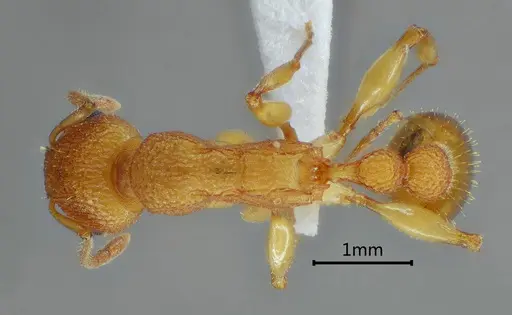
Literatura
Cargando mapa de distribución...Cargando productos...