
Monomorium carbo
- Nom. cient.
- Monomorium carbo
- Tribu
- Solenopsidini
- Subfamilia
- Myrmicinae
- Autor
- Forel, 1910
- Distribución
- Encontrado en 0 países
Introducción
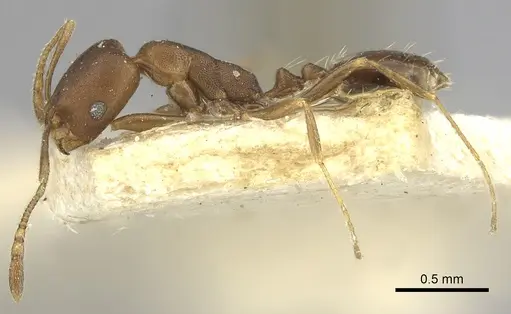
Monomorium carbo is a tiny ant species with workers measuring 2.3-2.4 mm in total length. They are uniform dark brown to blackish-brown in color . This species is known only from Northeast Africa and the Arabian Peninsula, including Eritrea, Ethiopia, Oman, Saudi Arabia, and the United Arab Emirates . What makes Monomorium carbo particularly unusual is that only workers have ever been collected; queens and males are completely unknown . This means we have almost no information about their colony structure or reproductive biology.
Quick Summary
- Difficulty: Expert
- Origin & Habitat: Recorded from Eritrea, Ethiopia, Oman, Saudi Arabia, and the United Arab Emirates, likely in hot, arid environments [2][3][4][5].
- Colony Type: Unknown, no queens or males have been collected, so colony structure is unconfirmed.
- Size & Growth:
- Antkeeping:
- Temperature: Based on the hot, arid native habitat, temperature needs are likely 22-28°C [2][3][4][5].
- Humidity: Likely prefers drier conditions, allow the nest substrate to dry out between waterings.
- Diapause: Unknown, no data on overwintering requirements.
- Nesting: No direct data, but related Monomorium species typically nest in soil or under stones.
- Behavior: Completely unstudied. Based on related species, they are likely generalist foragers. Their tiny size means escape prevention is critical. Temperament is unknown but likely not aggressive.
- Common Issues: this species is virtually unknown in captivity, no established husbandry guidelines exist., queens have never been collected, making captive breeding impossible., the extremely limited type series means species identification is challenging., no data on diet or feeding schedules exists.
Why Monomorium carbo Is So Rare in Collections
Monomorium carbo represents a significant gap in ant-keeping knowledge. This species was described from just a couple of workers collected in Ghinda, Eritrea in 1906,and no additional specimens have been documented since [1]. The complete absence of queen specimens means we cannot establish captive colonies, you need a mated queen to start any ant colony in captivity. Even the male caste has never been described. This makes M. carbo essentially impossible to keep as a pet, not because of any difficulty in husbandry, but because no one has ever collected or documented the reproductive castes needed to establish a colony.
Taxonomic Context and Related Species
Monomorium carbo belongs to the Monomorium salomonis species group. This group contains several similar dark-colored species that can be difficult to distinguish. The most commonly encountered relative in the ant-keeping hobby is Monomorium carbonarium, a similar-looking dark species that has become invasive in parts of Europe and Asia [6][7]. While M. carbonarium is well-studied and commonly kept, M. carbo remains a taxonomic mystery. Any ant you encounter that appears to be M. carbo is far more likely to be M. carbonarium or another related species.
Distribution and Native Habitat
The confirmed range of Monomorium carbo spans Northeast Africa and the Arabian Peninsula: Eritrea (type locality), Ethiopia, Oman, Saudi Arabia, and the United Arab Emirates [2][3][4][5]. The type locality in Eritrea is at low elevation in a hot, arid region. This suggests the species is adapted to warm, relatively dry conditions. However, we have no direct observations of their nesting habits, foraging behavior, or ecological preferences in the wild.
Identification Challenges
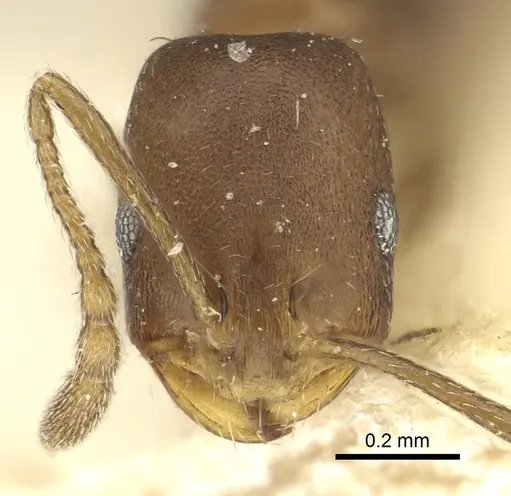
Correctly identifying Monomorium carbo requires microscopic examination of specific morphological features. Workers are tiny with uniform dark brown to blackish-brown coloration. The head has a dull, finely textured surface, while the abdomen is shiny. These are subtle characters that require a good microscope and comparison with related species, M. carbonarium looks very similar and is far more common [1].
Frequently Asked Questions
Can I keep Monomorium carbo ants?
No, Monomorium carbo cannot be kept because no one has ever collected a queen. Without a mated queen, it is impossible to establish a captive colony. Additionally, only a handful of workers have ever been documented, all collected in 1906,so the species is essentially unknown in the ant-keeping hobby [1].
Where can I find Monomorium carbo for sale?
This species is not available in the ant-keeping hobby. It has never been documented for sale because no colonies have ever been established. Any dark Monomorium offered for sale is almost certainly a different species, most commonly Monomorium carbonarium [1].
What does Monomorium carbo look like?
Workers are tiny at 2.3-2.4 mm total length with a uniform dark brown to blackish-brown color. The head has a dull, finely textured surface, while the abdomen is shiny. These are subtle features requiring microscopic examination to distinguish from similar species [1].
How big do Monomorium carbo colonies get?
Unknown, only a few workers have ever been collected, so we have no data on natural colony size. Related species in the genus can form colonies ranging from dozens to thousands of workers.
What is the closest species to Monomorium carbo that I can keep?
Monomorium carbonarium is the most similar commonly kept species. It is dark, tiny (around 2 mm), and forms polygynous colonies. It has become invasive in parts of Europe but is established in the ant-keeping hobby. However, it is a different species and should not be confused with M. carbo [6][7].
Is Monomorium carbo invasive?
Unknown, we have no data on population structure or behavior. However, related species like M. carbonarium have become invasive in suitable climates, forming supercolonies and outcompeting native ants. The lack of data makes assessing invasive potential impossible [6][7].
What temperature do Monomorium carbo ants need?
Unconfirmed, but likely 22-28°C based on the hot, arid to semi-arid native habitat in Eritrea and the Arabian Peninsula [2][3][4][5]. This is an estimate based on related species, not direct observation.
How long do Monomorium carbo queens live?
Unknown, queens have never been collected or described. We have no biological data on this species whatsoever [1].
Is Monomorium carbo endangered?
We cannot assess conservation status because the species has only been collected once, over a century ago. It may be extremely rare, or it may simply be overlooked due to its tiny size and resemblance to other dark Monomorium species [1].
Report an Issue
The current care sheet is based fully on literature. See inconsistencies, or something that's incorrect? Please , it will be resolved after review from an admin. Contributing to the blogs tab also helps providing information, to make us be able to further improve the caresheets. Thank you for your support!
References

Esta ficha de cuidados está bajo licencia CC BY-SA 4.0 .
Blogs de la comunidad
CASENT0249908
Ver en AntWeb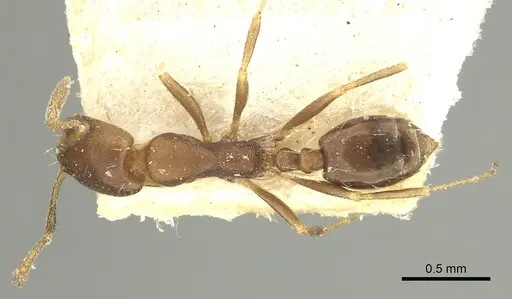
Literatura
Cargando mapa de distribución...Cargando productos...