
Cylindromyrmex escobari
- Nom. cient.
- Cylindromyrmex escobari
- Subfamilia
- Dorylinae
- Autor
- De Andrade, 1998
- Distribución
- Encontrado en 0 países
Introducción
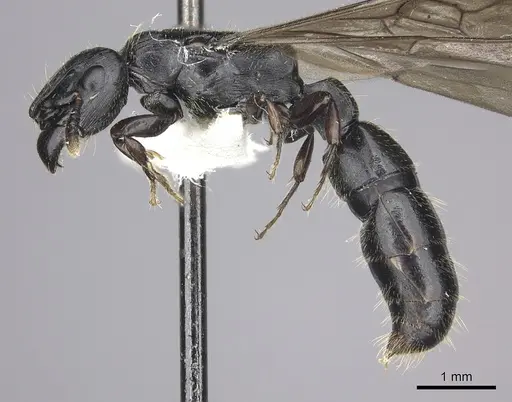
Cylindromyrmex escobari is a rarely seen ant species from the Dorylinae subfamily. It is only known from a handful of specimens collected in Colombia (Nariño) and Costa Rica . Workers measure about 8 mm in total length . They have a black body, dark reddish-brown mandibles and antennae, and yellowish-orange to light brown legs . The most unusual feature is the complete absence of grooves (striae) on the first segment of the gaster – something no other species in the brevitarsus clade shares . They live in high-elevation (1800 m) montane wet forests and nest in decayed wood . Almost nothing is known about the biology of this species. No one has observed a colony in the wild or in captivity. Even the queen has never been described. This makes C. escobari one of the most mysterious ants in the hobby, and any keeper would be working from a blank slate.
Quick Summary
- Difficulty: Expert
- Origin & Habitat: Colombia (Nariño department, Ricaurte La Planada at 1800 m elevation) and Costa Rica – montane wet forest [2][1][3]
- Colony Type: Unconfirmed – colony structure (single queen vs multiple queens) has not been documented for this species
- Size & Growth:
- Queen: size data unavailable – the queen has not been described in scientific literature
- Worker: ~8.16 mm total length [1]
- Colony: Unknown – no colony size data available
- Growth: Unknown
- Development: Unknown – no development data available for this species. Based on typical Dorylinae patterns, expect 4–8 weeks at optimal temperature, but this is an estimate. (Development timeline is unconfirmed. Dorylinae army ants typically develop relatively quickly once egg-laying begins, but specific data for C. escobari does not exist.)
- Antkeeping:
- Temperature: Keep cool – based on the 1800 m elevation habitat, aim for 18–22°C as a starting point. Monitor colony activity and adjust. Avoid overheating (never exceed 25°C). Provide a temperature gradient with one side slightly warmer.
- Humidity: High humidity required – they come from montane wet forests. Keep the nest substrate consistently moist but not waterlogged. Provide a humidity gradient so ants can choose their preferred zone.
- Diapause: Unknown – no documented hibernation or winter rest period for this species. The montane habitat suggests they may experience cooler seasonal temperatures, but no data exists.
- Nesting: Natural nesting: decayed wood in forest interior [1]. In captivity, a naturalistic setup with moist substrate (soil/peat mix) and decaying wood pieces works well. Y-tong or plaster nests with moisture reservoirs can also work if humidity is maintained high. Avoid acrylic nests – they don't hold moisture well for this species.
- Behavior: As a member of the Dorylinae subfamily, C. escobari is expected to be predatory, but no direct observations exist. Workers are about 8 mm and likely capable of stinging. Activity patterns are unknown, but many Dorylinae are nocturnal or crepuscular. Escape prevention should be good – they are not tiny, but they may be fast-moving. The species' extreme rarity means no captive behavior has been reported.
- Common Issues: no captive husbandry information exists – this is one of the least-studied ants in the hobby, high humidity requirements can lead to mold problems if ventilation is inadequate, predatory diet needs may be difficult to meet – live prey is essential, the species' rarity means finding colony founders is extremely difficult, the lack of documented colony development makes it impossible to know if the colony is progressing normally, unknown temperature and humidity tolerances – any mistake could be fatal
Taxonomy and Identification
Cylindromyrmex escobari belongs to the Dorylinae subfamily. It was described by Maria L. de Andrade in 1998 based on a worker collected in Colombia [1]. The species is named after Federico Escobar, who collected the holotype. It is the basalmost (most primitive) species within the brevitarsus clade [1].
Identifying C. escobari requires attention to a few key features. The most distinctive trait is the absence of striations on the first gastric tergite – unique among the brevitarsus clade [1]. The front edge of the clypeus is strongly convex. The mandibles have 13–14 denticles, more than related species [1]. The body is black with dark reddish-brown mandibles, antennae, and coxae, while the legs are yellowish-orange to light brown [1]. The overall shape is more elongated than other Cylindromyrmex species, especially the femora [1].
Distribution and Habitat
Cylindromyrmex escobari has a very limited known range: Colombia (Nariño department, Ricaurte La Planada at 1800 m elevation) and Costa Rica [2][1][3]. The habitat is montane wet forest [3]. The holotype was collected from decayed wood inside a forest [1]. This high-elevation cloud forest is cooler and wetter than lowland rainforest, with frequent cloud cover and high humidity. The nesting site (decayed wood) and habitat (forest interior) suggest a need for stable moisture and moderate temperatures.
Known Biology and Behavior
Almost nothing is known about the biology of C. escobari. No colonies have been observed in the wild, and the queen is undescribed. As a member of Dorylinae, it is presumed to be predatory, but no direct observations exist [1]. The genus Cylindromyrmex is characterized by an elongated body compared to other Dorylinae, but the function is unknown [1]. There is no information on foraging, nesting habits beyond decayed wood, reproductive behavior, or colony structure. This species is a blank page, and any husbandry would be entirely experimental.
Housing and Nesting
Based on the natural nesting habitat (decayed wood in montane forest), C. escobari should do well in a naturalistic setup that replicates these conditions. Use a moist soil- or peat-based substrate with pieces of decaying wood mixed in. The substrate should remain consistently damp but never waterlogged.
For a formicarium, Y-tong (AAC) blocks or plaster nests with moisture chambers work well. The key requirement is maintaining high humidity – keep the nest substrate consistently moist. Provide a humidity gradient by moistening one side of the nest while leaving another area slightly drier. Do not use acrylic nests, as they cannot hold the necessary humidity.
Because this species is likely predatory, include a foraging area where you can offer live prey. The outworld should be simple and easy to clean. Ensure all connections between nest and outworld are smooth and wide enough for the 8 mm workers to pass.
Feeding and Diet
As a member of Dorylinae, C. escobari is expected to require live prey. In captivity, offer:
- workers from other ant species (from safe, pesticide-free sources)
- small crickets
- mealworms, waxworms
- isopods, springtails
- other small arthropods
Feed every 1–2 days, offering prey items matched to worker size. Remove uneaten prey after 24–48 hours to prevent mold. Sugar sources (honey, sugar water) are not likely to be a major part of their diet but can be offered occasionally. Live prey is essential – this species probably does not survive on sugars alone.
Temperature and Seasonal Care
Given the high-elevation habitat (1800 m), keep temperatures on the cooler side. Aim for 18–22°C. This is notably lower than most tropical ants. Use a heating cable or mat on only one side of the nest to create a gradient. Never exceed 25°C.
Regarding diapause: the montane habitat experiences seasonal temperature variation, but no specific data exists on whether C. escobari enters dormancy. If your colony reduces activity during winter, you might try a slight temperature reduction to 15–18°C. However, without data, any seasonal care is guesswork.
Frequently Asked Questions
How long does it take for Cylindromyrmex escobari to develop from egg to worker?
The development time is unknown. No scientific data exists for this species. Based on typical Dorylinae patterns, expect roughly 4–8 weeks at 20°C, but this is an estimate. Without documented data, it is hard to know if the colony is progressing normally. Patience and careful observation are essential.
What do Cylindromyrmex escobari ants eat?
They are likely highly predatory and need live prey. Offer other ant workers, small crickets, mealworms, springtails, isopods, and similar small arthropods. Feed every 1–2 days. They may occasionally accept sugar water or honey, but this should not be their primary food. Remove uneaten prey after 24 hours to prevent mold.
Are Cylindromyrmex escobari ants good for beginners?
No. This species is not recommended for beginners. It is extremely rare, with almost no captive husbandry information available. They likely need specific cool, humid conditions and a constant supply of live prey. Colony development cannot be compared to known species. This is an expert-level species – only experienced keepers should consider it, and even then only if wild specimens are legally obtained.
What temperature should I keep Cylindromyrmex escobari at?
Keep them cool – aim for 18–22°C based on their high-elevation montane forest habitat. This is cooler than most tropical ant species. Use a heating cable on only one side of the nest to create a gradient, and never exceed 25°C. Room temperature around 20°C is likely ideal.
Can I keep multiple queens of Cylindromyrmex escobari together?
This has not been studied. Colony structure (monogyne vs polygyne) is unconfirmed. Without data, combining unrelated queens is not recommended. Dorylinae colonies can be aggressive toward each other, so it is safest to assume they are monogyne unless proven otherwise.
How big do Cylindromyrmex escobari colonies get?
Maximum colony size is unknown – no colony size data exists in the literature. Some Dorylinae colonies reach thousands of workers, but we do not know if C. escobari follows this pattern. Expect moderate to large colonies based on typical army ant behavior, but this is an estimate.
What humidity do Cylindromyrmex escobari ants need?
High humidity – they come from montane wet forests. Keep the nest substrate consistently moist but not waterlogged. Provide a humidity gradient so ants can choose their preferred zone. Inadequate humidity is likely fatal for this species.
When do Cylindromyrmex escobari nuptial flights occur?
Nuptial flight timing is unknown – no scientific data exists for this species. Their reproductive behavior has not been documented. If you maintain a colony, watch for alates (winged reproductives) and be prepared to separate them if needed.
What type of nest should I use for Cylindromyrmex escobari?
A naturalistic setup with moist soil/peat substrate and decaying wood pieces best matches their natural habitat. Y-tong or plaster nests with moisture chambers also work if you can maintain high humidity. Do not use acrylic nests. Ensure chambers are sized for 8 mm workers and provide good humidity control.
Report an Issue
The current care sheet is based fully on literature. See inconsistencies, or something that's incorrect? Please , it will be resolved after review from an admin. Contributing to the blogs tab also helps providing information, to make us be able to further improve the caresheets. Thank you for your support!
References

Esta ficha de cuidados está bajo licencia CC BY-SA 4.0 .
Blogs de la comunidad
CASENT0249589
Ver en AntWeb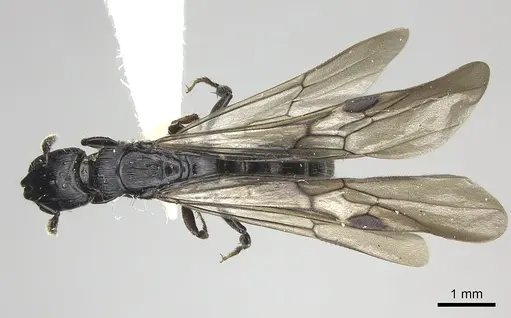
Literatura
Cargando mapa de distribución...Cargando productos...