
Carebara peruviana
- Nom. cient.
- Carebara peruviana
- Tribu
- Crematogastrini
- Subfamilia
- Myrmicinae
- Autor
- Emery, 1906
- Distribución
- Encontrado en 0 países
Introducción
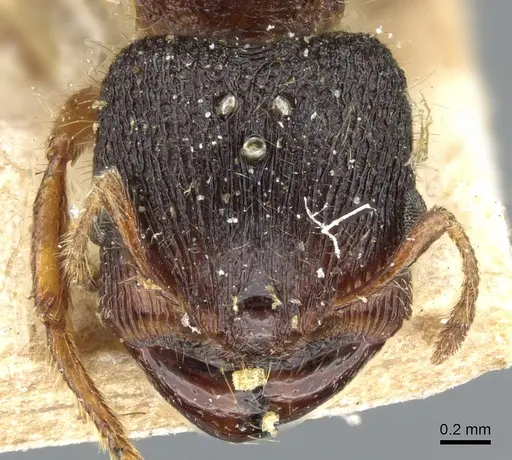
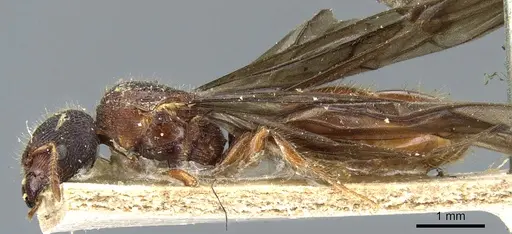
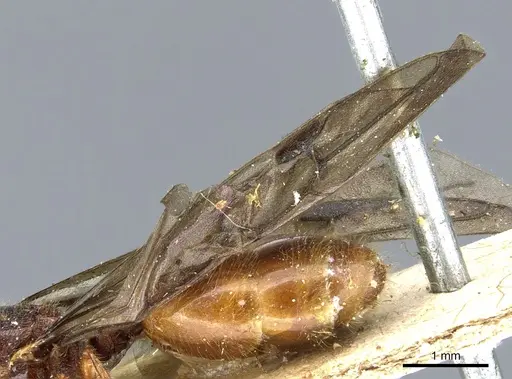
Carebara peruviana is a tiny myrmicine ant species known only from Peru. Queens measure approximately 7mm in total length with wings of equal length . The species belongs to the Carebara concinna species complex and was originally described from two queen specimens collected in the Marcapata region of Peru [AntWiki]. The worker caste remains unknown, having never been described . The queen has a distinctive appearance with a parallel-sided, subrectangular head that is longer than wide, short antennae with barely thickened scapes, and a reddish coloration on the petiole and lower thorax . The propodeum bears a blunt tooth, and the petiolar node is thick and 'scame' shaped, depressed above . This species remains one of the more poorly known Carebara from South America, with essentially no captive husbandry data available.
Quick Summary
- Difficulty: Expert
- Origin & Habitat: Known only from Peru, specifically the Marcapata region in the Andes [1][4]. The natural habitat is not documented, but related Carebara species typically inhabit tropical and subtropical forests, often nesting in soil, under stones, or in rotting wood.
- Colony Type: Unconfirmed. Only the queen caste has been described, the worker is unknown.
- Size & Growth:
- Antkeeping:
- Temperature: Likely 22-28°C based on typical Carebara preferences for warm, tropical conditions. Start in the mid-range and observe colony activity.
- Humidity: Moderate to high, aim for 60-80% humidity. Keep the nest substrate consistently moist but not waterlogged.
- Diapause: Unknown, likely minimal or none given the tropical origin from Peru [4].
- Nesting: No specific data exists. Based on related species, they likely prefer soil-based nests or will accept test tubes. Provide a moist substrate.
- Behavior: Not documented. Based on genus patterns, these are likely secretive ants that forage individually or in small groups. Their small size suggests they may be predatory on micro-arthropods. Escape prevention is critical due to their tiny size, even small gaps can allow escape.
- Common Issues: worker caste is unknown, you cannot obtain workers since they have never been described, no captive breeding data exists, this species has never been kept in captivity, very limited information makes proper care difficult to determine, escape prevention is critical due to their tiny size, no established feeding guidelines, diet must be determined experimentally
Species Identification and History
Carebara peruviana was originally described by Emery in 1906 as Carebara peruviana based on two queen specimens collected from Marcapata, Peru [1][3]. The species was subsequently moved through several genera, Erebomyrma, Oligomyrmex, and finally Carebara, as taxonomic understanding evolved [3]. Fernández (2004) confirmed its placement in the Carebara concinna species complex, noting that it resembles Carebara longii in color and sculpture but differs in several morphological features [1]. The most significant gap in our knowledge is that the worker caste has never been described, making field identification of this species extremely difficult [1][2]. Only two queen specimens exist in museum collections, and no ecological or behavioral observations have been published.
Current Knowledge Gaps
This is one of the most poorly known Carebara species in captivity, in fact, it has never been kept in captivity. The worker caste remains unknown, meaning no one has ever described what the workers look like or how large they are [1][2]. Colony structure, founding behavior, development timeline, diet preferences, temperature and humidity requirements, and natural history are completely unstudied. What we know is limited to the original queen description from 1906 and some taxonomic notes from Fernández (2004) [1]. This makes providing accurate care guidance essentially impossible, any advice given is based on inference from related species rather than direct observation of this species.
Housing and Nesting
Since the worker is unknown, there is no established captive husbandry for this species. Based on typical Carebara preferences, they would likely accept standard test tube setups with moist substrate. Provide a small, humid nest chamber scaled to their tiny size. Given their probable tropical origin from Peru, they likely need consistently warm and humid conditions. A small water reservoir in the test tube setup can maintain humidity. Escape prevention is critical, even if workers are tiny (as is typical for Carebara), they will escape through standard gaps if not properly contained.
Feeding and Diet
No feeding observations exist for this species. Based on genus-level patterns, Carebara ants are typically predatory or omnivorous, feeding on small insects, honeydew, and occasionally seeds. For an experimental colony, you would need to offer a variety of small live prey (fruit flies, pinhead crickets, springtails) and sugar sources (honey water, sugar water) to determine what they accept. Start with small live prey items appropriate to whatever size the workers turn out to be. Do not expect established feeding guidelines, this species would require significant experimentation to determine proper diet.
Temperature and Seasonal Care
No thermal data exists for this species. Given its origin in Peru (tropical/subtropical Andes), it likely prefers warm conditions in the range of 22-28°C. Related tropical Carebara species typically do not undergo true hibernation but may reduce activity during cooler periods. Without any captive data, you would need to start with moderate warmth and observe colony behavior to determine optimal conditions. A heating cable on one side of the nest can create a temperature gradient allowing the ants to self-regulate.
Frequently Asked Questions
Can I keep Carebara peruviana in captivity?
This species has never been kept in captivity. The worker caste has never been described, meaning there is no established captive population. You would need to locate wild-caught queens (if they can be found) and attempt to establish a colony from scratch with no guidance. This is extremely challenging and not recommended except for expert antkeepers with research goals.
What do Carebara peruviana workers look like?
The worker caste has never been described. This is one of the most significant gaps in our knowledge for this species. No one knows what the workers look like, how large they are, or how many workers a colony produces.
How long does it take for Carebara peruviana to develop from egg to worker?
This has never been studied. There is no data on development time for this species.
What do Carebara peruviana eat?
Unknown, no feeding observations exist. Based on genus patterns, they likely accept small live prey and sugar sources. You would need to experiment to determine accepted foods.
Are Carebara peruviana good for beginners?
No. This species is not recommended for any level of keeper. It has never been kept in captivity, the worker is unknown, and there is no established care guidance. The difficulty level is effectively 'unknown' rather than easy, medium, or hard.
Do Carebara peruviana queens need hibernation?
Unknown. Given their tropical origin in Peru, true hibernation is unlikely. Some reduction in activity during cooler periods may occur, but this has not been studied.
Can I keep multiple Carebara peruviana queens together?
Unknown. Colony structure has not been documented. Without any data, combining unrelated queens is not recommended.
What temperature should I keep Carebara peruviana at?
No specific data exists. Based on their Peruvian origin and related species, a range of 22-28°C is a reasonable starting point. Observe colony activity and adjust accordingly.
Why is there so little information about this ant?
Only two queen specimens have ever been collected and described, both in 1906. The worker has never been found or described. No ecological or behavioral studies have been conducted on this species. It remains one of the most poorly known Carebara species in South America.
Is Carebara peruviana aggressive?
Unknown. Behavior has not been documented for this species.
Report an Issue
The current care sheet is based fully on literature. See inconsistencies, or something that's incorrect? Please , it will be resolved after review from an admin. Contributing to the blogs tab also helps providing information, to make us be able to further improve the caresheets. Thank you for your support!
References

Esta ficha de cuidados está bajo licencia CC BY-SA 4.0 .
Blogs de la comunidad
CASENT0904673
Ver en AntWeb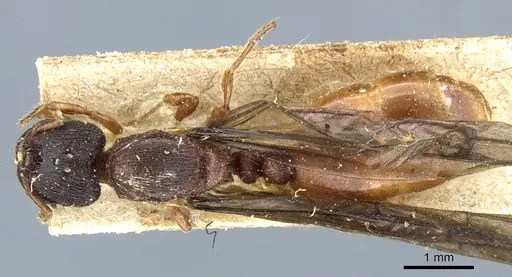
Literatura
Cargando mapa de distribución...Cargando productos...