
Vitsika obscura
- Sci. Name
- Vitsika obscura
- Tribe
- Crematogastrini
- Subfamily
- Myrmicinae
- Author
- Bolton & Fisher, 2014
- Distribution
- Found in 1 countries
Introduction
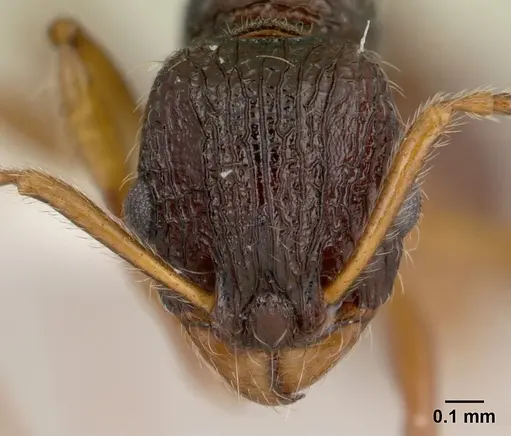
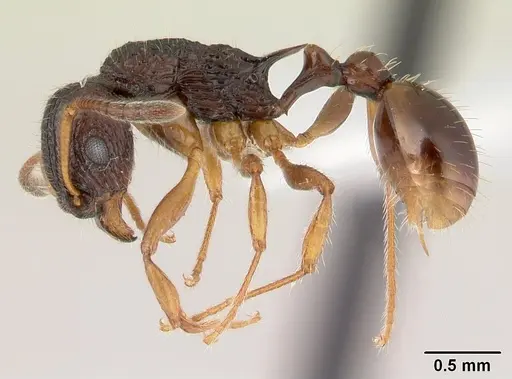
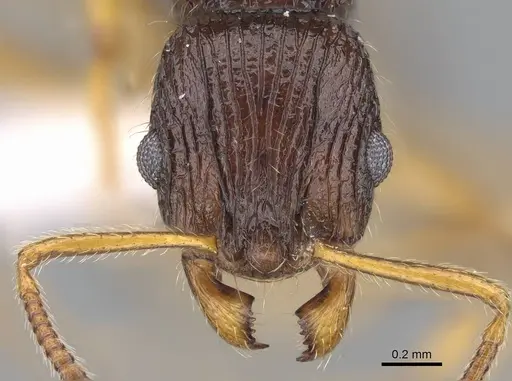
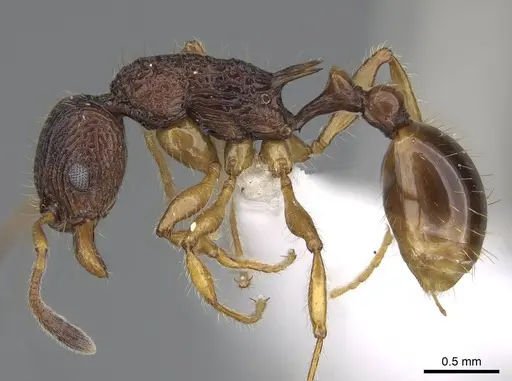
Vitsika obscura is a tiny myrmicine ant endemic to the montane rainforests of Madagascar. Workers measure 4.1mm in total length, with a brown to dark brown body and distinctive yellow antennal scapes that contrast with their darker head capsule . This species was only recently described in 2014 and is known from just four specimens collected in the Andringitra Reserve at 1680m elevation . They are litter-dwelling ants, found by sifting through leaf mold and rotten wood, as well as by beating low vegetation . The genus Vitsika is part of the Crematogastrini tribe and contains species closely related to Eutetramorium, all endemic to Madagascar .
Quick Summary
- Difficulty: Unknown, no captive husbandry data available
- Origin & Habitat: Montane rainforest in central Madagascar (Andringitra Reserve,1680m elevation). Found in leaf mold and rotten wood litter, and by beating low vegetation [1][2].
- Colony Type: Unknown, only worker caste has been described. Colony structure has not been documented.
- Size & Growth:
- Antkeeping:
- Temperature: Unconfirmed, likely moderate temperatures matching their montane habitat (estimated 18-24°C). Start around 20-22°C and observe colony activity.
- Humidity: Likely high humidity (60-80%) given their montane rainforest origin and litter-dwelling habits. Keep substrate consistently moist but not waterlogged.
- Diapause: Unknown, montane species may have seasonal activity patterns. Observe colony behavior for dormancy cues.
- Nesting: In nature they live in leaf litter and rotting wood. In captivity, a naturalistic setup with moist substrate (soil/peat mix) or a small Ytong/plaster nest with tight chambers would likely work. They are tiny, so narrow passages are important.
- Behavior: Litter-dwelling ants that forage in low vegetation and leaf litter. Their small size and cryptic habits suggest they are shy and non-aggressive. Escape prevention is critical due to their tiny 4.1mm size, they can squeeze through very small gaps. As members of the Crematogastrini tribe, they likely use a smear stinger, a modified, flattened spatulate stinger for wiping venom onto enemies rather than piercing flesh. No defensive stinging behavior documented for this genus.
- Common Issues: no captive husbandry data exists, all care is speculative, tiny size makes escape prevention challenging, only known from four specimens in the wild, availability is extremely limited, queen caste undescribed, founding behavior unknown, montane origin may require specific temperature and humidity conditions
Species Discovery and Taxonomy
Vitsika obscura was only described in 2014 by Bolton and Fisher as part of a major taxonomic revision of Madagascan myrmicine ants related to Eutetramorium [1]. The species is known from just four worker specimens collected in the Andringitra Reserve in central Madagascar [1]. It was initially described as separate from Vitsika miranda with some reservations, the specimens are consistently larger and lighter in color than miranda, and have fewer but more widely spaced costulae on the mesopleuron [1]. Both species are similar to the yellow Vitsika astuta, but can be distinguished by their shorter, stubbly metatibial setae [1]. This species represents how little we still know about Madagascar's ant fauna, with many species remaining undescribed even in well-studied areas.
Natural Habitat and Distribution
This species is endemic to Madagascar, known only from the Andringitra Reserve at 1680m elevation in the Fianarantsoa Province [1]. The collection site is montane rainforest, a habitat characterized by high humidity, moderate temperatures, and dense vegetation [1]. They were collected using two methods: sifting through leaf mold and rotten wood (litter sampling), and by beating low vegetation, suggesting they forage both on the forest floor and in understory plants [1]. This is typical behavior for small, cryptic ants that live in the forest litter layer. The montane elevation suggests they may be adapted to cooler conditions than lowland tropical ants.
Identification and Appearance
Workers are tiny at just 4.1mm total length, with a brown to dark brown body [1]. The most distinctive feature is the yellow antennal scape, which is noticeably lighter than the brown head capsule [1]. They have relatively large eyes for their size (9 rows of ommatidia) [1]. The propodeum has short spines, and the petiole node has a characteristic shape that is highest at the anterodorsal angle [1]. The postpetiole is short and high with a distinctly convex dorsum [1]. All suberect setae on the dorsal metatibia are short and uniform, shorter than the maximum tibial width [1]. This combination of features helps distinguish them from similar Vitsika species.
Housing and Captive Care
Since no captive husbandry data exists for this species, all care recommendations are speculative but based on reasonable inference from their natural history. They are tiny litter-dwelling ants, so a naturalistic setup with moist substrate (a soil/peat mix that holds humidity well) would be the best starting point. Alternatively, a small Ytong (aerated concrete) or plaster nest with tight, scaled-down chambers could work. Given their montane origin, aim for moderate temperatures around 18-24°C, start at 20°C and adjust based on colony activity. Humidity should be high (60-80%), keeping the substrate consistently moist but not waterlogged. Because they are only 4.1mm, escape prevention is critical, use fine mesh and ensure all connections are sealed. Feed them tiny prey items like springtails, fruit flies, or other micro-arthropods appropriate to their size.
Feeding and Diet
The natural diet of Vitsika obscura has not been studied, but they are likely generalist foragers that collect small insects, honeydew, and other organic matter in their litter habitat. As tiny Myrmicinae, they probably prefer small, soft-bodied prey. In captivity, offer small live prey items like springtails, fruit flies (Drosophila), and other micro-arthropods. They may also accept sugar sources like diluted honey or sugar water, though this is unconfirmed. Feed small amounts every few days and remove uneaten prey to prevent mold. Given their small size, even tiny prey items represent significant meals.
Challenges and Limitations
Vitsika obscura presents significant challenges for antkeepers. First, this species is only known from four specimens in scientific collections, they have never been cultured in captivity and may not be available in the antkeeping hobby [1]. Second, the queen caste remains undescribed, meaning we have no information about their founding behavior or colony structure. Third, all care recommendations are speculative since no one has successfully kept this species. Finally, their tiny 4.1mm size makes them challenging to house and feed properly. For these reasons, this species is not recommended for beginners or even most experienced antkeepers. Those interested in contributing to the knowledge of this species should focus on documenting any colonies that become available through research or conservation channels.
Frequently Asked Questions
Is Vitsika obscura available in the antkeeping hobby?
No. This species is only known from four specimens collected in Madagascar in 1993. It has never been cultured in captivity and is not currently available in the antkeeping hobby. The entire genus Vitsika is endemic to Madagascar and rarely encountered in captivity.
How do I keep Vitsika obscura ants?
No captive husbandry data exists for this species. Based on their natural history (montane rainforest, litter-dwelling), a naturalistic setup with moist substrate at 18-24°C and 60-80% humidity would be a reasonable starting point. However, this species is not recommended for captivity due to its extreme rarity and lack of available colonies.
What do Vitsika obscura ants eat?
Their natural diet is unstudied. As tiny litter-dwelling Myrmicinae, they likely forage for small insects, honeydew, and organic matter. In captivity, you would need to offer tiny live prey like springtails and fruit flies. Sugar acceptance is unconfirmed.
How big do Vitsika obscura colonies get?
Unknown. Only four worker specimens have ever been collected. Colony size estimates for similar litter-dwelling Myrmicinae suggest small colonies of probably under 100 workers, but this is purely speculative for this species.
Does Vitsika obscura have a queen?
The queen caste has not been described. Only the worker caste is known from scientific collections. This is common for rarely collected, cryptic ant species where finding reproductive castes requires specific sampling efforts.
Where is Vitsika obscura found?
This species is endemic to Madagascar, known only from the Andringitra Reserve at 1680m elevation in central Madagascar. The habitat is montane rainforest.
Can I keep Vitsika obscura in a test tube?
While test tubes work for many small Myrmicinae, no captive data exists for this species. Their tiny 4.1mm size would require very small test tubes with appropriate water reservoirs. However, since this species is not available in the hobby, this question is theoretical.
Do Vitsika obscura ants sting?
Stinging behavior has not been documented for this species. As Myrmicinae, they have a functional stinger, but given their tiny size and cryptic nature, any sting would be negligible to humans. Their primary defense is likely escape rather than stinging.
What temperature do Vitsika obscura ants need?
Unconfirmed. Their montane rainforest origin suggests moderate temperatures, likely 18-24°C. No captive data exists to confirm optimal conditions. Start around 20°C and observe colony activity if a colony ever becomes available.
Is Vitsika obscura a good species for beginners?
No. This species is not available in the antkeeping hobby, and even if it were, the complete lack of captive husbandry data makes it unsuitable for any keeper. Additionally, their tiny size and unknown requirements would make them extremely challenging to keep successfully.
How long do Vitsika obscura workers live?
Unknown. No captive studies exist for this species. Typical Myrmicinae workers live several months to a few years, but specific data for Vitsika is unavailable.
Is Vitsika obscura endangered?
Conservation status has not been assessed. However, their extremely limited known distribution (single site in Madagascar) and rarity suggest they could be vulnerable if their habitat is threatened.
Report an Issue
The current care sheet is based fully on literature. See inconsistencies, or something that's incorrect? Please , it will be resolved after review from an admin. Contributing to the blogs tab also helps providing information, to make us be able to further improve the caresheets. Thank you for your support!
References

This caresheet is licensed under CC BY-SA 4.0 .
Community Blogs
CASENT0127742
View on AntWeb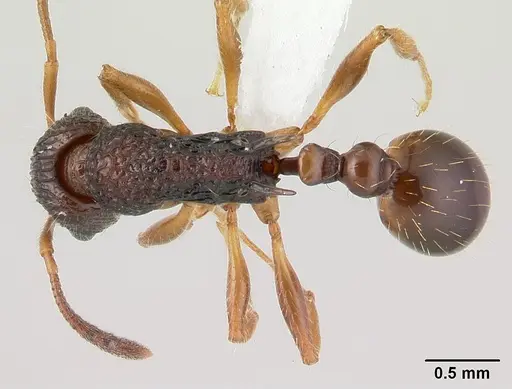
CASENT0192019
View on AntWeb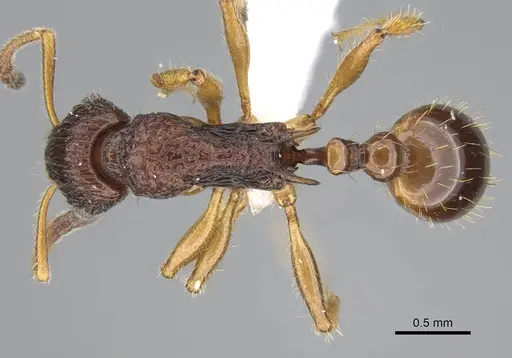
Literature
Loading distribution map...Loading products...