
Typhlomyrmex reichenspergeri
- Sci. Name
- Typhlomyrmex reichenspergeri
- Tribe
- Ectatommini
- Subfamily
- Ectatomminae
- Author
- Santschi, 1929
- Distribution
- Found in 1 countries
Introduction
Typhlomyrmex reichenspergeri is a small, dark brown ant from the subfamily Ectatomminae. Workers are about 5-6 mm (inferred from related species) with a concave vertexal margin, smooth and shining areas on the head and gaster, and an absent metanotal groove . It was first described as Acanthoponera reichenspergeri in 1929,later moved to Gnamptogenys, and transferred to Typhlomyrmex in 2022 . This ant is a habitat specialist found only in primary humid forests in the Neotropical region, specifically Brazil, Colombia, and Venezuela within the Orinoco-Amazon watershed . It belongs to the haytiana complex within the striatula species group and is closely related to Holcoponera relicta . The species stands out as a true soil-dweller - it's one of the more common ponerine ants found in soil samples from its native Atlantic Forest range . It has a short, stout stinger (total surface area 0.07 mm², volume 0.000245 mm³) that confirms its predatory lifestyle, typical of the Ectatomminae subfamily .
Quick Summary
- Difficulty: Expert
- Origin & Habitat: Neotropical region, Brazil, Colombia, and Venezuela. Found in humid primary Atlantic Forests within the Orinoco-Amazon watershed. This species only lives in primary forest, it has never been found in secondary forest or rubber plantations [3][2].
- Colony Type: Unknown, colony structure has not been documented. Based on related Ectatomminae species, likely monogyne (single queen) but this is unconfirmed.
- Size & Growth:
- Queen: Unknown, no data available for queens. Likely slightly larger than workers, estimated from related species.
- Worker: Approximately 5-6 mm, inferred from related Gnamptogenys morphology [1]
- Colony: Unknown, likely small to moderate based on soil-dwelling habits of related species
- Growth: Unknown, likely moderate based on typical Ectatomminae development
- Development: Unknown, estimated 6-10 weeks based on related Ectatomminae species at optimal temperature (Development timeline has not been directly studied. These are rough estimates from genus-level data for related predatory ants.)
- Antkeeping:
- Temperature: Keep warm and stable, roughly 22-26°C. These are tropical forest floor ants, so avoid temperature swings. A gentle gradient allowing workers to self-regulate is recommended.
- Humidity: High humidity is critical, think damp forest floor conditions. Keep the nest substrate consistently moist but not waterlogged. This species is sensitive to drying out.
- Diapause: Unlikely, as a tropical species from humid forests, they probably do not need a diapause period. Maintain year-round warm conditions.
- Nesting: Soil-dwelling species, requires a naturalistic setup with deep substrate (at least 5-10 cm) or a plaster/soil nest with a moist soil chamber. They are subterranean and rarely come to the surface. Use Y-tong (AAC), plaster, soil nests, or 3D-printed nests, avoid acrylic. Tight escape prevention is essential despite their moderate size.
- Behavior: This is a predatory ant with a functional stinger [6]. Workers are likely aggressive toward prey and may sting if threatened, though the stinger is short and stout. They are soil-dwelling and forage through the substrate rather than on the surface. Escape risk is moderate, they are not strong climbers but can squeeze through small gaps. Activity level is likely moderate, with workers patrolling through soil tunnels.
- Common Issues: specialized habitat requirements make captive care challenging, they need primary forest conditions that are hard to replicate, humidity control is critical, these ants can die quickly if the nest dries out, rarity in the hobby, colonies are very difficult to obtain, predatory diet may be demanding, they probably need live small prey regularly, soil-dwelling nature makes observation difficult and colony monitoring a challenge
Natural History and Distribution
Typhlomyrmex reichenspergeri is native to the Neotropical region, specifically Brazil, Colombia, and Venezuela within the Orinoco-Amazon watershed [1][2]. This is a habitat specialist that only lives in primary humid forests, studies found it in 8 forest regions but never in secondary forests or rubber plantations [3]. It's one of the more common ponerine species in soil samples from southern Brazil [5].
The ant was originally described by Santschi in 1929 as Typhlomyrmex reichenspergeri, then moved to Gnamptogenys by Brown in 1958,and most recently transferred to Typhlomyrmex by Camacho et al. in 2022 [2]. It belongs to the haytiana complex within the strigata subgroup of the striatula species group. Its nearest relative is Holcoponera relicta [4].
In its native habitat, this species is exclusively found in soil samples, it is a true soil-dwelling ant that rarely ventures to the surface. Studies in the Atlantic Forest of Brazil show it occurs in leaf-litter and soil layers, with specimens collected using specialized subterranean sampling methods [7][5]. Additional records from Atlantic Forest remnants in the Upper Tietê River Basin show low occurrence rates (0.18-0.34%) [8].
Identification and Morphology
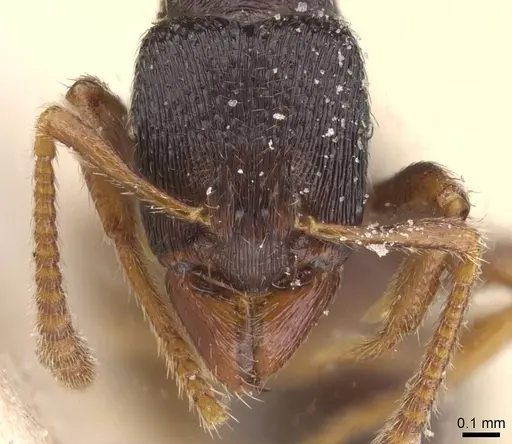
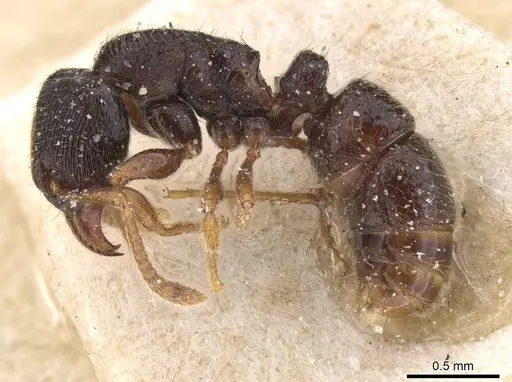
Workers of Typhlomyrmex reichenspergeri are approximately 5-6 mm in size with a dark brown color [2]. Key identifying features: the head has a concave vertexal margin in frontal view with a smooth, shiny vertex, the front of the postpetiole and the middle of the second gastric tergite are smooth and shiny, the metacoxa has a lobe or denticle instead of a spine, the propodeal slope has small lobes above the spiracles, and the metanotal groove is absent [1].
The top of the mesosoma has large smooth and shiny areas, while the pronotum is densely costulate and striate with deep striations [2]. In side view, the petiolar node has nearly parallel front and rear edges. The stinger is short, stout, and almost straight, with a total surface area of 0.07 mm² and volume of 0.000245 mm³ [6].
Housing and Nesting
This is a tough species to keep in captivity due to its specialized soil-dwelling nature. You need a setup with deep substrate (at least 5-10 cm), these ants tunnel through soil, not through exposed nests. Use a plaster nest, Y-tong (AAC) nest, or a 3D-printed nest with a moist soil chamber. Do not use acrylic nests. The key is keeping high humidity while allowing some ventilation to prevent mold.
The nest should be consistently moist but never waterlogged. The substrate should feel damp to the touch. Because these ants live underground, you'll mostly only see workers when they occasionally venture into the outworld. Give them a dark, humid environment that mimics the forest floor.
Escape prevention is important: they can squeeze through small gaps even though they're not tiny. Use tight-fitting barriers and check regularly. [3][5]
Feeding and Diet
Based on its predatory lineage and stinger morphology, Typhlomyrmex reichenspergeri is a predator that hunts small invertebrates in the soil. The species belongs to a predatory lineage based on regime shift analysis [6]. In captivity, offer small live prey like springtails, fruit flies, small crickets, and other micro-arthropods.
Feed small prey items 2-3 times per week, adjusting based on how much the colony eats. Remove any uneaten prey after 24-48 hours to prevent mold. Sugar sources may be accepted occasionally but should not be the main food, these are predators, not sugar-seekers. Always provide fresh water.
Temperature and Seasonal Care
Keep temperatures between 22-26°C, these are tropical forest floor ants that need stable warmth. Avoid temperature swings and direct sunlight on the nest. If using a heating cable, heat only one side to create a temperature gradient so the ants can choose their comfort zone.
As a tropical species from humid primary forests, they likely do not need a diapause period. Maintain year-round warm conditions with consistent humidity. The species lives in the Atlantic Forest region where temperatures stay warm all year, so mimic that in captivity.
Behavior and Temperament
This is a predatory ant with a functional stinger [6]. Workers are likely aggressive toward prey and may sting if the colony feels threatened. The short, stout stinger suggests they rely on subduing small prey rather than defending against large threats [6].
Workers are soil-dwelling and forage through the substrate rather than on the surface. They'll spend most of their time underground, making regular observation tricky but possible when workers emerge into the outworld.
Based on related Ectatomminae species, they're likely moderately aggressive when defending their nest but not particularly territorial. Handle with care and respect their space.
Frequently Asked Questions
How difficult is Typhlomyrmex reichenspergeri to keep?
This is an expert-level species because of its specialized habitat needs. It requires high humidity, warm temperatures, and a soil-based naturalistic setup. It's rarely available in the hobby and has specific care demands that make it unsuitable for beginners.
What do Typhlomyrmex reichenspergeri ants eat?
Based on their predatory lineage and stinger morphology, they are predators that hunt small soil invertebrates. In captivity, offer small live prey like springtails, fruit flies, and small crickets.
Can I keep Typhlomyrmex reichenspergeri in a test tube?
No, a test tube setup is not suitable for this species. They are soil-dwelling ants that need deep substrate to tunnel through. A naturalistic setup with moist soil or a plaster nest with a soil chamber is much more appropriate. Test tubes cannot provide the humidity or tunneling space they need.
Do Typhlomyrmex reichenspergeri ants sting?
Yes, they have a functional stinger. The stinger is short, stout, and almost straight, which is typical for predatory ants in the Ectatomminae subfamily [6]. While the sting is not dangerous to healthy humans, it could be painful and they may sting if threatened.
What temperature do they need?
Keep them at 22-26°C. These are tropical forest floor ants that need warm, stable conditions. Avoid temperature fluctuations and direct sunlight on the nest.
Do they need hibernation?
No, they likely do not require a diapause period. As a tropical species from humid primary forests in Brazil, Colombia, and Venezuela, they should be kept warm year-round without hibernation.
How big do colonies get?
The exact colony size is unknown. Based on related soil-dwelling Ectatomminae species, colonies are likely small to moderate in size. They are not known to form large supercolonies.
Where is Typhlomyrmex reichenspergeri found in the wild?
They are found in Brazil, Colombia, and Venezuela in primary humid forests within the Orinoco-Amazon watershed. This is a habitat specialist restricted to primary forest, they are not found in secondary forest or rubber plantations [3][2].
Why are they so rarely seen in antkeeping?
This species is rarely collected in the wild and has only been found in soil samples from primary forests. Their specialized habitat needs and soil-dwelling nature make them hard to locate and collect. They are not commonly available in the hobby.
Are Typhlomyrmex reichenspergeri good for beginners?
No, this species is not recommended for beginners. They require specific humidity levels, warm temperatures, a naturalistic soil setup, and a predatory diet. Their rarity and specialized care make them suitable only for experienced antkeepers.
Report an Issue
The current care sheet is based fully on literature. See inconsistencies, or something that's incorrect? Please , it will be resolved after review from an admin. Contributing to the blogs tab also helps providing information, to make us be able to further improve the caresheets. Thank you for your support!
References

This caresheet is licensed under CC BY-SA 4.0 .
Community Blogs
CASENT0915131
View on AntWeb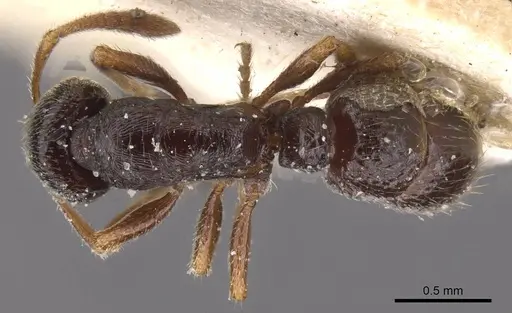
Literature
Loading distribution map...Loading products...