
Trichomyrmex shakeri
- Sci. Name
- Trichomyrmex shakeri
- Tribe
- Crematogastrini
- Subfamily
- Myrmicinae
- Author
- Sharaf & Al Dhafer, 2016
- Distribution
- Found in 1 countries
Introduction
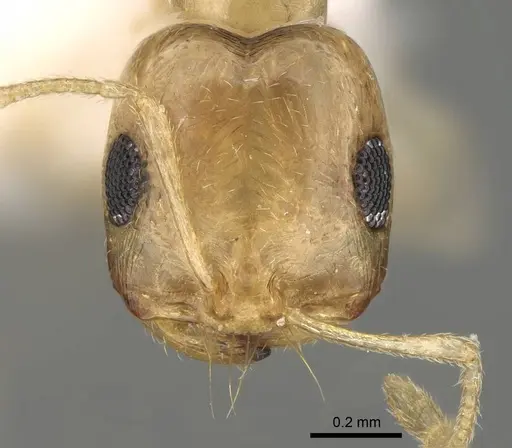
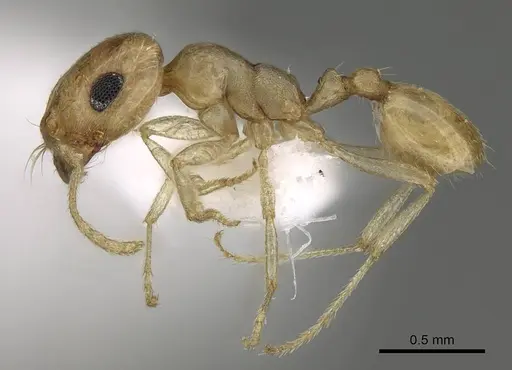
Trichomyrmex shakeri is a tiny yellow ant from Riyadh, Saudi Arabia. Workers measure just 1.94-2.33mm long, placing them among the smallest ant species you can keep . They stand out for their uniform yellow body and large eyes, which are noticeably bigger than those of related species in the region . The species was discovered in Wadi Hanifa, a dry river valley in central Saudi Arabia, and remains very rare in collections . One notable aspect is that this species was only described in 2016,making it a newcomer to science . Almost nothing is known about its biology, colony structure, or care requirements. Keeping this ant means you will be pioneering its husbandry, contributing valuable observations.
Quick Summary
- Difficulty: Expert
- Origin & Habitat: Native to central Saudi Arabia, specifically the Riyadh region. Known only from Wadi Hanifa, a dry river valley at about 814m elevation [1]. The type locality is described as a relatively pristine section of this wadi system [1].
- Colony Type: Unconfirmed. No queen or colony structure data exists in published literature.
- Size & Growth:
- Queen: Unknown, queen has not been described [1]
- Worker: 1.94-2.33mm [1]
- Colony: Unknown, only six workers have ever been collected [1]
- Growth: Unknown
- Development: Unconfirmed, no development data exists for this species (This is a newly described species (2016) with no published biological or developmental studies. Estimates based on similar small Myrmicinae suggest 4-8 weeks at warm temperatures, but this is speculative.)
- Antkeeping:
- Temperature: Based on their Saudi Arabian origin, these ants likely prefer warm conditions. Start around 24-28°C and observe colony activity. Avoid temperatures below 18°C or above 35°C until you learn their preferences.
- Humidity: Originating from an arid wadi, they likely prefer drier conditions than tropical ants. Keep nest substrate moderately dry with a small water reservoir. Allow portions of the nest to dry out completely between waterings.
- Diapause: Unknown, no published data on seasonal requirements. Saudi Arabia has cool winters, so some form of winter rest may be beneficial. Try keeping at room temperature (18-22°C) during winter and observe for reduced activity.
- Nesting: Natural nesting is unconfirmed. Given their wadi origin, they likely nest in soil or under stones. Use small test tubes or mini formicariums scaled to their tiny size. Fine substrate that holds some moisture but drains well is recommended.
- Behavior: Temperament is unconfirmed, but most Trichomyrmex species are not aggressive. Their tiny size (under 2.5mm) means they pose no sting threat to humans. As members of the subfamily Myrmicinae, they have a modified stinger used to smear venom rather than pierce, but at this size it's harmless. Escape prevention is critical, they can squeeze through standard test tube cotton and will require fine mesh barriers.
- Common Issues: tiny size makes escape likely without fine mesh barriers and tight-fitting lids, limited scientific data means care is largely experimental with no established protocols, very rare in the hobby, finding a colony may be difficult, unknown colony structure makes it unclear if single or multiple queens should be kept together, slow growth potential due to limited data on optimal conditions
Discovery and Identification
Trichomyrmex shakeri was described in 2016,making it one of the most recently discovered ant species in the antkeeping hobby [2]. It was found during a survey of Trichomyrmex in the Arabian Peninsula. Researchers collected just six workers using pitfall traps over an entire year [1]. This rarity means wild-caught colonies are exceptionally uncommon.
The species is named after the Egyptian writer Mahmoud M. Shaker (1909-1997) [2]. It is quickly identified by its uniform yellow color and notably large eyes, which are about one-third the width of the head [1]. Another key feature is the absence of a psammophore, a basket of hairs under the head used by some desert ants for carrying water or sand. Its relative Trichomyrmex santschii from Tunisia has a well-developed psammophore, but Trichomyrmex shakeri does not [1].
Origin and Natural Habitat
Trichomyrmex shakeri is known only from Wadi Hanifa in Riyadh, Saudi Arabia, at approximately 24.90°N,46.18°E [1]. The type locality sits at about 814m elevation in a relatively pristine section of this dry river valley [1].
Wadis are dry riverbeds that only carry water during rare rain events. This environment experiences extreme temperatures, very hot summers and cooler winters. The ants have adapted to these conditions, but specific microhabitat preferences are unknown.
The fact that only six workers were collected despite extensive trapping (150 pitfall traps running for one year) suggests this species is either genuinely rare, has very localized populations, or spends most of its time underground [1]. Other collection methods including soil sifting, light traps, and beating sheets also failed to find more specimens [1].
Size and Morphology
Workers are tiny, measuring only 1.94-2.33mm in total length [1]. This places them among the smallest ant species commonly kept. Their small size has major implications for housing and escape prevention.
The head is slightly longer than broad, broader at the front than the back, with a notched posterior margin [1]. The antennae have 12 segments, and the first segment (scape) extends past the back of the head by about one-third of the eye length [1]. The body is largely smooth and shiny, with the head showing longitudinal ridges near the eyes and mandibles, while the mid-body and rear segments have a densely dotted texture [1]. The body is uniformly yellow, with black eyes and dark brown mandibular teeth [1].
Housing and Care Recommendations
Since this species is newly described and extremely rare in captivity, there are no established care protocols. The following are inferences from their origin and related species.
Housing: Use small test tubes or mini formicariums scaled to their tiny size. Standard test tube setups work well, but ensure cotton is packed tightly and consider adding a fine mesh barrier over the opening. Their small size means they can escape through gaps that would hold larger ants.
Temperature: Start around 24-28°C, which matches the warm climate of central Saudi Arabia. A heating cable on one side can create a gradient. Monitor activity, if workers become sluggish, warm slightly, if they avoid the heated area, reduce temperature.
Humidity: The wadi environment suggests they prefer drier conditions. Keep substrate moderately moist but allow portions to dry completely. A small water reservoir in the test tube provides drinking water without creating overly damp conditions.
Feeding: Like other Trichomyrmex species, they likely accept small insects and sugar sources. Offer tiny prey like fruit flies, pinhead crickets, or aphids. A small drop of sugar water can also be offered.
Challenges and Considerations
Keeping Trichomyrmex shakeri presents unique challenges for experienced antkeepers.
First, this is an expert-level species because there is no published care information. You will be pioneering husbandry techniques for a species with no established protocols. Document your observations carefully, they could contribute valuable knowledge.
Second, colonies are extremely rare. Unlike common species, you likely won't find Trichomyrmex shakeri at typical ant suppliers. If you do acquire a colony, it may be the only one in captivity.
Third, the tiny worker size (under 2.5mm) creates significant escape prevention challenges. Standard barriers that work for larger ants may not contain these ants. Use fine mesh, tightly packed cotton, and consider multiple barrier layers.
Finally, patience is essential. With limited data on optimal conditions, establishing a colony may take time. Start with a small founding queen if available, and experiment with temperature, humidity, and feeding.
Frequently Asked Questions
How big do Trichomyrmex shakeri ants get?
Workers are tiny, measuring only 1.94-2.33mm in total length [1]. This makes them one of the smallest ant species kept in captivity. The queen has not yet been described.
Where is Trichomyrmex shakeri from?
This species is native to central Saudi Arabia, specifically the Riyadh region. It is only known from Wadi Hanifa, a dry river valley at approximately 814m elevation [1].
Are Trichomyrmex shakeri ants good for beginners?
No. This is an expert-level species for several reasons: it was only described in 2016 with almost no published biological data, colonies are exceptionally rare, and there are no established care protocols [2]. You will be pioneering husbandry techniques instead of following known best practices.
What do Trichomyrmex shakeri ants eat?
Diet is unconfirmed for this species. Based on related Trichomyrmex species, they likely accept small insects and sugar sources. Offer tiny prey like fruit flies, small crickets, or aphids, along with occasional sugar water. Start with small amounts and observe what they accept.
Do Trichomyrmex shakeri ants sting?
As members of the subfamily Myrmicinae, they have a functional stinger. However, at only 2mm in length, they are far too small to penetrate human skin or cause any pain. They pose no sting threat to keepers. Their defense mechanism is to smear venom rather than pierce.
How long does it take for Trichomyrmex shakeri to develop from egg to worker?
Development time is unconfirmed, no scientific studies have documented the lifecycle of this species. Based on similar small Myrmicinae, estimates suggest 4-8 weeks at warm temperatures (around 26°C), but this is speculative.
What temperature do Trichomyrmex shakeri ants need?
Temperature requirements are unconfirmed, but their Saudi Arabian origin suggests warm conditions. Start around 24-28°C and adjust based on colony activity. Avoid temperatures below 18°C or above 35°C until you learn their preferences.
Do Trichomyrmex shakeri ants need hibernation?
Diapause requirements are unknown. Saudi Arabia experiences cool winters, so some form of winter rest may be beneficial. Try keeping them at room temperature (18-22°C) during winter months and observe for reduced activity. More research is needed.
Why is Trichomyrmex shakeri so rare?
This species is considered uncommon in the wild, researchers only collected six workers despite extensive trapping (150 pitfall traps over one year) [1]. It may have very localized populations or spend most of its time underground where standard collection methods cannot reach them.
How do I identify Trichomyrmex shakeri?
Trichomyrmex shakeri can be identified by its uniform yellow body color combined with notably large eyes [1]. Unlike its relative Trichomyrmex santschii, it lacks a psammophore (the basket of hairs under the head used for carrying water or sand) [1].
Can I keep multiple Trichomyrmex shakeri queens together?
Colony structure is unconfirmed, no data exists on whether they are single-queen (monogyne) or multi-queen (polygyne) colonies. Without this information, combining unrelated queens is not recommended.
What makes Trichomyrmex shakeri different from other ants?
Several things: it was only described in 2016,is known from only a tiny area in Saudi Arabia, has exceptionally large eyes for its genus, and is one of the rarest ant species in captivity [1][2]. Keeping this species means you are contributing to our understanding of a virtually unknown ant.
Report an Issue
The current care sheet is based fully on literature. See inconsistencies, or something that's incorrect? Please , it will be resolved after review from an admin. Contributing to the blogs tab also helps providing information, to make us be able to further improve the caresheets. Thank you for your support!
References

This caresheet is licensed under CC BY-SA 4.0 .
Community Blogs
CASENT0922068
View on AntWeb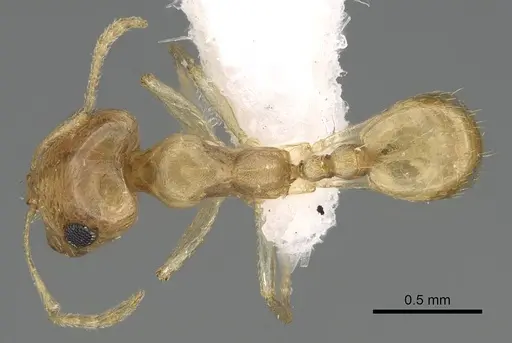
Literature
Loading distribution map...Loading products...