
Tetraponera phragmotica
- Sci. Name
- Tetraponera phragmotica
- Tribe
- Pseudomyrmecini
- Subfamily
- Pseudomyrmecinae
- Author
- Ward, 2006
- Distribution
- Found in 1 countries
Introduction
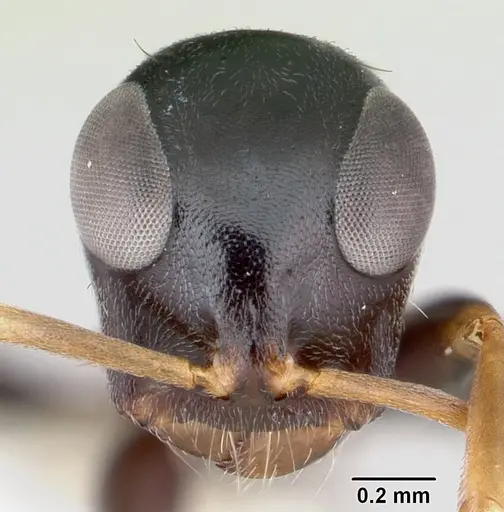
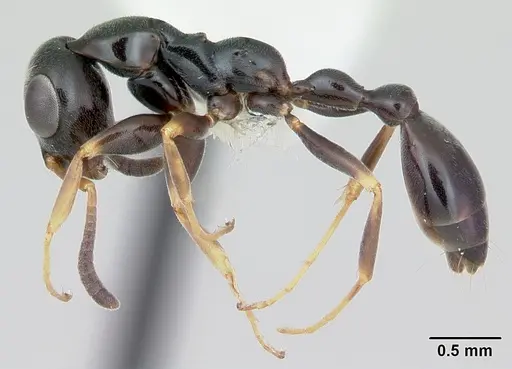
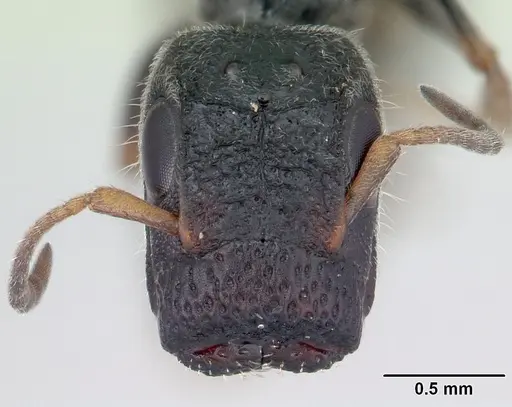
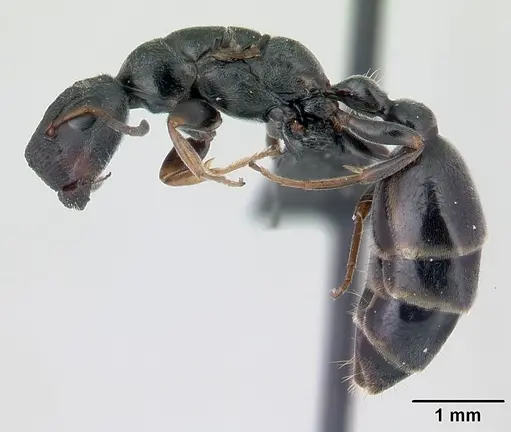
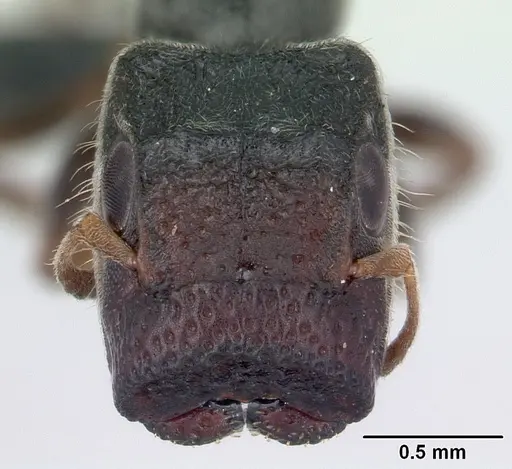
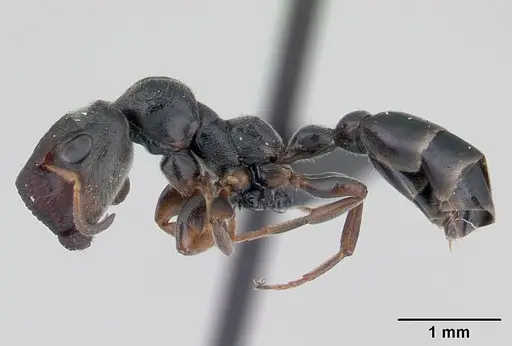
Tetraponera phragmotica is an ant species known only from Nosy Be island in northwestern Madagascar. Workers are black to brownish-black with lighter yellowish-brown on their mandibles, antennae, and leg tips . What makes this species special is its phragmotic soldier caste - these major workers have an enlarged, plug-shaped head formed by a cut-off clypeus that blocks the nest entrance, similar to the unrelated Colobopsis ants . This is called phragmosis, a rare trait where physical defense happens by sealing the nest cavity. The queen also has a phragmotic head but retains distinct ocelli (simple eyes) that are absent in the soldier .
Quick Summary
- Difficulty: Unknown, no captive husbandry data available
- Origin & Habitat: Nosy Be island, northwestern Madagascar. Found in dead twigs of Albizia trees along roadside next to mangroves at elevations below 5 m [1].
- Colony Type: Colony structure is unconfirmed. Based on related Tetraponera species, likely single-queen colonies. The species has a distinct soldier (major worker) caste with phragmotic head morphology [1].
- Size & Growth:
- Queen: Size data unavailable [1]
- Worker: Body length ~4-6 mm (inferred from Tetraponera genus) [1]
- Colony: Unknown, no colony size data available
- Growth: Unknown, no development data available
- Development: Unconfirmed, no development data available for this species (Development timeline is unknown. Related Tetraponera in the ambigua group may provide estimates, but specific data for T. phragmotica is not available.)
- Antkeeping:
- Temperature: Inferred: keep warm, around 24-28°C, based on tropical Madagascar habitat. Nosy Be has a warm, humid climate year-round [1].
- Humidity: Inferred: provide a consistently moist nest substrate, the species inhabits mangroves and coastal areas. Keep the nest substrate moist but not waterlogged [1].
- Diapause: Unlikely, as a tropical species from Madagascar, diapause is probably not required. A slight temperature reduction during cooler months may be beneficial, but this is speculation.
- Nesting: Twig-dwelling ant, in captivity, they would likely accept small natural twigs, bamboo sections, or plaster nests with narrow chambers. Provide a naturalistic setup with dead twigs if possible [1].
- Behavior: The most notable behavior is phragmosis, soldier workers use their plug-shaped heads to block nest entrances, protecting the colony [1]. This is a passive defense mechanism rather than aggressive behavior. Workers are small (head width ~0.8 mm) and can squeeze through tiny gaps, so escape prevention must be excellent. Foraging style is unknown, but related Tetraponera species are generalist feeders.
- Common Issues: no captive husbandry data exists, this species has never been kept in captivity, small workers (head width ~0.8 mm) can fit through gaps as narrow as 0.8 mm, so the nest must be sealed perfectly [1], tropical species may be sensitive to temperature drops or dry conditions, colony structure and founding behavior are unconfirmed, may be difficult to establish from wild-caught queens
The Phragmotic Soldier Caste
The most remarkable feature of Tetraponera phragmotica is its specialized soldier caste. These major workers have a greatly enlarged head with an abruptly cut-off (truncate) front part. The clypeus (the plate above the mandibles) is expanded into a plug shape that seals the nest entrance perfectly [1]. This is called phragmosis, a rare phenomenon in ants where workers physically block the nest cavity with their modified heads. The surface of this plug is coarsely pitted and rough, which may help create a better seal. The queen also has this phragmotic head but differs in having distinct ocelli (simple eyes) on the top of her head, which the soldier lacks [1]. This convergence with the unrelated Colobopsis genus (Formicinae) is striking, both evolved the same solution to nest defense independently.
Natural History and Distribution
Tetraponera phragmotica is known only from Nosy Be (also called Hellville), a small island off the northwest coast of Madagascar. All specimens were collected from dead twigs of Albizia trees growing along a roadside next to mangroves at elevations below 5 meters [1]. This habitat suggests they prefer warm, humid tropical conditions near coastal areas. The species was described by Philip S. Ward in 2006 as part of a revision of the Tetraponera ambigua species group. The type series was collected in May 1989 and February 1991,with specimens found in both a recently felled tree and a standing tree [1]. This twig-nesting behavior is typical of the genus Tetraponera, which commonly inhabits hollow stems, dead twigs, and bamboo.
Identification and Morphology
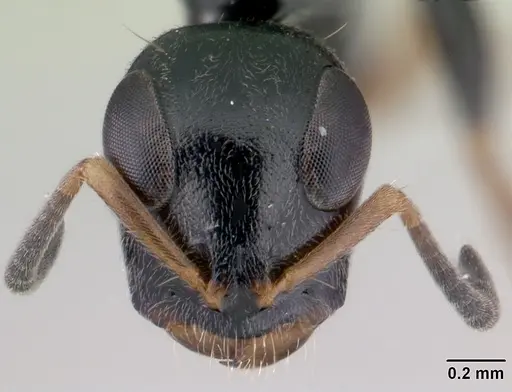
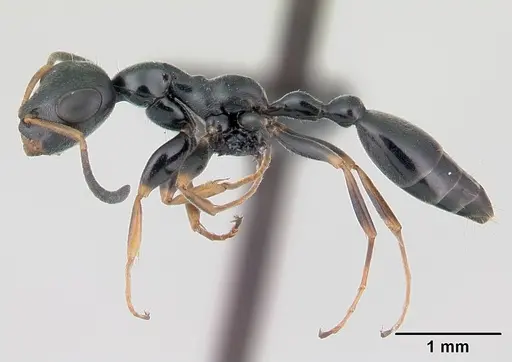
Workers of T. phragmotica are relatively large for the ambigua group, with a head width exceeding 0.80 mm and a length of the hind tarsus (LHT) over 0.70 mm [1]. They have a broad head with protruding eyes and a distinctive six-toothed mandible, unique among species in the ambigua group [1]. The body is largely smooth and shining black to brownish-black, with lighter yellowish-brown on the mandibles, scapes (first antennal segments), tarsi, parts of the tibiae, and the tips of the femora [1]. Standing hairs are sparse, and the species lacks hairs on the mesonotum, propodeum, and petiole. A unique feature among the ambigua group is a metabasitarsal sulcus, a weak line on the upper half of the basitarsus (first tarsal segment) [1].
Housing and Captive Care
Since this species has never been documented in captive antkeeping, all care recommendations are estimates based on natural history and related species. Provide a warm, humid environment, aim for temperatures around 24-28°C [1]. Keep the nest substrate consistently moist, not waterlogged, because they come from mangrove areas. As twig-dwelling ants, they may accept small natural twigs, bamboo sections, or plaster nests with narrow chambers. Escape prevention is critical, workers have a head width of about 0.8 mm and can squeeze through tiny gaps. Use fine mesh barriers and seal all connections. Feed a varied diet including small live prey (fruit flies, springtails) and sugar sources (honey water, sugar water). Remove uneaten food regularly to prevent mold.
Feeding and Diet
The specific diet of T. phragmotica has not been documented, but Tetraponera species are generally omnivorous, feeding on nectar, honeydew, and small insects. In captivity, offer small live prey such as fruit flies, pinhead crickets, and other tiny arthropods. Provide sugar sources, a drop of honey water or sugar water periodically. As with all ants, remove uneaten prey within 24-48 hours to prevent mold and bacterial issues. Start with small amounts and observe what the colony accepts.
Challenges and Considerations
This species has never been documented in captive husbandry, so no established care protocol exists. Its natural range is extremely limited, only Nosy Be island in Madagascar, making wild-caught queens difficult or impossible to obtain. The phragmotic soldier caste suggests specialized colony dynamics that may differ from typical ant species. If you do obtain a colony, document your observations carefully, as they would contribute valuable information. The tropical origin means they likely have no diapause requirement but may be sensitive to temperature drops or low humidity [1].
Frequently Asked Questions
How do I keep Tetraponera phragmotica ants?
This species has never been documented in captive antkeeping, so there is no established care protocol. Based on its natural history, provide a warm (24-28°C), humid environment with small nesting chambers. Use fine mesh for escape prevention as workers have a head width of about 0.8 mm. This is an advanced species that requires experience with tropical ants.
What do Tetraponera phragmotica ants eat?
Specific diet data is not available, but related Tetraponera species are omnivorous. Offer small live prey (fruit flies, springtails) and sugar sources (honey water, sugar water). Start with variety and observe what your colony accepts.
What is special about Tetraponera phragmotica soldiers?
The soldiers have a unique plug-shaped head used to block the nest entrance, this is called phragmosis. The cut-off clypeus forms a perfect seal that protects the colony from predators and intruders [1]. This rare trait makes them one of the most morphologically distinctive ants in the hobby.
Where does Tetraponera phragmotica live?
This species is known only from Nosy Be island in northwestern Madagascar. All specimens have been collected from dead twigs of Albizia trees growing along roadsides next to mangroves at elevations below 5 meters [1].
How big do Tetraponera phragmotica colonies get?
Colony size data is not available. The species is known only from the type series collected in 1989 and 1991. Based on related Tetraponera species, colonies likely reach several hundred workers at maturity.
Do Tetraponera phragmotica ants need hibernation?
Unlikely. As a tropical species from Madagascar, they probably do not require a diapause period. However, a slight temperature reduction during cooler months may be beneficial. Monitor colony activity and adjust accordingly.
Can I keep multiple Tetraponera phragmotica queens together?
Colony structure has not been documented for this species. Based on related Tetraponera species, they likely form single-queen colonies. Combining unrelated queens is not recommended without evidence they can form multi-queen colonies.
How long does it take for Tetraponera phragmotica to develop from egg to worker?
Development data is not available for this species. The egg-to-worker timeline is unknown and has never been studied. Estimates based on related species suggest 4-8 weeks at tropical temperatures, but this is speculative.
Are Tetraponera phragmotica ants aggressive?
Their primary defense is the phragmotic soldier head-plug, which is a passive barrier rather than aggressive behavior. They are small ants of subfamily Pseudomyrmecinae which have stingers, but stinging has not been documented for this species. The plug-shaped head blocks intruders physically [1].
What size nest do Tetraponera phragmotica need?
As twig-dwelling ants, they prefer small, narrow chambers. A naturalistic setup with small wooden sections or bamboo pieces would be appropriate. The chambers should be sized for their small worker size (body length ~4-6 mm) [1].
Do Tetraponera phragmotica ants sting?
Tetraponera belongs to the subfamily Pseudomyrmecinae, which does have stingers. However, these ants' primary defense appears to be the phragmotic head plug. The stinging capability of this specific species has not been documented.
Is Tetraponera phragmotica available for sale?
This species has likely never been available in the antkeeping hobby. Its known range is extremely limited to Nosy Be island, Madagascar, and it was only described in 2006. Obtaining this species would be extremely difficult if not impossible.
Report an Issue
The current care sheet is based fully on literature. See inconsistencies, or something that's incorrect? Please , it will be resolved after review from an admin. Contributing to the blogs tab also helps providing information, to make us be able to further improve the caresheets. Thank you for your support!
References

This caresheet is licensed under CC BY-SA 4.0 .
Community Blogs
CASENT0106134
View on AntWeb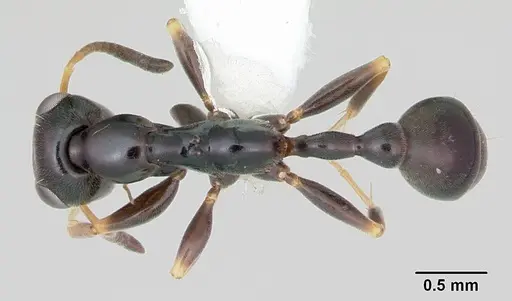
CASENT0136419
View on AntWeb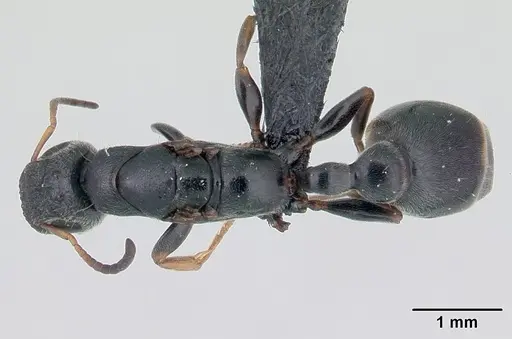
CASENT0136420
View on AntWeb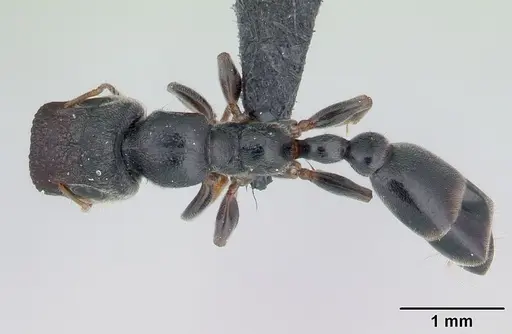
CASENT0136912
View on AntWeb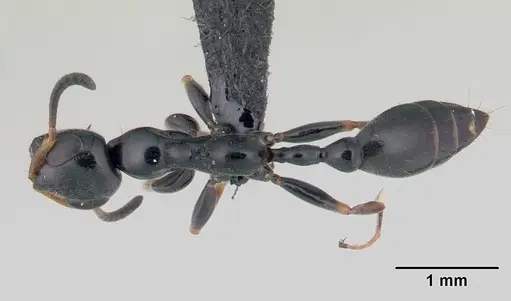
Literature
Loading distribution map...Loading products...