
Tetraponera inermis
- Sci. Name
- Tetraponera inermis
- Tribe
- Pseudomyrmecini
- Subfamily
- Pseudomyrmecinae
- Author
- Ward, 2009
- Distribution
- Found in 1 countries
Introduction
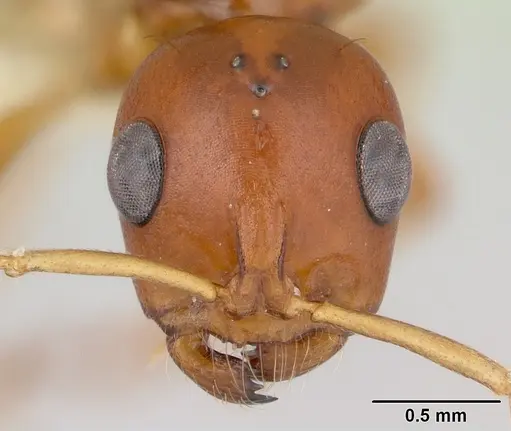
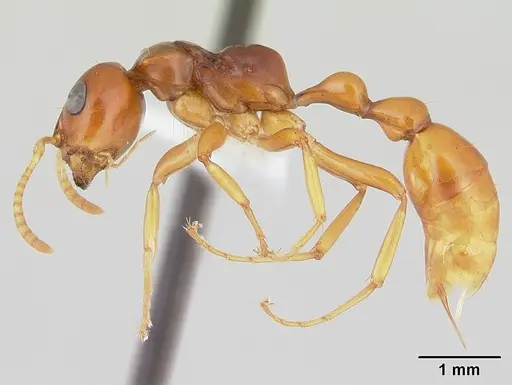
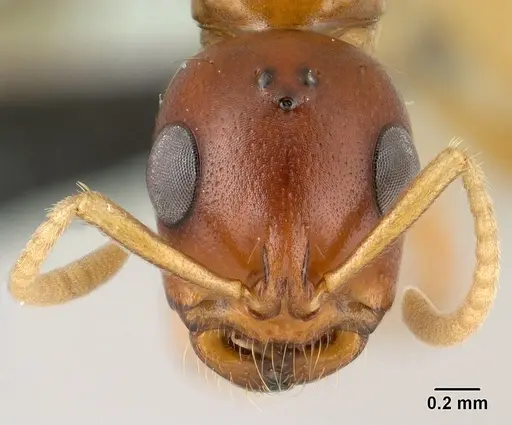
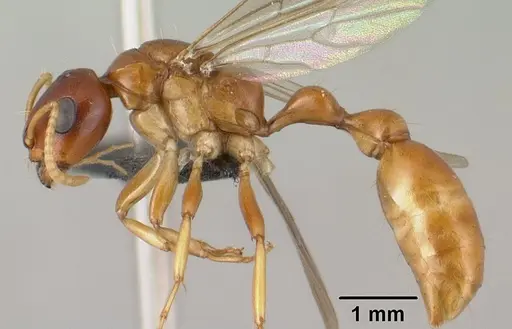
Tetraponera inermis is a small ant from the rainforests of eastern Madagascar. Workers are reddish-brown, often with a darker red on the upper part of the propodeum and a paler metasoma . They are identified by the lack of a tooth on the basal margin of the mandible, a broad head, and a metanotal spiracle that does not stick out when the mesosoma is viewed from the side . This species belongs to the Tetraponera grandidieri group. Unlike many ants, T. inermis queens are non-claustral (also called semi-claustral) – they leave the nest to forage for food while raising their first workers . Foraging workers also display a unique behavior: they walk rapidly and raise their gaster (the rear part of the abdomen) high in the air, likely as a defensive display . This species nests in small cavities inside rotten sticks on the forest floor and forms small colonies .
Quick Summary
- Difficulty: Medium
- Origin & Habitat: Eastern Madagascar, from Montagne d'Anjanaharibe to Tolagnaro (Fort Dauphin). Found only in rainforest habitats, at elevations from 30 m to 1040 m [1].
- Colony Type: Single-queen (monogyne) colonies. Queens are the only reproductive females, no ergatoid queens or gamergates are known [1].
- Size & Growth:
- Queen: Size data unavailable. Queens are winged and slightly larger than workers, but total length has not been recorded.
- Worker: Size data unavailable. Head width is about 1.02–1.27 mm, but total length is not documented.
- Colony: Small colonies – nests are described as small, fitting inside a rotten stick on the ground [1].
- Growth: Moderate – semi-claustral founding may allow faster initial growth because the queen can forage, but colony size remains modest.
- Development: Estimated 6–8 weeks at around 24°C, based on typical Pseudomyrmecinae patterns. (Semi-claustral queens can supplement their energy by foraging, which may shorten development compared to fully claustral species.)
- Antkeeping:
- Temperature: Maintain 22–26°C. Avoid sudden drops, this is a tropical rainforest species.
- Humidity: High humidity needed – keep the nest substrate consistently moist but not waterlogged. Aim for a moist environment, as the ants come from rainforest floors [1].
- Diapause: Unknown. As a tropical species, true hibernation is unlikely, but a slight winter cooling (a few degrees cooler) may be beneficial. Do not allow temperatures below 18°C.
- Nesting: In nature, they nest in small cavities inside rotten sticks on the ground [1]. In captivity, a test tube setup works well for founding. For established colonies, use a small Y-tong, plaster, or naturalistic nest with good moisture retention. Provide a moisture gradient.
- Behavior: T. inermis is an active, fast-moving ant. Foraging workers raise their gaster high in the air – this is a defensive display, not aggression toward the keeper [1]. They will not seek to sting humans unless handled roughly. Because workers are small (~1 mm head width), they can squeeze through tiny gaps, so escape-proof enclosures are essential. They are ground-dwelling but can climb glass and plastic.
Housing and Nest Setup
In the wild, T. inermis nests in small cavities inside rotten sticks on the rainforest floor [1]. For captivity, start with a test tube setup: fill a tube with water, plug the dry end with cotton, and connect it to a small outworld. The queen will settle in the dry part. Once the colony has workers, you can move them to a small Y-tong or plaster nest. Since they are used to moist rotten wood, the nest material should hold humidity well. Provide a moisture gradient – one side slightly drier, one side moist. Avoid acrylic nests, they do not hold humidity well for this species. Use a small formicarium (e.g.,10x10 cm) with a removable lid for easy feeding and cleaning.
Feeding and Diet
As a member of the Pseudomyrmecinae subfamily, T. inermis is likely omnivorous. In the wild, foraging queens and workers glean leaf surfaces for food [1]. In captivity, offer small protein sources: fruit flies, pinhead crickets, or tiny mealworms. Sugar sources are also important: diluted honey or sugar water (changed daily to prevent spoilage). Feed founding queens very small items (e.g., one fruit fly every 2–3 days) because they cannot store much fat. Remove uneaten prey after 24 hours to prevent mold in the humid environment. For established colonies, feed 2–3 times per week, adjusting based on consumption. You can also try small segments of mealworm or Drosophila.
Temperature and Humidity
T. inermis comes from Madagascar's rainforest environments, so they need warm, stable conditions. Keep temperatures between 22–26°C. Avoid cold drafts and direct heat that can dry the nest. Humidity should be high – keep the nest substrate moist (but not waterlogged) and provide a humid outworld. Mist the outworld lightly if needed, but avoid waterlogging the nest. Use a moisture gradient: a water reservoir in the nest or a carefully dampened substrate. A heating cable placed on top of the nest (not underneath) can create a gentle warm zone, but check that it does not dry out the nest too quickly. [1]
Colony Founding
This species has semi-claustral (non-claustral) colony founding, which is rare among ants [1]. The founding queen must leave the nest to forage for food. She returns to a brood chamber in a small cavity. In captivity, you need to provide her with food regularly – tiny insects or a drop of honey water every few days. Keep the founding setup in a quiet, dark place and minimize disturbance. A test tube with a claustral setup (where the queen cannot leave) would fail because she needs to exit to eat. Instead, use a test tube with an open entrance connected to a small foraging arena. The queen will venture out for food. A wild foundress was observed walking rapidly on leaf surfaces and returning to her nest containing eggs, larvae, and worker pupae [1]. This shows that colony founding requires attentive care.
Behavior and Temperament
T. inermis workers display a distinctive defensive behavior: they raise their gaster high in the air while walking [1]. This is thought to be a warning signal to predators, and it may be accompanied by a sting threat. They are not aggressive toward humans unless provoked, and they rarely sting. Workers are fast-moving and alert. Because they are small (head width ~1 mm), they can escape through gaps of 1 mm or less, so seal all connections with fluon or a thin layer of oil. Their activity level is moderate – they forage actively when food is offered. The gaster-raising behavior is a good sign that the colony is healthy and aware of its surroundings.
Frequently Asked Questions
Is Tetraponera inermis a good beginner ant?
Tetraponera inermis is of medium difficulty. The semi-claustral founding requires more attention than typical claustral species because the queen needs food during founding. Their high humidity needs and small colony size also demand careful monitoring. Not ideal for complete beginners, but manageable for those with some antkeeping experience. [1]
How long does it take for Tetraponera inermis to raise first workers?
Based on typical tropical Pseudomyrmecinae patterns, expect first nanitic workers in about 6–8 weeks at 24°C. Semi-claustral queens can forage, which may speed development slightly compared to claustral species. [1]
Do Tetraponera inermis ants sting?
Yes, T. inermis belongs to the subfamily Pseudomyrmecinae, which has a functional sting. However, they are not aggressive and will only sting if handled roughly. Their gaster-raising display is a warning. [1]
What do I feed Tetraponera inermis?
Offer small protein insects like fruit flies, pinhead crickets, or small mealworms. They also accept sugar water or diluted honey. Remove uneaten prey after 24 hours to prevent mold. During founding, provide tiny prey items directly to the queen. [1]
Can I keep multiple Tetraponera inermis queens together?
No, T. inermis is monogyne – colonies normally have one queen. Two unrelated queens would fight. In the wild, colonies are founded by a single dealate queen. [1]
Do Tetraponera inermis need hibernation?
As a tropical rainforest species from Madagascar, they do not require true hibernation. A slight seasonal cool-down (a few degrees lower, but not below 18°C) may be beneficial but is not necessary. [1]
Why is my Tetraponera inermis queen dying during founding?
The most common reason is lack of food. Semi-claustral queens must eat to produce eggs and raise brood, so you must offer small prey or honey water regularly. Also check humidity: too dry will desiccate her, too wet can cause drowning. [1]
How big do Tetraponera inermis colonies get?
Colonies remain small. In the wild, nests are tiny cavities in rotten sticks, so expect fewer than 100 workers at maturity. This makes them suitable for small formicariums. [1]
When should I move Tetraponera inermis to a formicarium?
Wait until the colony has at least 20–30 workers before moving to a small formicarium. A test tube is sufficient for founding and early growth. Choose a nest with high humidity (Y-tong or plaster). [1]
What makes Tetraponera inermis different from other ants?
Their most distinctive trait is the gaster-raising behavior of foraging workers – they walk with the abdomen held high, likely as a defensive display [1]. They also have semi-claustral colony founding, which is relatively rare. Identification features include no tooth on the mandible base and a broad head [1].
Report an Issue
The current care sheet is based fully on literature. See inconsistencies, or something that's incorrect? Please , it will be resolved after review from an admin. Contributing to the blogs tab also helps providing information, to make us be able to further improve the caresheets. Thank you for your support!
References

This caresheet is licensed under CC BY-SA 4.0 .
Community Blogs
CASENT0012862
View on AntWeb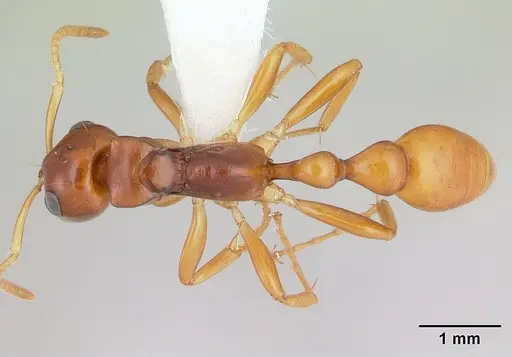
CASENT0138658
View on AntWeb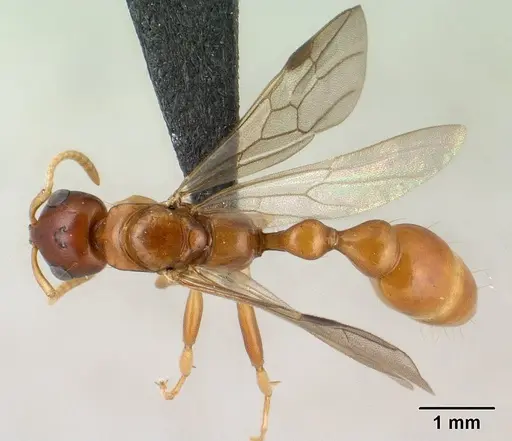
Literature
Loading distribution map...Loading products...