
Tetramorium tsingy
- Sci. Name
- Tetramorium tsingy
- Tribe
- Crematogastrini
- Subfamily
- Myrmicinae
- Author
- Hita Garcia & Fisher, 2012
- Distribution
- Found in 1 countries
Introduction
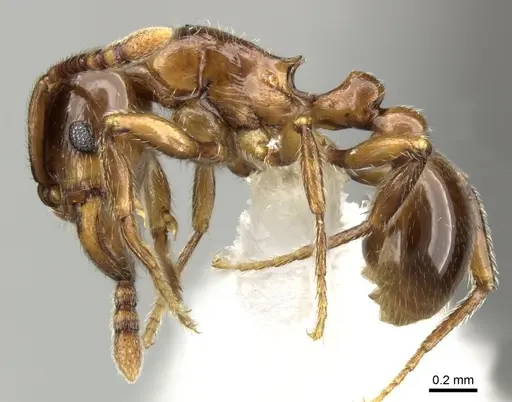
Tetramorium tsingy is an extremely tiny ant from Madagascar, known only from a handful of specimens. The workers are uniformly brown with short, triangular propodeal spines and a strongly appressed layer of hair on the first segment of the gaster . The species lives in Parc National Tsingy de Bemaraha, a tropical dry forest famous for its sharp limestone karsts - the name 'tsingy' means 'where one cannot walk barefoot' in Malagasy . What really sets this ant apart is that all collected individuals were found inside the ground nests of the much larger ant *Aphaenogaster swammerdami* . Whether it's a social parasite, a tolerated guest, or something else is completely unknown, making this one of the most mysterious ant species in the world.
Quick Summary
- Difficulty: Expert
- Origin & Habitat: Parc National Tsingy de Bemaraha, Madagascar, at 100 m elevation in tropical dry forest on tsingy limestone karst formations [1][2]
- Colony Type: Unknown colony structure, only known from a few individuals found inside nests of Aphaenogaster swammerdami [1][2]
- Size & Growth:
- Queen: Unknown, no queens have been described [1]
- Worker: Size data unavailable, only head measurements exist (head length 0.63-0.66 mm, head width 0.60-0.62 mm), total body length has not been recorded [1]
- Colony: Unknown, only two worker specimens have ever been collected [1]
- Growth: Unknown
- Development: Unknown, no development data exists for this species (All life history information is missing, any timeline would be pure guesswork.)
- Antkeeping:
- Temperature: Likely 24-28 °C based on Madagascar tropical dry forest climate, no direct data exists
- Humidity: Likely prefers the drier conditions of tsingy limestone habitat, provide moderate humidity with some dry areas
- Diapause: Unknown, as a Madagascar species, it may have reduced activity during cooler months, but true diapause is unconfirmed
- Nesting: Likely ground‑nesting (type collected in a ground nest) and may prefer tight chambers scaled to its tiny size
- Behavior: Behavior is completely unstudied. Like other myrmicine ants, it has a modified stinger used to smear venom rather than pierce flesh (subfamily/ tribe default). Its extremely small size makes escape prevention critical, it can slip through gaps that larger ants cannot. The association with Aphaenogaster swammerdami hints at possible social parasitism, but this is entirely speculative.
- Common Issues: no captive husbandry information exists, this species has never been kept in captivity, extreme rarity, only known from two type specimens collected in 2001, ecological relationship with the host species is unknown and may be impossible to replicate, tiny size makes feeding and escape prevention extremely challenging, may require live micro‑prey (springtails, tiny arthropods), sugar acceptance unknown, standard escape barriers (fluon, oil) may be ineffective, the ants could walk across oil films
Discovery and Distribution
Tetramorium tsingy was described in 2012 by Hita Garcia and Fisher from specimens collected in Parc National Tsingy de Bemaraha, Madagascar [1]. This species is known only from this single location at approximately 100 meters elevation [1]. The tsingy formations are dramatic limestone karst cliffs and towers that create a unique habitat with vertical faces and narrow crevices, the Malagasy word 'tsingy' literally means 'where one cannot walk barefoot' due to the sharp limestone [2]. The type specimens were collected in November 2001 from a ground nest of Aphaenogaster swammerdami [1]. Despite extensive ant surveys in Madagascar, no additional specimens have been found since the original collection, making this one of the rarest and least known ant species in the world [2].
The Aphaenogaster Relationship
The most fascinating aspect of Tetramorium tsingy is its apparent association with Aphaenogaster swammerdami, a much larger ant species [2]. The only known T. tsingy specimens were found inside ground nests of A. swammerdami [1]. This relationship is poorly understood, several possibilities exist. T. tsingy could be a social parasite living within the host colony, though no parasitic behavior has been observed. They might be commensals simply tolerated by the host, gaining shelter without harming the colony. Alternatively, they could be slave‑makers, though this seems unlikely given their tiny size compared to the host [2]. A. swammerdami is itself a notable species known for its large nests that are famously shared with snakes (Leioheterodon modestus), suggesting these nests provide substantial resources and protection that could benefit smaller ant species [2]. More nest collections from A. swammerdami colonies would be needed to understand this relationship [2].
Identification and Morphology
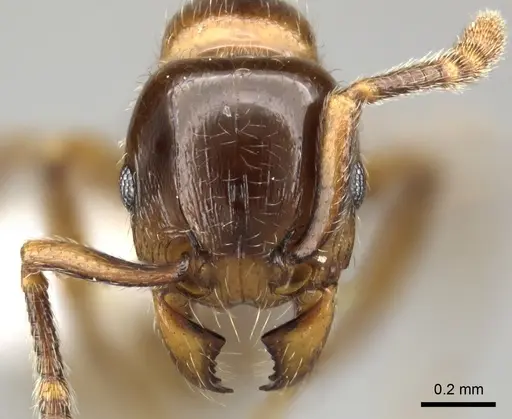
Tetramorium tsingy workers are extremely small, only head measurements are known (head length 0.63-0.66 mm), but total body length has not been recorded [1]. Their head is slightly longer than wide, with relatively small eyes and short antennae that do not reach the back of the head [1]. The propodeum bears moderately short triangular spines, and the propodeal lobes are well‑developed and broadly triangular [1]. A key identifying feature is the strongly appressed pubescence on the first gastral tergite, which distinguishes them from related species in the T. tsingy group [1]. The body is uniformly brown with faint to absent ground sculpture, giving them a smooth and shiny appearance [1]. The petiolar node is rectangular nodiform, about 1.3 times higher than long, and the postpetiole is more voluminous than the petiolar node [1].
Keeping an Extremely Rare Species
Tetramorium tsingy presents extraordinary challenges for antkeeping that must be honestly acknowledged. This species has never been maintained in captivity, and no information exists about its dietary needs, colony structure, or basic husbandry requirements [2]. The extremely small worker size means standard antkeeping approaches may not work, they would require micro‑prey items and could escape through standard barrier systems. If you were to obtain this species, you would essentially be pioneering its captive care with no prior guidance. Recommended approaches would include starting with very small live prey (springtails, micro‑arthropods), maintaining temperatures around 24-28 °C typical of Madagascar tropical dry forest, and providing tight escape prevention. However, obtaining this species would be nearly impossible as it has not been collected since 2001 and is only known from two type specimens [1]. This species is best appreciated as a fascinating natural history curiosity rather than a realistic keeping goal.
Frequently Asked Questions
Can I keep Tetramorium tsingy as a pet ant?
No realistic path exists to keep this species. It is only known from two type specimens collected in 2001 and has never been found again despite extensive ant surveys in Madagascar [1]. No captive colonies exist, and nothing is known about its basic care requirements. Even if specimens were somehow obtained, you would be pioneering all aspects of its husbandry with no guidance [2].
What does Tetramorium tsingy eat?
This is completely unknown. No dietary observations have ever been made. Based on its tiny size, it would likely need micro‑prey such as springtails and other tiny arthropods, but this is speculative.
Where does Tetramorium tsingy live?
This species is known only from Parc National Tsingy de Bemaraha in Madagascar, at about 100 meters elevation in tropical dry forest [1]. The tsingy are dramatic limestone karst formations, steep vertical cliffs and narrow crevices that give the area its name meaning 'where one cannot walk barefoot' [2].
Is Tetramorium tsingy a parasite?
The relationship with Aphaenogaster swammerdami is unknown and highly speculative [2]. Specimens were found in A. swammerdami nests, but no parasitic behavior has been documented. It could be a social parasite, a commensal organism simply tolerated by the host, or perhaps accidentally collected. More research is needed to understand this relationship [2].
How big do Tetramorium tsingy colonies get?
This is completely unknown. Only two worker specimens have ever been collected, and no colony has ever been observed [1]. The colony size and social structure of this species remain a mystery.
Do Tetramorium tsingy ants sting?
Tetramorium tsingy belongs to the subfamily Myrmicinae, whose members use a modified stinger to smear venom onto enemies rather than piercing flesh (subfamily defense mechanism). No specific studies on the stinging behavior of this species exist, but given its tiny size, any venom would likely be negligible to humans.
What makes Tetramorium tsingy special?
Several things. It is one of the smallest Tetramorium species known, with total body length unrecorded but head length only 0.63-0.66 mm [1]. It has the most restricted distribution of any known ant, only a single location in Madagascar [1]. Its apparent association with the much larger Aphaenogaster swammerdami in nests that also harbor snakes creates a fascinating ecological puzzle that remains unsolved [2]. The species is essentially a mystery, every aspect of its biology from colony structure to diet remains unknown.
How do I identify Tetramorium tsingy?
Within the Tetramorium tsingy species group, T. tsingy is identified by its moderately short propodeal spines and the distinctive strongly appressed pubescence on the first gastral tergite [1]. The body is uniformly brown with smooth, shiny sculpture [1]. However, given the species is only known from two specimens and has never been found again, encountering one would be extraordinarily unlikely.
Does Tetramorium tsingy need hibernation?
This is unknown. As a Madagascar species from tropical dry forest, it likely does not require true hibernation but may have reduced activity during cooler months. No research exists on the seasonal biology of this species.
Is Tetramorium tsingy endangered?
The conservation status of this species has not been assessed. Its extremely restricted range (only known from one location) and apparent rarity could make it vulnerable, but without additional records, proper conservation evaluation is impossible [1]. The Parc National Tsingy de Bemaraha is a protected area, which may help protect its habitat [2].
Report an Issue
The current care sheet is based fully on literature. See inconsistencies, or something that's incorrect? Please , it will be resolved after review from an admin. Contributing to the blogs tab also helps providing information, to make us be able to further improve the caresheets. Thank you for your support!
References

This caresheet is licensed under CC BY-SA 4.0 .
Community Blogs
CASENT0426807
View on AntWeb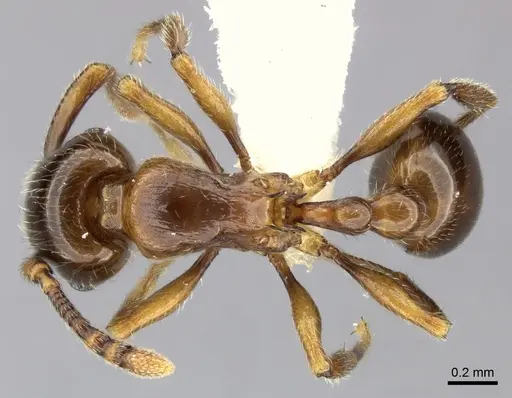
Literature
Loading distribution map...Loading products...