
Tetramorium sepultum
- Sci. Name
- Tetramorium sepultum
- Tribe
- Crematogastrini
- Subfamily
- Myrmicinae
- Author
- Bolton, 1980
- Distribution
- Found in 1 countries
Introduction
Tetramorium sepultum is a small, rare Southern African ant known from only a few collections in South Africa, Mozambique, and Eswatini . Workers measure about 3.5 mm in total length, with a uniformly brown body, medium-sized thick propodeal spines, and relatively small eyes . It belongs to the *Tetramorium weitzeckeri* species group and is easily identified by the complete lack of standing hairs on the first gastral tergite - a trait shared only with a few close relatives . This species is poorly studied, with almost nothing known about its colony structure, behavior, or ecology beyond basic morphology.
Quick Summary
- Difficulty: Unknown, no documented care data exists. Not recommended for beginners.
- Origin & Habitat: Southern Africa, specifically South Africa, Mozambique, and Eswatini [2][4]. Likely inhabits leaf‑litter in moist, shaded forest environments, based on related species in the *weitzeckeri* group [1].
- Colony Type: Unknown, colony structure has not been studied. Most *Tetramorium* species are monogyne (single queen), but this is unconfirmed for *T. sepultum*.
- Size & Growth:
- Queen: Undocumented, no data available.
- Worker: 3.5 mm total length (TL) [3].
- Colony: Unknown, likely under 500 workers if similar to other leaf‑litter *Tetramorium* species.
- Growth: Unknown, likely moderate based on genus patterns.
- Development: Unconfirmed, estimated 6-10 weeks based on typical *Tetramorium* development at optimal temperatures. (Development timeline has not been directly studied for this species. These are rough estimates from related species.)
- Antkeeping:
- Temperature: Unconfirmed, aim for 22-26°C as a starting point for this Southern African species. Monitor colony activity and adjust if needed.
- Humidity: Unconfirmed, based on leaf‑litter habitat of related species, keep the nest substrate consistently moist but not waterlogged. Provide a humid nesting area.
- Diapause: Unknown, Southern African ants may have reduced activity during cooler months, but true diapause requirements are unconfirmed.
- Nesting: Based on related *weitzeckeri* group species, they likely prefer naturalistic setups with soil or a soil‑sand mix for tunneling. Y‑tong (AAC) or plaster nests with a moisture reservoir are also suitable. Avoid dry conditions.
- Behavior: Behavior is unconfirmed. Based on its subfamily (Myrmicinae, tribe Crematogastrini), *T. sepultum* likely uses a 'smear' defense, applying venom with a flattened stinger rather than stinging. Workers are small (3.5 mm) so escape prevention must be tight, tiny ants can slip through standard barriers. They are probably not aggressive but will defend the nest if threatened.
- Common Issues: very limited scientific data, most care advice is inferred from related species, so expect trial and error, nuptial flight timing is unconfirmed, Southern African species typically fly during warm, humid months, but this is not documented, humidity requirements are unconfirmed, too dry or too wet conditions may stress the colony, as a rare species with few records, wild‑caught colonies may be difficult to find, no information on diet specifics, start with small protein sources and sugars and observe acceptance
Appearance and Identification
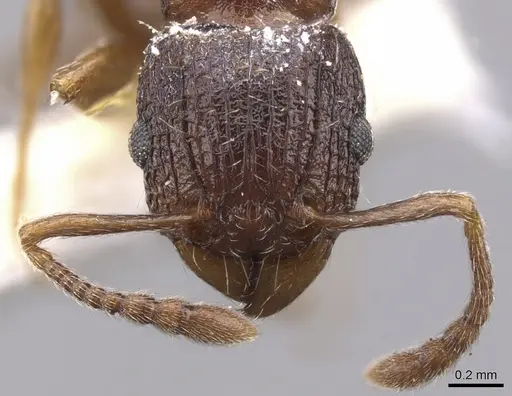
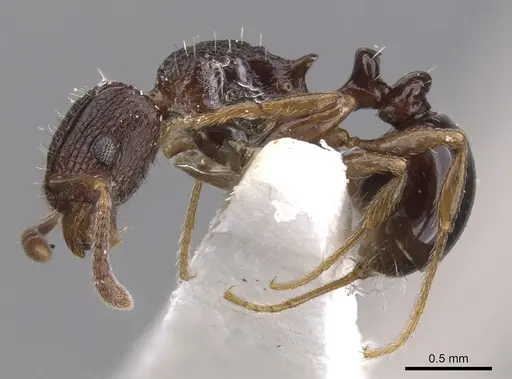
Workers of Tetramorium sepultum are small, about 3.5 mm in total length [3]. The body is uniformly brown, with no standing hairs on the first gastral tergite, a key feature that separates it from many related species [1]. The head is slightly longer than wide, and the eyes are relatively small (with only 8-9 ommatidia in the longest row) [1]. Propodeal spines are medium‑sized and thick, and the mesosoma (thorax) is longitudinally rugose (lined with ridges) without distinct small‑scale sculpturing [1]. The dorsum of the mesosoma usually has 14-16 erect hairs, which is more than in the similar Tetramorium humbloti (which has at most 6) [3].
Natural Habitat and Distribution
Tetramorium sepultum is known only from Southern Africa: South Africa, Mozambique, and Eswatini [2][4]. It is considered a rare species, with very few documented collections [1]. As a member of the Tetramorium weitzeckeri species group, it likely inhabits leaf‑litter in moist, shaded forest environments, similar to other species in this group [1][5]. The climate in its range includes warm temperatures and seasonal rainfall. In captivity, try to mimic a forest‑floor microhabitat, keep things shaded, humid, and well‑ventilated.
Housing and Nest Setup
No specific housing data exists for T. sepultum. Based on related Tetramorium species, a naturalistic setup with a substrate of soil mixed with sand (allowing tunneling) works well. You can also use a Y‑tong (AAC) or plaster nest with a built‑in moisture reservoir. The nest area should stay humid, keep the substrate consistently moist but not waterlogged. Because workers are only 3.5 mm, escape‑proofing needs to be thorough: use fluon or mineral oil barriers on the outworld edges and seal any gaps. A small water tube or a humidified corner can help provide humidity gradients.
Feeding and Diet
The specific diet of T. sepultum has not been documented. Most Tetramorium species are omnivorous, feeding on small insects and sweet liquids. In captivity, offer small live prey such as fruit flies, pinhead crickets, or tiny mealworms. Provide sugar sources like diluted honey or sugar water (in a small container with cotton to prevent drowning). Remove uneaten prey after 24-48 hours to avoid mold. Adjust portion sizes based on colony consumption, start small and increase as the colony grows.
Temperature and Seasonal Care
Temperature needs for T. sepultum are unconfirmed. Based on its Southern African origin, start with a range of 22-26°C. Observe your colony: if workers become sluggish, try a slightly warmer spot, if they avoid the heated area, back off. Diapause (hibernation) is not documented for this species. Southern African ants often slow down during dry or cool months but do not require a true cold dormancy. If your colony reduces activity in winter, you can lower the temperature slightly (to around 18-20°C) for a few weeks, but do not force cold conditions unless you see a clear need.
Colony Development and Growth
No colony development data exists specifically for T. sepultum. Based on typical Tetramorium biology, after a queen lays eggs, the first workers (nanitics) likely emerge in 6-10 weeks at optimal temperatures (22-26°C). The queen probably seals herself in during founding (claustral founding) and lives off her fat reserves until workers appear, but this is unconfirmed. Growth is expected to be moderate, with the colony eventually reaching a few hundred workers. Keep detailed notes on your colony’s progress, any observations can help fill gaps in knowledge about this rare species.
Frequently Asked Questions
How long does it take for Tetramorium sepultum to raise first workers?
The exact timeline is unconfirmed. Based on typical Tetramorium development, expect 6-10 weeks from egg to first worker at around 24-26°C. The queen likely founds her colony claustrally (sealed in her chamber) and uses stored fat reserves until the first workers emerge.
What do Tetramorium sepultum ants eat?
No specific data is available, but related Tetramorium species are omnivorous. Offer small live prey (fruit flies, pinhead crickets) and sugar sources (honey water, sugar water). Remove leftover prey after 24-48 hours. Adjust based on what the colony accepts.
What temperature do Tetramorium sepultum ants need?
Temperature needs are unconfirmed. Start with 22-26°C and watch your colony. If workers are inactive, try warming the nest slightly, if they cluster away from heat, lower it. Avoid extremes above 30°C or below 15°C.
How big do Tetramorium sepultum colonies get?
Colony size is unconfirmed. Based on similar leaf‑litter Tetramorium species, they likely reach a few hundred workers. There are no documented colony counts for this rare species.
Do Tetramorium sepultum ants need hibernation?
Diapause requirements are unknown for this Southern African species. They may slow down during cooler or drier months but likely do not need a full cold dormancy. If your colony reduces activity in winter, you can lower the temperature to 18-20°C for a few months, but it is not required.
Can I keep multiple Tetramorium sepultum queens together?
Colony structure is unconfirmed. Most Tetramorium species are monogyne (single queen), but some are polygyne. Until more is known, it is safest to assume single‑queen colonies and not combine unrelated queens. If you observe multiple egg‑laying queens, that would be new information.
Are Tetramorium sepultum ants aggressive?
Aggression levels are unconfirmed. Based on related Tetramorium species, they are likely docile but will defend their nest. Their small size (3.5 mm) means their sting is unlikely to penetrate human skin, the defense mechanism is probably 'smear' venom (rubbing venom on attackers) rather than piercing stings.
What makes Tetramorium sepultum different from other Tetramorium?
It can be identified by its small eyes (fewer than 10 ommatidia in longest row), medium‑sized thick propodeal spines, longitudinally rugose mesosoma without ground sculpturation, and, most importantly, the complete absence of standing hairs on the first gastral tergite [1]. It is also one of the rarest Tetramorium species in the hobby, known only from a handful of collections in Southern Africa.
Is Tetramorium sepultum a good species for beginners?
No, it is not recommended. Very little is known about its care, so keepers would have to experiment. Beginners should start with well‑documented species such as Tetramorium caespitum or other common Tetramorium.
Where does Tetramorium sepultum live in the wild?
It is found only in Southern Africa: South Africa, Mozambique, and Eswatini [1][2][4]. As a member of the weitzeckeri species group, it probably lives in leaf‑litter in moist, shaded forests. Only a few field collections have ever been made, making it a rare ant.
Report an Issue
The current care sheet is based fully on literature. See inconsistencies, or something that's incorrect? Please , it will be resolved after review from an admin. Contributing to the blogs tab also helps providing information, to make us be able to further improve the caresheets. Thank you for your support!
References

This caresheet is licensed under CC BY-SA 4.0 .
Community Blogs
CASENT0901160
View on AntWeb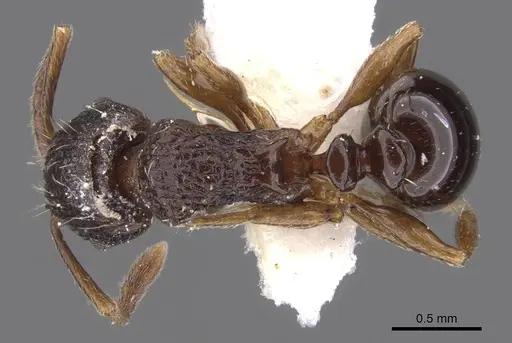
Literature
Loading distribution map...Loading products...