
Tetramorium saudiae
- Sci. Name
- Tetramorium saudiae
- Tribe
- Crematogastrini
- Subfamily
- Myrmicinae
- Author
- Collingwood & Agosti, 1996
- Distribution
- Found in 1 countries
Introduction
Tetramorium saudiae is a tiny myrmicine ant known only from a single specimen collected in Saudi Arabia. Workers measure just 2.8mm in total length, making them one of the smaller ant species in the region . The body is uniformly brown with noticeably paler antennae and legs. The head is somewhat rectangular with rounded corners, and the dorsal surface is covered in scattered thick hairs. The propodeal spines are short and blunt. This species was originally described as Leptothorax saudiae in 1996,later moved to Temnothorax, and finally transferred to Tetramorium in 2017 based on key morphological features including the shape of the clypeus and position of the propodeal spiracles . Almost nothing is known about the biology of this species. The single known specimen was collected in Al-Muraywah, Saudi Arabia, at 420m elevation in late October 1986. This region in northwestern Saudi Arabia has a hot desert climate. Until more specimens are found and studied, all aspects of their natural history, including colony structure, diet, nesting preferences, and behavior, remain completely unknown .
Quick Summary
- Difficulty: Unknown
- Origin & Habitat: Known only from Al-Muraywah in northwestern Saudi Arabia (28°46'N,45°00'E), at 420m elevation. The region has a hot desert climate with extremely hot summers and mild winters [2][1].
- Colony Type: Unconfirmed, only a single worker specimen has ever been collected, so colony structure is completely unknown.
- Size & Growth:
- Antkeeping:
- Temperature: No data available. If ever kept, start with standard room temperature (20-25°C) and adjust based on observation.
- Humidity: Likely prefers drier conditions typical of desert environments, but specific requirements are unknown.
- Diapause: Unknown, no data on seasonal behavior
- Nesting: Unknown in the wild. If specimens become available, standard test tube setups would be appropriate starting points for such a small ant.
- Behavior: Completely unstudied. No behavioral observations have been documented. Based on its subfamily (Myrmicinae) and tribe (Crematogastrini), it likely possesses a modified spatulate stinger used to smear venom (smear defense), but this has not been observed in this species. Escape prevention would be important given their very small size (2.8 mm), though this is speculative.
- Common Issues: no specimens are available in the antkeeping hobby, this species is only known from a single museum specimen, no biological data exists to guide captive care, all recommendations would be pure speculation, taxonomic history is complex, originally described as Leptothorax, moved to Temnothorax, now in Tetramorium
Taxonomic History
This species has had a complicated taxonomic journey. It was originally described as Tetramorium saudiae by Collingwood and Agosti in 1996,based on a single worker specimen collected in Saudi Arabia [2]. In 2003,Bolton transferred it to the genus Temnothorax. However, Sharaf et al. (2017) determined that this placement was incorrect, the specimen actually belongs to the genus Tetramorium based on two key morphological features: the lateral portions of the clypeus are raised into sharp ridges or shield walls in front of the antennal insertions, and the propodeal spiracles are low on the sides and distinctly behind the midlength of the sclerite [2][3]. The holotype specimen is held in the World Museum Liverpool (WMLC) with collection data matching Al-Muraywah, Saudi Arabia,28°46'N 45°00'E,420m altitude, collected 27-28 October 1986 by W. Buttiker.
Distribution and Habitat
Tetramorium saudiae is known only from the type locality in Al-Muraywah, northwestern Saudi Arabia, at coordinates 28°46'N 45°00'E and approximately 420m elevation [2][1]. This region lies in the Arabian Peninsula's Afrotropical zone and features a hot desert climate with summer temperatures regularly exceeding 40°C and annual rainfall typically under 100mm. The single specimen was collected in late October, suggesting the species may be active during the cooler winter months or that the collection occurred during a brief period of increased activity. Nothing else is known about the microhabitat or nesting preferences of this species.
Morphology
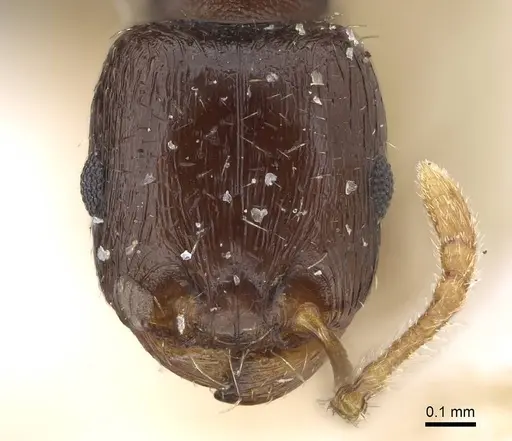
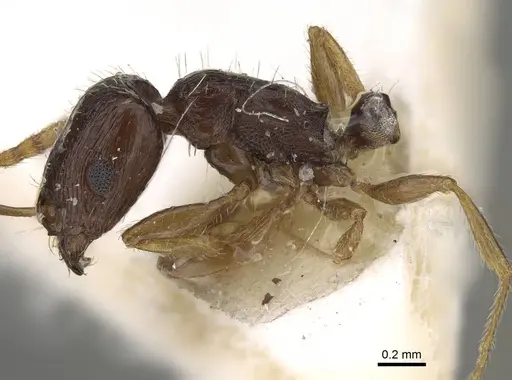
The holotype worker measures just 2.8mm in total length, making this a very small ant species [1]. The head is subrectangular with rounded occipital corners and a straight occipital margin. The sides of the head show only very slight curvature in dorsal view. The pronotum is slightly angled at each corner, and the alitrunk lacks a mesopropodeal furrow. The dorsal outline is rather flat, with the propodeum gently curving to its basal face. The propodeal spines are short, blunt, and semi-erect. The petiole is thick but raised dorsally to a sharply pointed triangle. The entire dorsal surface including the gaster has scattered strong hairs that are thick but bluntly pointed rather than clavate. The head dorsum and clypeus are strongly striate (grooved), while the promesonotum is longitudinally striate with striae merging into the strongly punctate propodeum. The petiole is brilliant and without sculpture, while the postpetiole and gaster dorsum are both shining but with weak superficial sculpture. Body color is uniformly brown with much paler antennae and legs.
Current Knowledge Status
This is one of the least known ant species in the world from a biological perspective. Only a single worker specimen has ever been collected, described in 1996,and no additional specimens have been found since. This means virtually nothing is documented about their colony structure (monogyne vs polygyne), founding behavior (claustral vs semi-claustral), diet, nesting habits, behavior, or seasonal patterns [1]. The species is essentially a taxonomic name attached to a single specimen with no biological data. For antkeepers, this means there is no information available to guide care, and this species is not available in the hobby. Related Tetramorium species from similar regions are typically ground-nesting and may have varied diets, but these cannot be reliably applied to Tetramorium saudiae without any direct observations.
Frequently Asked Questions
Is Tetramorium saudiae available in the antkeeping hobby?
No. This species is only known from a single specimen collected in Saudi Arabia in 1986. No additional specimens have ever been found, and the species does not appear in any antkeeping collections or culture collections [1].
What does Tetramorium saudiae look like?
Workers are tiny at just 2.8mm total length. They have a uniformly brown body with noticeably paler antennae and legs. The head and body have strong striations (grooves), and the dorsal surface is covered in scattered thick hairs. The propodeal spines are short and blunt [1].
Where does Tetramorium saudiae live?
The species is known only from Al-Muraywah in northwestern Saudi Arabia, at 420m elevation. This is a hot desert region with extremely hot summers and very low annual rainfall [2][1].
What is the colony structure of Tetramorium saudiae?
Unknown. Only a single worker specimen has ever been collected, so nothing is known about whether they form single-queen or multi-queen colonies [1].
How do I care for Tetramorium saudiae?
No captive care information exists for this species. It is not available in the antkeeping hobby and no biological data has been collected to guide husbandry [1].
What does Tetramorium saudiae eat?
Unknown. No observations of feeding behavior or diet have ever been documented for this species [1].
Do Tetramorium saudiae queens fly?
Unknown. No queen specimens have ever been collected, so nothing is known about their nuptial flights or reproduction [1].
Is Tetramorium saudiae related to other common pet ants?
Yes, it belongs to the genus Tetramorium, which contains many common species worldwide. However, this species is taxonomically and biologically distinct from commonly kept Tetramorium species like Tetramorium caespitum or Tetramorium bicarinatum. The genus placement was only confirmed in 2017 [2][3].
Report an Issue
The current care sheet is based fully on literature. See inconsistencies, or something that's incorrect? Please , it will be resolved after review from an admin. Contributing to the blogs tab also helps providing information, to make us be able to further improve the caresheets. Thank you for your support!
References

This caresheet is licensed under CC BY-SA 4.0 .
Community Blogs
CASENT0922184
View on AntWeb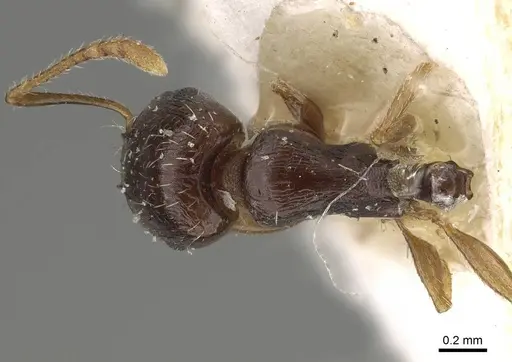
Literature
Loading distribution map...Loading products...