
Tetramorium margueriteae
- Sci. Name
- Tetramorium margueriteae
- Tribe
- Crematogastrini
- Subfamily
- Myrmicinae
- Author
- Mbanyana <i>et al.</i>, 2018
- Distribution
- Found in 1 countries
Introduction
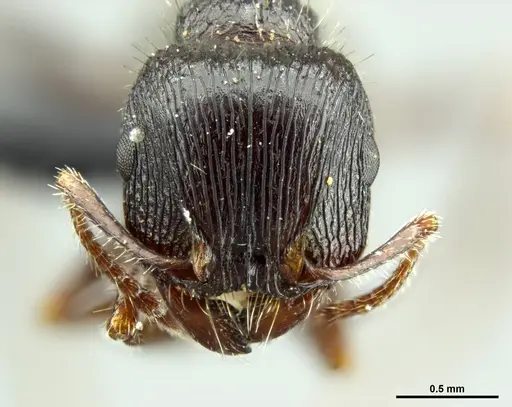
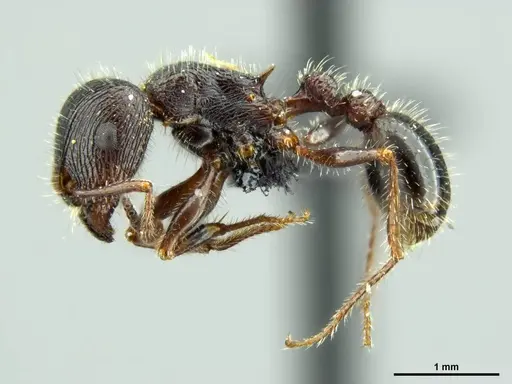
Tetramorium margueriteae is a small, uniformly black ant from South Africa, part of the seed-harvesting *Tetramorium solidum* group . Workers are covered in fine, erect hairs and have a distinct hair basket (psammophore) under the head for carrying sand . They were only described in 2018,and almost nothing is known about their wild biology. Their natural habitat - Nama Karoo and Drakensberg Montane Grasslands - suggests they are adapted to semi-arid, rocky environments . Like other Myrmicinae, they have a modified stinger that smears venom rather than piercing. Because so little is known, all care advice is inferred from related *Tetramorium* species and the ants' South African origin.
Quick Summary
- Difficulty: Hard
- Origin & Habitat: South Africa (Western Cape, Northern Cape, Eastern Cape) in Nama Karoo and Drakensberg Montane Grasslands at ~832 m elevation [1]
- Colony Type: Unconfirmed, likely monogyne (single queen) based on typical *Tetramorium* patterns, but not verified
- Size & Growth:
- Queen: Unknown, estimated 5-7 mm total length based on related *Tetramorium* species (queen undescribed)
- Worker: Unknown, inferred from *Tetramorium* genus, workers likely around 3-4 mm total length (head width 1.1-1.3 mm, mesosoma length 1.2-1.4 mm reported in description [1])
- Colony: Unknown, likely several hundred workers based on genus patterns (estimate)
- Growth: Moderate, estimated from *Tetramorium* patterns
- Development: Estimated 6-10 weeks at 22-26°C (based on related *Tetramorium*) (Direct development data unavailable. Timeline depends on temperature and feeding.)
- Antkeeping:
- Temperature: Aim for 22-26°C, typical for South African species. Their semi-arid habitat [1] suggests tolerance of some fluctuation. A heating cable on one side creating a gradient helps ants self-regulate.
- Humidity: Low to moderate, their natural Nama Karoo habitat is semi-arid. Provide a dry nest chamber with a small moist area. Substrate can be allowed to dry slightly between waterings, but never become bone-dry. The psammophore [1] suggests adaptation to sandy, well-drained soil.
- Diapause: Unknown, the species' biology is unstudied. If temperate (likely based on South African origin), a 2-3 month winter rest at 10-15°C may be required, but this is speculative. Monitor colony behavior.
- Nesting: Test tube for founding. For colonies, use Y-tong or plaster nests with narrow chambers. In nature they likely nest in soil under stones, so a sand-clay mix that allows digging works well. Avoid acrylic nests.
- Behavior: Based on subfamily/tribe, Tetramorium margueriteae has a modified stinger for smearing venom rather than piercing. They are not aggressive but may apply venom if threatened. As seed harvesters, they forage on the ground. Workers are small (~3-4 mm), so standard escape prevention is needed. Specific behavior is undocumented.
- Common Issues: entire biology is unstudied, all care recommendations are inferred from genus patterns, increasing risk of errors., founding behavior unknown, if the queen is not claustral, keeping her in a test tube without food may fail., hibernation requirements speculative, incorrect overwintering can cause colony death., queens are undescribed, size and lifespan unknown, making colony planning difficult., this is a recently described species with no captive breeding data, handling stress and unknown development risks exist.
Appearance and Identification
Workers are uniformly black with abundant fine, erect, short hairs covering the entire body, including the antennal scapes [1]. The dorsum of the mesosoma has short longitudinal rugulae (ridges) and the ground sculpture is mainly smooth and shiny [1]. A key feature is the strongly developed psammophore (a basket of hairs for carrying sand) on the underside of the head [1]. Workers are small: head width 1.1-1.3 mm, mesosoma length 1.2-1.4 mm (total length likely 3-4 mm) [1]. This species differs from similar Tetramorium by its black colour (vs. orange in T. peringueyi) and the presence of erect hairs on the antennal scapes (lacking in T. dichroum and T. brigitteae) [1]. Queens have not been described.
Natural Habitat and Distribution
Endemic to South Africa, known from the Western Cape, Northern Cape, and Eastern Cape provinces [1]. The type specimens were collected in the Gariep Rocky Desert, a semi-arid area with kokerboom trees and Euphorbia at 832 m elevation [1]. Their recorded habitats are Nama Karoo (semi-arid savanna) and Drakensberg Montane Grasslands [1]. The psammophore suggests they nest in sandy or loose soil, likely under stones. The climate features hot days, cool nights, and low rainfall. For captive care, aim for well-drained, dryish conditions.
Feeding and Diet
As a member of the Tetramorium solidum group, this species is a seed harvester [1]. Offer a staple of seeds: grass seeds, millet, sesame, or commercial ant seed mixes. Supplement with small insects for protein (fruit flies, pinhead crickets, tiny mealworms). Prey should be no larger than the workers. Sugar water or honey water can be provided occasionally but is not required. Offer seeds continuously in a feeding dish, give protein 2-3 times per week and remove uneaten prey after 48 hours to prevent mold.
Temperature and Seasonal Care
Based on their South African origin [1], maintain a temperature of 22-26°C, with 24°C as a good target. A slight drop at night is fine. Create a gradient using a heating cable on one side of the nest so ants can choose their preferred temperature. Avoid prolonged temperatures above 30°C or below 18°C. Hibernation requirements are unknown, if the colony slows down in winter, you may try a cool period (10-15°C for 2-3 months) but this is speculative. Monitor activity and adjust.
Nesting and Housing
In the wild, they likely nest in soil under stones, as indicated by their well-developed psammophore [1]. For captive keeping, start a foundress queen in a standard test tube setup (water reservoir sealed with cotton). Once a colony is established, transfer to a Y-tong or plaster nest with narrow chambers. You can also use a formicarium with a sand-clay substrate that holds its shape when slightly moist. Provide a dry outworld with a shallow water dish and feeding stations. Because workers are small, ensure tight connections and use fluon on barriers to prevent escapes.
Colony Development and Growth
No species-specific data exists. Based on typical Tetramorium patterns, colony development likely proceeds as follows: founding is probably claustral (queen seals herself in and raises the first brood from stored reserves), but this is unconfirmed. The first nanitic workers appear after about 6-10 weeks at 24°C. Colony growth is moderate, expect a few dozen workers in the first year, potentially increasing to several hundred over time. Queen lifespan is unknown but Tetramorium queens often live several years. All timelines are estimates.
Frequently Asked Questions
How long does it take for Tetramorium margueriteae to get first workers?
The exact timeline is unconfirmed for this species, but based on typical Tetramorium development, expect 6-10 weeks from egg to first worker at optimal temperature (around 24°C). The queen likely founds claustrally, raising the first brood on stored reserves.
What do Tetramorium margueriteae ants eat?
As seed harvesters [1], they primarily eat seeds. Offer grass seeds, millet, sesame, or commercial ant seed mixes. Supplement with small insects like fruit flies or tiny crickets for protein. Sugar water is optional.
Do Tetramorium margueriteae ants need hibernation?
Unknown, the species' biology is unstudied. The South African origin suggests they may need a winter rest period. If you attempt diapause, try 2-3 months at 10-15°C, but this is speculative. Watch your colony's behavior.
Are Tetramorium margueriteae good for beginners?
Probably not. So little is known about this species that care is largely guesswork. We recommend it only for experienced keepers comfortable with uncertainty. Better to start with a well-documented Tetramorium species.
Can I keep multiple Tetramorium margueriteae queens together?
Colony structure is unconfirmed. Most Tetramorium are monogyne, but polygyny occurs in some. Without data, do not combine unrelated foundress queens, they may fight.
What size colony does Tetramorium margueriteae reach?
Maximum colony size is unknown. Based on related Tetramorium species, expect several hundred workers over several years. They are not among the largest Tetramorium.
Do Tetramorium margueriteae ants sting?
As a Myrmicinae, they have a stinger, but it is modified to smear venom rather than pierce. They are not aggressive and the venom is not medically significant for humans. Avoid handling to prevent defensive smearing.
What temperature should I keep Tetramorium margueriteae at?
Aim for a stable 22-26°C, with 24°C ideal. Their South African origin [1] suggests they tolerate some variation, but avoid extremes above 30°C or below 18°C for long periods.
When was Tetramorium margueriteae discovered?
This species was formally described in 2018 by Mbanyana, Robertson, and Hita Garcia, based on specimens collected in 2007. It is named after Marguerite Blignaut for her molecular lab work [1].
Where is Tetramorium margueriteae found?
Endemic to South Africa: Western Cape, Northern Cape, and Eastern Cape provinces, in Nama Karoo and Drakensberg Montane Grasslands at around 832 m elevation [1].
Report an Issue
The current care sheet is based fully on literature. See inconsistencies, or something that's incorrect? Please , it will be resolved after review from an admin. Contributing to the blogs tab also helps providing information, to make us be able to further improve the caresheets. Thank you for your support!
References

This caresheet is licensed under CC BY-SA 4.0 .
Community Blogs
SAM-HYM-C019839
View on AntWeb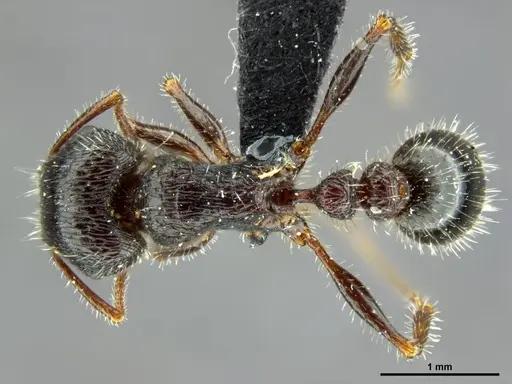
Literature
Loading distribution map...Loading products...