
Tetramorium longicorne
- Sci. Name
- Tetramorium longicorne
- Tribe
- Crematogastrini
- Subfamily
- Myrmicinae
- Author
- Forel, 1907
- Distribution
- Found in 3 countries
Introduction
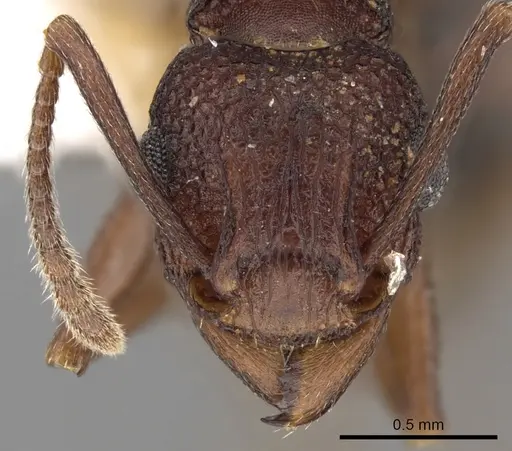
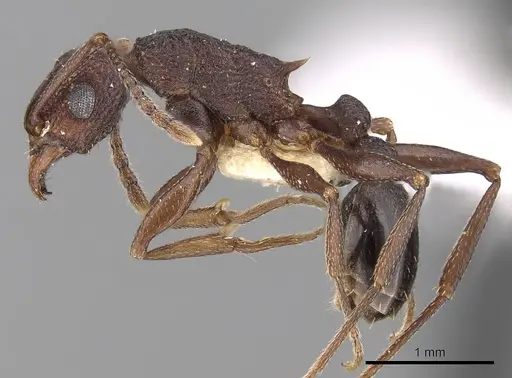
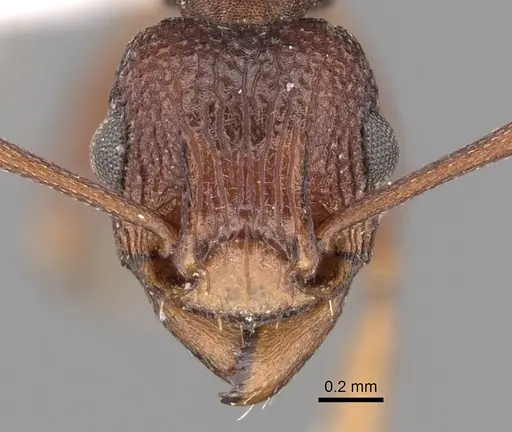
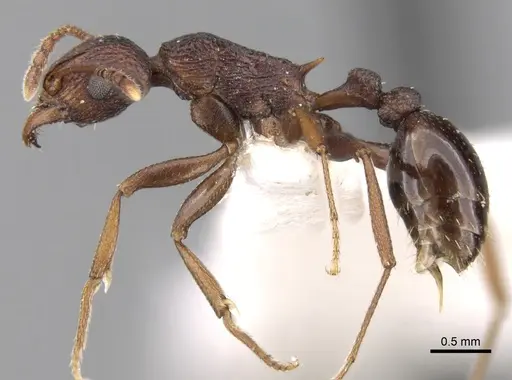
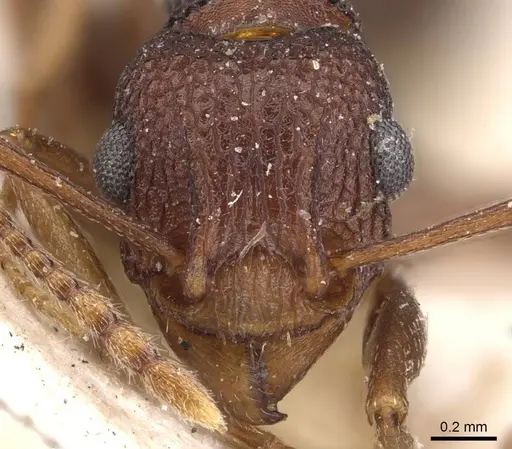
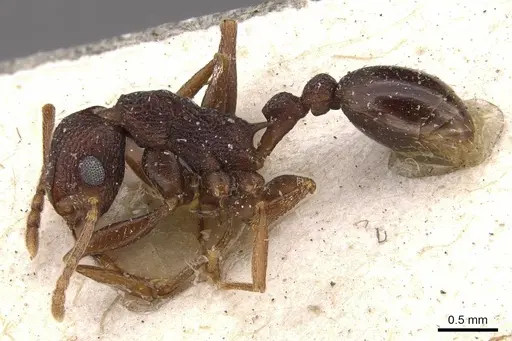
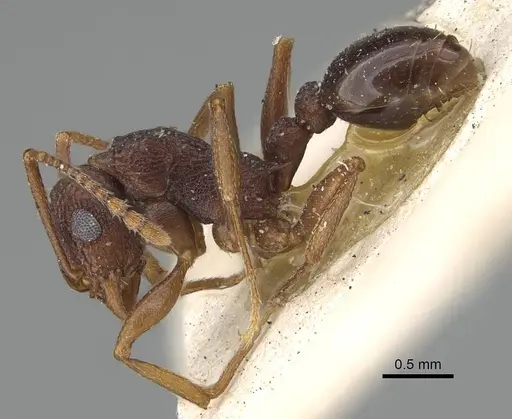
Tetramorium longicorne is a medium-sized ant from the Ethiopian region of Africa, found in Kenya, South Africa, Tanzania, Cameroon, Zimbabwe, and other countries . Workers measure 4.4-5.1 mm (total length) and have a distinctive dull red body with a darker gaster, large eyes, strong frontal carinae, and long propodeal spines . They have very little hair on the upper body - almost none on the alitrunk - which makes them easy to spot . This species lives in woodland, savannah, and open grassland, nesting directly in soil. Field notes describe nest entrances as crater-like depressions about 12 mm wide, with a vertical tunnel going down . One observer saw a worker drag a harvester termite into the nest, suggesting they hunt termites that fall into the entrance . In Cameroon, they were found only in gardens (never inside houses) and their relative frequency in non-invaded areas was 0.08-0.17% .
Quick Summary
- Difficulty: Medium
- Origin & Habitat: Ethiopian region of Africa (Burkina Faso, Cameroon, Kenya, Mozambique, Nigeria, South Africa, Tanzania, Zimbabwe). Inhabits woodland, savannah, and open grassland. Also found in gardens [1][3].
- Colony Type: Unconfirmed, no research data on colony structure or queen number.
- Size & Growth:
- Antkeeping:
- Temperature: No specific research data. Based on habitat (warm savannah/woodland), likely prefers stable warm conditions. Keep at room temperature (20-26°C) and observe the colony's behavior.
- Humidity: Soil-nesting species from relatively dry habitats. Keep nest substrate slightly moist but not waterlogged. Avoid high humidity. Provide a gradient if possible.
- Diapause: Likely not required given tropical/subtropical distribution, but no research confirms this. If you want to simulate seasonal slowdown, a slight reduction to 18-20°C for a few weeks in winter may be tried, but it's not proven.
- Nesting: Soil-nesting species. Best kept in a naturalistic setup with compact soil substrate, or a Y-tong (AAC) nest with soil chambers. Nests in the wild have crater-like entrances and vertical tunnels [1].
- Behavior: No specific research data on temperament. This species belongs to subfamily Myrmicinae, tribe Crematogastrini, which typically uses a 'smear' defense: a flattened stinger that wipes venom onto enemies rather than piercing. Generalist forager, observed taking termites that fall into nest entrances [1]. Escape risk is standard for ants of this size, use barrier methods like fluon.
- Common Issues: rarely encountered in the wild, limited research data makes care guidance uncertain, soil-nesting requires substrate setup, not suitable for test tube-only keeping long-term, may be challenging to obtain founding queens due to low relative frequency in surveys [2], overheating risk, if kept too hot without a gradient, brood may dry out, too much humidity can lead to mold, allow substrate to partially dry between waterings
Housing and Nest Setup
Tetramorium longicorne nests in soil, so your setup should copy their natural underground home. A compact soil substrate works best, it lets them dig their own chambers and tunnels. Y-tong (AAC) nests with soil-filled chambers or plaster nests with a damp soil insert are good options [1]. In the wild, nest entrances are crater-like depressions about 12 mm in diameter, with a tunnel going straight down [1]. Use tight, enclosed chambers instead of large open spaces, these ants prefer cozy tunnels. The outworld should be simple: a foraging area where you offer food. Use fluon or other barriers on edges to prevent escapes. Avoid acrylic nests, they don't suit soil-nesting species well.
Feeding and Diet
In the wild, Tetramorium longicorne eats small insects, nectar, and honeydew. They have been observed catching termites that fall into their nest entrance, showing they are active predators [1]. In captivity, offer protein 2-3 times per week: small crickets, mealworms, fruit flies, or other soft-bodied insects. Provide sugar water, honey, or commercial ant nectar constantly, they will take sweet liquids readily. Remove uneaten prey after 24-48 hours to prevent mold. They have been found in gardens in Cameroon, which suggests they can adapt to some human activity [3].
Temperature and Seasonal Care
Tetramorium longicorne is from warm African habitats, mostly savannah and open woodland. No specific temperature research exists, but based on its distribution, it likely prefers stable warm conditions. Keep the nest at room temperature (20-26°C) and watch your ants: if they are active and brood develops, the temperature is fine. A heating cable on one side of the nest can create a gentle gradient, allowing ants to choose their preferred spot. True diapause is probably not needed since they come from tropical/subtropical areas, but a slight seasonal slowdown (18-20°C for a few weeks in winter) might be tried, there is no research to confirm this helps. Avoid sudden temperature changes and cold drafts. [1]
Identification and Distribution
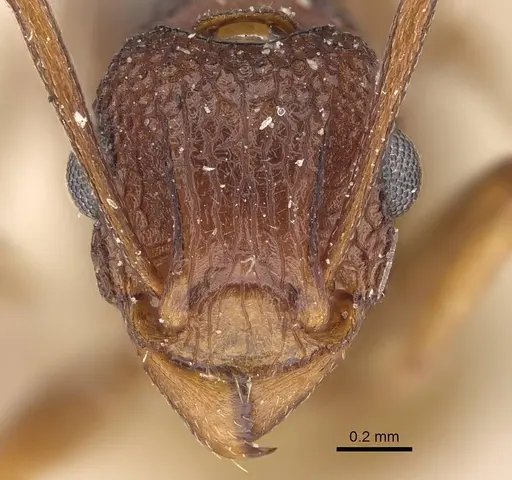
Tetramorium longicorne is easy to identify among its group: it has almost no hairs on the alitrunk (upper body), large eyes, a broad clypeus, strong frontal carinae, and long propodeal spines [1]. The mandibles are not strongly striate. The petiole has an elongate peduncle and a square node. The first gastral tergite has dense longitudinal striae at the base [1]. Workers are 4.4-5.1 mm long and dull red with a darker gaster. This species lives across the Ethiopian region: Burkina Faso, Cameroon, Kenya, Mozambique, Nigeria, South Africa, Tanzania, and Zimbabwe [1]. It prefers woodland, savannah, and open grassland, and appears relatively uncommon, in one survey, its frequency was only 0.08-0.17% [2]. It also occurs in gardens [3].
Behavior and Defense
No specific studies on Tetramorium longicorne behavior exist, but we can use its subfamily and tribe to guess some traits. It belongs to Myrmicinae, tribe Crematogastrini, which usually defends themselves by smearing venom with a flattened, spatulate stinger rather than stinging. So this ant likely does not sting you, it wipes venom on enemies. In the wild, a field observer saw a T. longicorne worker drag a harvester termite that fell into its crater-like nest entrance, which suggests they are ambush predators [1]. They are generalist foragers. In captivity, they will hunt small insects. Their large eyes probably help them spot prey. There is no data on how aggressive they are, but ants that rely on venom-smearing rather than stinging are usually not quick to attack.
Frequently Asked Questions
How long does it take for Tetramorium longicorne to produce first workers?
Unknown, no research data on development time for this species. If you have a founding queen, be patient and keep her warm and undisturbed.
Can I keep Tetramorium longicorne in a test tube?
A test tube might work for a founding queen, but these ants are soil nesters and need substrate long term. Once the first workers arrive, move them to a setup with soil or a Y-tong nest.
Do Tetramorium longicorne ants sting?
There is no direct data, but this species belongs to tribe Crematogastrini, which uses a 'smear' defense: a flattened stinger that wipes venom rather than piercing. It likely does not sting in the normal sense and poses no danger to keepers.
What temperature do Tetramorium longicorne need?
No specific research data. Based on their warm African habitat, keep them at room temperature (20-26°C). Provide a gradient so they can choose their preferred spot.
Are Tetramorium longicorne good for beginners?
They are rated as medium difficulty. The main challenge is that very little is known about their care, you will need to experiment. Finding a queen may be hard because they are uncommon.
How big do Tetramorium longicorne colonies get?
Unknown, no research data. Related Tetramorium species can reach hundreds or thousands of workers, but this is just a guess.
Do Tetramorium longicorne need hibernation?
Probably not, as they come from tropical/subtropical regions. But no research confirms this. A slight winter temperature drop (18-20°C) may be tried but is not necessary.
What do Tetramorium longicorne eat?
Generalist feeders: small insects (crickets, fruit flies, termites) and sweet liquids (sugar water, honey). In the wild, they have been seen catching termites that fall into their nest entrance [1].
Why are my Tetramorium longicorne dying?
Common causes when care data is scarce: overwatering the nest (they prefer drier conditions), temperature extremes, or poor nutrition. Start by checking that the substrate is not waterlogged and temperature is stable.
Report an Issue
The current care sheet is based fully on literature. See inconsistencies, or something that's incorrect? Please , it will be resolved after review from an admin. Contributing to the blogs tab also helps providing information, to make us be able to further improve the caresheets. Thank you for your support!
References

This caresheet is licensed under CC BY-SA 4.0 .
Community Blogs
CASENT0217213
View on AntWeb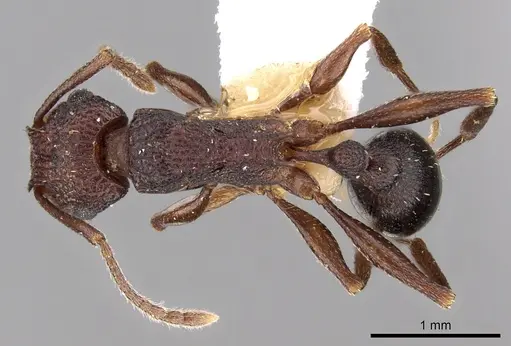
CASENT0280923
View on AntWeb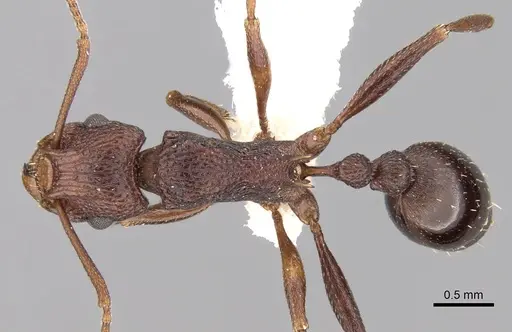
CASENT0909138
View on AntWeb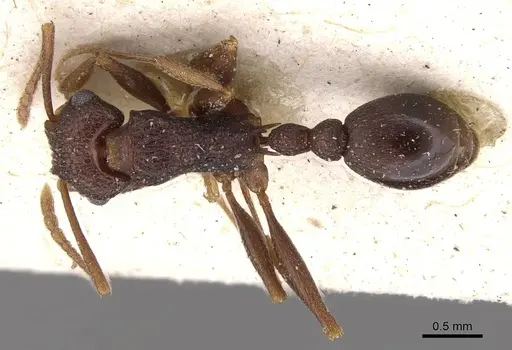
CASENT0915997
View on AntWeb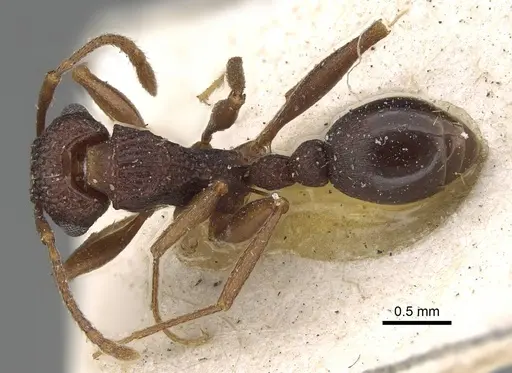
Literature
Loading distribution map...Loading products...