
Tetramorium lerouxi
- Sci. Name
- Tetramorium lerouxi
- Tribe
- Crematogastrini
- Subfamily
- Myrmicinae
- Author
- Mbanyana <i>et al.</i>, 2018
- Distribution
- Found in 1 countries
Introduction
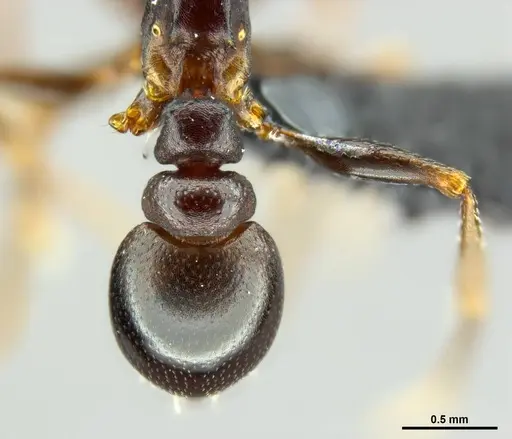
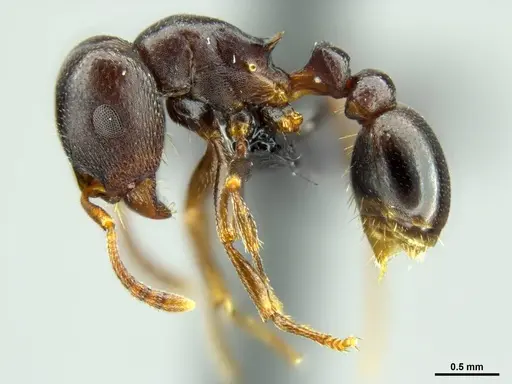
Tetramorium lerouxi is a small, dark ant species native to South Africa, first described in 2018. Workers are uniformly black, and no body size data is available - only head and mesosoma measurements are reported in the literature, which do not indicate total length . This species belongs to the Tetramorium solidum group, commonly known as seed harvester ants. The most distinctive feature is the unique petiolar node shape - it has posterior, lateral, rounded extensions that set it apart from other species in the group . They also have a psammophore (a basket of hairs on the underside of the head) that helps them move sand particles . This is a newly described species with no published biological data. Based on its placement in the solidum group and its South African distribution, it likely inhabits arid to semi-arid regions and behaves like other seed harvester ants in the genus - collecting seeds and foraging for protein. The two known collection sites are Melton Wold near Victoria West in the Northern Cape and Oranjekrag in the Free State, both at around 1333m elevation .
Quick Summary
- Difficulty: Unknown
- Origin & Habitat: South Africa, known only from two locations in the Northern Cape (Melton Wold near Victoria West) and Free State (Oranjekrag), collected at 1333m elevation [1]. Based on location and elevation, likely inhabits arid to semi-arid savanna or grassland regions.
- Colony Type: Unconfirmed, no published data on colony structure. Related species in the Tetramorium solidum group are typically monogyne (single queen), but this has not been studied for T. lerouxi specifically.
- Size & Growth:
- Queen: Undescribed, no queen specimens have been documented [1].
- Worker: Size data unavailable, only head and mesosoma measurements are documented [1].
- Colony: Unknown, no colony size data exists for this species.
- Growth: Unknown
- Development: Unconfirmed, no development data exists. Based on typical Tetramorium patterns, expect 6-10 weeks at optimal temperature. (Development timeline is entirely unstudied. Estimates based on genus-level data only.)
- Antkeeping:
- Temperature: Unconfirmed, no thermal studies exist. Based on South African distribution (Northern Cape and Free State), likely tolerates a wide range from roughly 18-30°C. Start around 22-25°C and observe colony activity.
- Humidity: Unconfirmed, no humidity data exists. Based on arid collection locations, likely prefers drier conditions than most tropical ants. Keep nest substrate moderately dry to slightly damp, with some variation available.
- Diapause: Unknown, no seasonal data exists. South African populations may experience mild winter dormancy given the temperate-to-subtropical climate of the collection sites.
- Nesting: Unconfirmed, no natural nesting observations exist. As a seed harvester ant in the solidum group, likely nests in soil or under stones in open areas. Standard test tubes or Y-tong nests work for initial captivity.
- Behavior: Unconfirmed, no behavioral studies exist. Based on genus membership, likely forms moderate-sized colonies, forages for seeds and small insects, and demonstrates typical Tetramorium aggression when disturbed. Escape risk is moderate due to small worker size, use standard barrier methods. As a member of subfamily Myrmicinae, tribe Crematogastrini, this species likely uses a 'smear' defense mechanism: a modified flattened stinger that wipes venom onto enemies rather than piercing.
- Common Issues: no biological data exists, this is one of the least studied ant species in the hobby, so standard care guidelines may not apply, queen and colony development is completely unstudied, keepers should expect unexpected challenges, origin from arid regions means overwatering is likely more dangerous than under-watering, wild-caught colonies may carry unknown parasites or diseases since no health data exists
Species Identification and Distinction
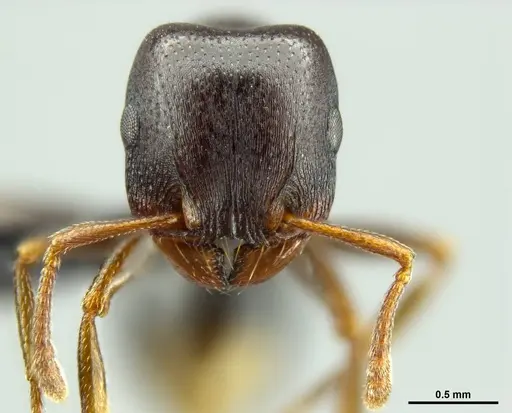
Tetramorium lerouxi was formally described in 2018 and can be identified by several key features. The most distinctive is the petiolar node shape, it has posterior, lateral, rounded extensions that make it unique within the solidum species group [1]. In posterior view, the dorsal margin is straight and angulate relative to the lateral margin [1]. Workers are uniformly black with no erect hairs on the mesosoma, nodes, or first gastral tergite, only sparse white pubescence [1]. The propodeal spines are long and acute, and the head has a psammophore (a collection of hairs on the underside used for carrying sand particles) [1]. This species is only the second known glabrous (hairless) species in the group with distinctly laterally expanded petiole nodes [2].
Distribution and Collection Data
This species has an extremely limited known distribution in South Africa. The type locality is Melton Wold near Victoria West in the Northern Cape Province, at coordinates 31.46741°S,22.721550°E, at 1333 meters elevation [1]. A second population was later documented from Oranjekrag in the Free State [1]. The January collection date (Southern Hemisphere summer) and the semi-arid nature of these locations suggest this species is adapted to hot, dry conditions with seasonal rainfall [1]. The limited distribution makes wild collection difficult, and any captive colonies likely originate from the original scientific collections.
Housing and Nesting
Since no natural nesting observations exist for this species, housing recommendations are based on genus-level knowledge. As a seed harvester ant in the Tetramorium solidum group, it likely nests in soil or under stones in open, sunny areas. For captivity, standard test tube setups work well for founding colonies. Once established, Y-tong (AAC) nests or plaster nests provide better space for growing colonies. Given the arid origin, err on the side of drier conditions, keep the nest substrate moderately dry rather than damp. Ensure adequate ventilation to prevent mold while maintaining enough humidity for the ants to survive.
Feeding and Diet
Feeding recommendations are inferred from the species group classification. Tetramorium solidum group ants are seed harvesters, meaning they collect and store seeds as their primary food source. In captivity, offer a mix of small seeds (grass seeds, millet, poppy seeds) as a staple. Also provide protein sources like small insects (fruit flies, small mealworms, crickets) since they likely supplement their diet with arthropod prey like other Tetramorium species. Sugar water or honey can be offered occasionally, though seed harvester ants rely less on sugar than some other species. Feed seeds continuously and protein 2-3 times per week.
Temperature and Seasonal Care
No specific temperature data exists for this species. Based on the South African distribution (Northern Cape and Free State), expect it to tolerate a broader temperature range than tropical species. These regions experience hot summers and cool winters, with temperatures ranging from below freezing in winter to above 30°C in summer. For captivity, maintain temperatures roughly between 20-26°C. A slight temperature gradient allows the colony to self-regulate. The January collection date suggests summer activity is peak, expect reduced activity during Southern Hemisphere winter (roughly June-August), possibly requiring a mild cool-down period.
Challenges and Unknowns
This is one of the least-studied ant species available in the antkeeping hobby. No published research exists on colony size, development timeline, founding behavior, queen morphology, or any aspect of its biology [1]. Everything in this caresheet is inferred from genus-level patterns or must be considered an educated guess. Keepers should expect unexpected challenges and be prepared to adapt care based on observed colony behavior. Document your observations carefully, any captive breeding success would represent significant new knowledge for this species. The extremely limited wild distribution also means wild collection is rare, and most captive colonies likely descend from the original type specimens.
Frequently Asked Questions
How do I care for Tetramorium lerouxi ants?
Care is largely unconfirmed since this species has no published biological data. Based on genus membership, use a standard test tube setup for founding colonies, then transition to a Y-tong or plaster nest. Keep temperatures around 22-25°C, err on the drier side for humidity, and feed seeds as a staple with occasional protein. Expect challenges since no care protocols exist for this species.
What do Tetramorium lerouxi ants eat?
As members of the Tetramorium solidum group (seed harvesters), their primary diet is seeds. Offer small seeds like grass seeds, millet, or poppy seeds. They also likely accept protein from small insects like fruit flies or small mealworms. Sugar sources like honey water can be offered occasionally but are not essential.
How big do Tetramorium lerouxi colonies get?
Colony size is completely unstudied, no published data exists on maximum colony size. Based on related species in the genus, expect colonies of several hundred workers at maximum. The small worker size suggests moderate colony development.
Do Tetramorium lerouxi ants need hibernation?
Diapause requirements are unknown. The South African distribution suggests they may tolerate cooler temperatures during winter but likely do not require a true hibernation period like temperate species. A mild cool-down during Southern Hemisphere winter (roughly June-August) may be beneficial but is not confirmed as necessary.
How long does it take for Tetramorium lerouxi to raise first workers?
Development timeline is entirely unstudied. Based on typical Tetramorium patterns, expect roughly 6-10 weeks from egg to first worker at optimal temperature. This is an estimate only, actual development could be faster or slower.
Are Tetramorium lerouxi ants good for beginners?
This species is NOT recommended for beginners. No biological data exists, there are no established care guidelines, temperature ranges, or colony development expectations. Any antkeeper attempting to keep this species should be prepared to experiment and document their findings. Beginners should choose species with well-documented care requirements instead.
What temperature do Tetramorium lerouxi ants need?
No specific temperature requirements are documented. Based on South African distribution, aim for roughly 22-25°C as a starting point. The species likely tolerates a range from about 18-30°C. Use a heating cable on one side of the nest to create a gradient if room temperature is below 22°C.
Can I keep multiple Tetramorium lerouxi queens together?
Colony structure is unconfirmed, no data exists on whether this species is monogyne (single queen) or polygyne (multiple queens). Related species in the solidum group are typically single-queen colonies. Do not attempt combining unrelated queens until more is known about their social structure.
Where is Tetramorium lerouxi found in the wild?
This species is only known from two locations in South Africa: Melton Wold near Victoria West in the Northern Cape Province, and Oranjekrag in the Free State. Both locations are at approximately 1333m elevation in semi-arid regions [1].
Why is Tetramorium lerouxi so hard to keep?
This species has no published biological or ecological data, it was only described in 2018 and no research has examined its behavior, diet preferences, colony development, or captive requirements. Every aspect of care is an educated guess based on genus-level patterns. This makes it exceptionally challenging even for experienced antkeepers.
Report an Issue
The current care sheet is based fully on literature. See inconsistencies, or something that's incorrect? Please , it will be resolved after review from an admin. Contributing to the blogs tab also helps providing information, to make us be able to further improve the caresheets. Thank you for your support!
References

This caresheet is licensed under CC BY-SA 4.0 .
Community Blogs
SAM-HYM-C023329
View on AntWeb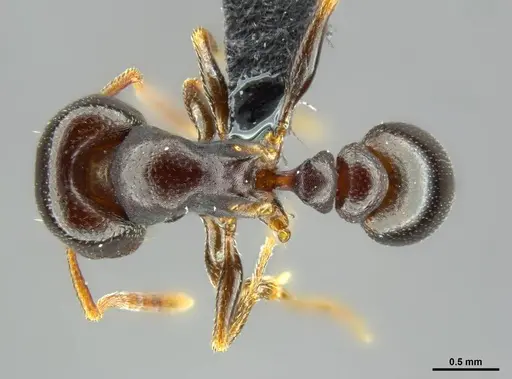
Literature
Loading distribution map...Loading products...