
Tetramorium dysderke
- Sci. Name
- Tetramorium dysderke
- Tribe
- Crematogastrini
- Subfamily
- Myrmicinae
- Author
- Bolton, 1980
- Distribution
- Found in 0 countries
Introduction
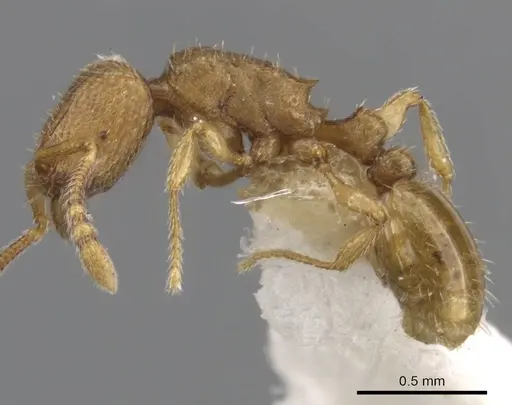
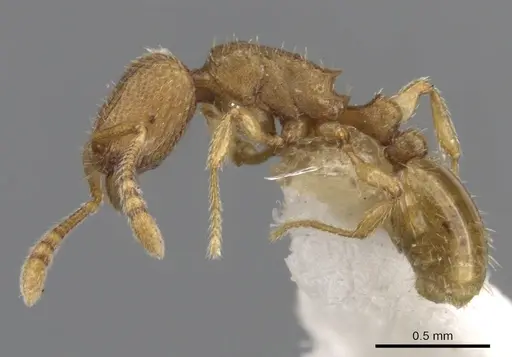
Tetramorium dysderke is a rare tiny ant known from only a handful of specimens. Workers measure 2.4mm in total length and are uniformly yellow . They have extremely reduced eyes (a single ommatidium) and very short, weak frontal carinae, placing them as an intermediate between two species complexes . The only confirmed nesting record is from a rotten stump in Gambari, Nigeria , with a secondary record from a green space in Abidjan, Côte d'Ivoire . Their biology and captive care remain almost entirely unstudied.
Quick Summary
- Difficulty: Unknown, data extremely limited
- Origin & Habitat: West Africa (Nigeria and Côte d'Ivoire). The holotype was collected from a rotting stump in forest, one other record from an urban green space [1][2].
- Colony Type: Unknown, only worker specimens are known. Most Tetramorium are monogyne, but this has not been confirmed for this species [1].
- Size & Growth:
- Antkeeping:
- Temperature: No specific data. Based on tropical West African origin, likely 22-28°C. Start in the mid-range and observe.
- Humidity: Moderate to high. The sole nesting record (rotten stump) suggests consistently moist substrate. Keep nest material damp but not waterlogged [1].
- Diapause: Unknown, no seasonal data. As a Nigerian species, it may not require true hibernation, but activity patterns are unstudied.
- Nesting: Natural nests are in rotting wood [1]. In captivity, a small Y-tong (AAC) or plaster nest with tight, small chambers is recommended. Keep substrate moist.
- Behavior: Behavior is unstudied. Based on the Myrmicinae subfamily, they likely use a smear defense (flattened stinger, venom spread rather than stung). Their tiny size (2.4mm) means escape risk is extreme, require fine mesh and sealed enclosures. Temperament is unknown, treat with caution.
- Common Issues: data scarcity makes reliable care recommendations impossible, this is one of the least-studied ant species, tiny size (2.4mm) means escapes are likely without fine mesh barriers and tight-fitting lids, queen founding behavior and colony establishment are completely unobserved, diet preferences are unknown, start with tiny prey (springtails, fruit flies) and sugar water, but acceptance is unpredictable, no information on aggression levels or colony temperament
Discovery and Rarity
Tetramorium dysderke is known from only two locations: the holotype worker collected in 1969 from a rotten stump in Gambari, Nigeria [1], and one additional worker from a green space in Abidjan, Côte d'Ivoire [2]. No queens, males, or intact colonies have ever been documented. The entire species description is based on a single worker's morphology. This extreme scarcity means nearly everything about its biology remains a mystery.
Identification and Unique Features
This species is part of the Tetramorium genus and belongs to two species complexes simultaneously, sharing traits with both the shilohense-complex and subcoecum-complex [1]. Its most distinctive features include extremely reduced eyes (a single ommatidium, giving a tiny eye diameter about 0.06 times head width), very short frontal carinae that are no stronger than the surrounding head sculpture, and a petiole node that is about as long as broad in dorsal view [1]. Workers are uniformly yellow with conspicuous sculpture on the head and alitrunk [1]. Due to the lack of queen or male descriptions, workers are the only known caste.
Natural Habitat and Nesting
The primary nesting record is from a rotten stump in a forested area of Nigeria, suggesting Tetramorium dysderke nests in decaying wood in humid, shaded environments [1]. The Côte d'Ivoire record comes from an urban green space, which might indicate some tolerance of modified habitats, but the sample size is extremely small [2]. For captive care, replicate damp, decaying wood conditions by using a nest substrate that retains moisture (e.g., Y-tong or plaster) and providing moderate ventilation to prevent mold.
Defense Mechanism
As a member of the Myrmicinae subfamily, tribe Crematogastrini, Tetramorium dysderke likely employs a smear defense: a modified, flattened spatulate stinger used to wipe or smear venom onto enemies rather than piercing flesh. This is typical for the tribe but has not been directly observed in this species. Keepers should treat them as capable of chemical defense, though the effect on humans is unknown.
Housing Recommendations
Given the minuscule worker size (2.4mm), housing is challenging. Use a small Y-tong (AAC) or plaster nest with chambers that are tight and scaled to their body size. The nest material should be kept moderately moist to simulate the damp rotting wood they inhabit in nature. Escape prevention is critical: use fine mesh (e.g.,0.1mm or smaller), seal all connections, and avoid large open spaces. A small outworld (e.g., a modified test tube or small container) allows for feeding. Since no captive records exist, be prepared to adjust conditions frequently.
Feeding and Diet
Diet preferences are completely unstudied. Based on general Tetramorium patterns, they are likely generalist omnivores that accept small insects and sugary liquids. Offer very small prey such as springtails, Drosophila fruit flies, or tiny pieces of mealworms, along with honey water or sugar water. Avoid large prey items that the small workers cannot handle. Remove uneaten food promptly to prevent spoilage. Observed acceptance or rejection will be the best guide.
Temperature and Seasonal Care
No thermal tolerance data exists. Given the tropical West African origin, a warm range of 22-28°C is a reasonable starting point. Keep temperatures stable and avoid cold drafts. There is no information on diapause, Nigerian tropical species often remain active year-round, but seasonal changes in activity are unknown. Monitor colony behavior and adjust if activity drops significantly.
Frequently Asked Questions
How long do Tetramorium dysderke workers live?
Not studied. Typical Tetramorium workers live several months to over a year, but no specific data exists for this species. Expect short lifespans due to small size, but confirm through observation.
What do Tetramorium dysderke ants eat?
Diet is unknown. Based on genus patterns, they likely accept small insects and sugar sources. Start with tiny prey like springtails or fruit flies and offer honey water. Adjust based on what the colony takes.
Are Tetramorium dysderke ants good for beginners?
No. This is one of the least-documented ant species with no captive care information available. The extreme rarity also makes finding specimens virtually impossible. Beginners should stick to well-known species.
How big do Tetramorium dysderke colonies get?
Unknown, no colony has ever been documented. Related Tetramorium species can reach several hundred to a few thousand workers, but this is purely speculative.
Do Tetramorium dysderke ants sting?
They likely use a smear defense (a flattened stinger that wipes venom) rather than a typical sting, as is common in their tribe (Crematogastrini). The effect on humans is unknown.
What temperature should I keep Tetramorium dysderke at?
No documented requirements. Based on their Nigerian origin, aim for 22-28°C. Start in the mid-range and adjust based on colony activity.
Can I keep multiple Tetramorium dysderke queens together?
Unknown. Polygyny has not been documented for this species. Most Tetramorium are monogyne, but without direct evidence, assume single-queen unless observed otherwise.
How do Tetramorium dysderke queens found colonies?
Unknown, no queen has ever been described. Most Tetramorium are claustral (queen seals herself and lives off stored fat), but this is unconfirmed for Tetramorium dysderke.
Why is Tetramorium dysderke so rare in antkeeping?
The species is known from only two worker records (Nigeria 1969,Côte d'Ivoire 2018). No colonies or queens have ever been found in the wild or hobby. It has never been available in the ant trade.
What is the best nest type for Tetramorium dysderke?
Based on the rotten stump nesting record, a small Y-tong (AAC) or plaster nest with tight, moist chambers is suitable. No captive data confirms this, it is an educated guess.
Report an Issue
The current care sheet is based fully on literature. See inconsistencies, or something that's incorrect? Please , it will be resolved after review from an admin. Contributing to the blogs tab also helps providing information, to make us be able to further improve the caresheets. Thank you for your support!
References

This caresheet is licensed under CC BY-SA 4.0 .
Community Blogs
CASENT0901167
View on AntWeb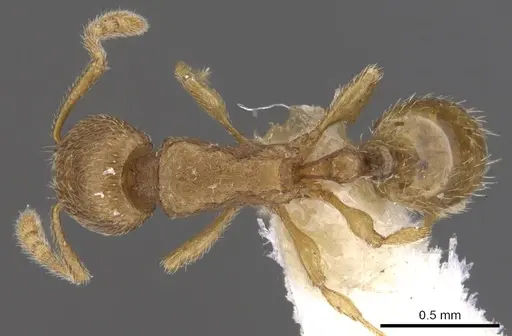

Literature
Loading distribution map...Loading products...