
Tetramorium brigitteae
- Sci. Name
- Tetramorium brigitteae
- Tribe
- Crematogastrini
- Subfamily
- Myrmicinae
- Author
- Mbanyana <i>et al.</i>, 2018
- Distribution
- Found in 1 countries
Introduction
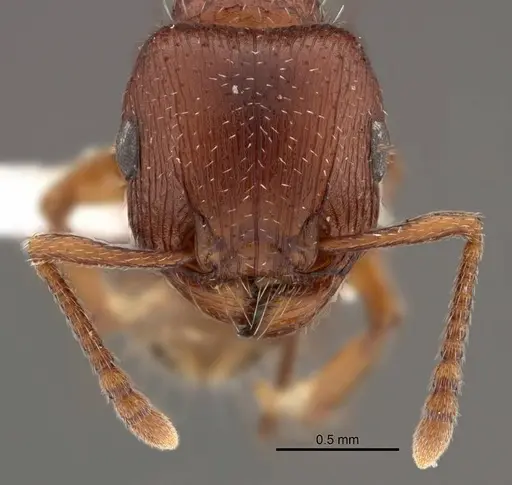
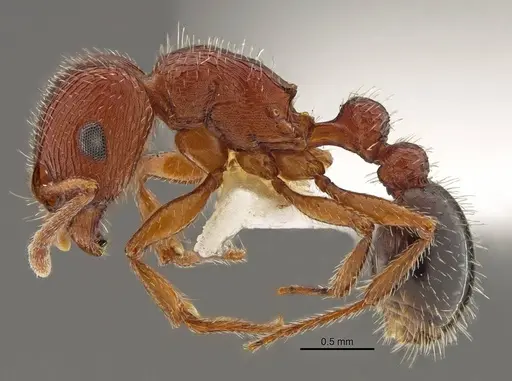
Tetramorium brigitteae is a seed harvester ant known from a single worker specimen collected in the Nama Karoo region of Northern Cape, South Africa . Workers have a two-tone color: head and mesosoma light brown, gaster black . The body is covered in abundant short to moderately long erect hairs, and the propodeum has short teeth rather than long spines. A key feature is the psammophore - a basket of hairs under the head that helps handle sand, an adaptation to arid environments . This species belongs to the Tetramorium solidum group, all of which are seed harvesters. Because only one specimen has ever been found, almost nothing is known about its biology, colony structure, or behavior.
Quick Summary
- Difficulty: Unknown, too little biological data available for reliable difficulty rating
- Origin & Habitat: Nama Karoo region in Northern Cape, South Africa. Known only from near Augrabies Falls National Park at 639 m elevation [1]. This is a semi-arid to arid desert environment with hot summers, cold winters, and low rainfall.
- Colony Type: Unconfirmed, colony structure has not been documented. Most Tetramorium species are monogyne (single queen colonies), but this has not been confirmed for T. brigitteae.
- Size & Growth:
- Queen: Undescribed, no queen caste has been documented [1]
- Worker: Size data unavailable, the only known specimen was measured by head length (0.982 mm) and mesosoma length (1.098 mm), but total body length was not reported [1]. Based on related Tetramorium, workers likely reach around 5-7 mm, but this is an estimate.
- Colony: Unknown, no colony data exists
- Growth: Unknown
- Development: Unconfirmed, no development data exists for this species. Based on typical Tetramorium patterns, expect 6-10 weeks at optimal temperature, but this is entirely inferred. (Development timeline is inferred from genus-level data. No species-specific research exists.)
- Antkeeping:
- Temperature: Based on its Nama Karoo origin, this species likely tolerates warm conditions. Start around 22-26°C and observe colony activity. Related Tetramorium species in southern Africa typically thrive in the low-to-mid 20s°C range.
- Humidity: Adapted to arid conditions, keep substrate moderately dry with occasional damp areas. The Nama Karoo is a dry region, so avoid high humidity. Provide a shallow water dish for drinking.
- Diapause: Unknown, no seasonal data exists. The Nama Karoo experiences cold winters, so some form of winter rest is likely beneficial. Consider a cool period around 10-15°C for 2-3 months.
- Nesting: In nature, these ants likely nest in soil or under stones in arid ground. For captivity, a simple setup with dry to moderately moist substrate works well. Test tubes or small ytong (aerated concrete) or plaster nests are suitable. Avoid overly damp conditions.
- Behavior: As a member of the Myrmicinae subfamily and Crematogastrini tribe, T. brigitteae uses a smear defense: it has a modified stinger that wipes venom onto enemies rather than piercing them, this is known from subfamily/tribe traits. Workers are seed harvesters, collecting and processing seeds. Their small size (unknown but likely under 7 mm) means escape prevention is critical. Aggression levels are unknown but likely moderate like most Tetramorium.
- Common Issues: lack of biological data makes reliable care recommendations difficult, this is a recently described species with only one known worker, escape prevention is important due to small worker size, no confirmed diet acceptance, offer seeds, small insects, and sugar water to test preferences, colony founding behavior is unconfirmed, unknown if queens are claustral or semi-claustral, defense mechanism (smear) may be unfamiliar to keepers, stinger is not used to sting but to apply venom topically
Identification and Appearance
Tetramorium brigitteae workers are small ants (total body size unknown, but head length is about 1 mm). They have a distinctive two-tone coloration: the head and mesosoma are light brown, while the gaster is black [1]. The body is covered in abundant short to moderately long erect hairs, giving them a somewhat fuzzy appearance. The propodeum has short teeth (longer than their basal width) rather than the long spines seen in some related species [1]. A key identifying feature is the psammophore, a collection of specialized hairs on the underside of the head that helps these ants move sand particles [1]. The antennae have sub-erect pubescence (not fully erect hairs), which helps distinguish this species from similar species like T. peringueyi [1].
Distribution and Habitat
This species is known only from a single location in the Nama Karoo region of Northern Cape, South Africa. The holotype worker was collected near Augrabies Falls National Park at coordinates 28.623°S,20.328°E, at an elevation of 639 meters above sea level [1]. The collection date was December 13,2011. The Nama Karoo is a semi-arid to arid ecoregion characterized by sparse vegetation, extreme temperature variations between summer and winter, and low annual rainfall. This habitat suggests T. brigitteae is well-adapted to dry, warm conditions with access to sandy substrates suitable for nesting. The region experiences hot summers where temperatures regularly exceed 30°C and cold winters with occasional frosts.
Taxonomy and Relationships
Tetramorium brigitteae belongs to the Tetramorium solidum species group, a cluster of closely related seed harvester ants found in southern Africa [1]. The species was formally described in 2018 by Mbanyana, Robertson, and Hita Garcia based on a single worker specimen. It is morphologically similar to three other species in the group: T. peringueyi, T. dichroum, and T. margueriteae. The main distinguishing features include the short propodeal teeth, the combination of longitudinal striations on the mesosoma with superficial ground sculpture, and the sub-erect pubescence on the antennae rather than fully erect hairs [1]. The species was named after Dr. Brigitte Braschler, who collected the holotype and contributed to research on southern African arid-zone ants.
Housing and Nesting
For captive care, provide a simple setup that mimics the arid conditions of the Nama Karoo [1]. A test tube setup works well for founding colonies, while small ytong (aerated concrete) or plaster nests suit established colonies. The substrate should be kept relatively dry, slightly moist but not wet. Avoid the damp conditions preferred by many tropical ant species. A small water dish should always be available for drinking. Since this is a very small ant, ensure escape prevention is adequate, even small gaps in tubing or lid seals can allow escapes. The psammophore (sand-handling hairs) suggests these ants interact with sandy substrates, so including some sand in the setup may be beneficial. Keep nesting areas relatively dark and undisturbed.
Feeding and Diet
As a member of the Tetramorium solidum group, T. brigitteae is a seed harvester, this is confirmed from species group affiliation. In captivity, offer a variety of seeds appropriate for small ants (millet, grass seeds, broken sunflower pieces). Also provide protein sources like small insects (fruit flies, small crickets, mealworms) and occasional sugar water or honey. Start with seeds as the primary food since this is a seed harvester species. Observe which items workers accept and adjust offerings accordingly. Fresh water should always be available. [1]
Temperature and Seasonal Care
Based on the Nama Karoo origin, this species likely tolerates and may prefer warm conditions [1]. Aim for temperatures in the range of 22-26°C for normal colony activity. Related Tetramorium species from similar latitudes in southern Africa do well in this range. The Nama Karoo experiences cold winters, so providing a cool period during winter months may be beneficial, consider reducing temperatures to 10-15°C for 2-3 months to simulate natural seasonal cycles. However, since no specific diapause data exists for this species, monitor your colony's response and adjust accordingly. Avoid temperatures below 10°C or above 30°C until you understand their tolerance.
Defense Mechanism
As a member of the subfamily Myrmicinae and tribe Crematogastrini, T. brigitteae uses a smear defense. It has a modified, flattened spatulate stinger that wipes or smears venom onto enemies rather than piercing flesh. This is a general trait of the tribe and not specific to this species, no published data exists on its defense behavior. Given the small size, the sting is unlikely to cause more than mild irritation in humans.
Important Keeper Notes
This is one of the least-studied ant species in captivity. T. brigitteae was only described in 2018 and is known from a single worker specimen, there is essentially no biological or ecological data available beyond the original description [1]. All care recommendations are inferences from the species' habitat (Nama Karoo desert), its taxonomic position (Tetramorium solidum group, which are seed harvesters), and general knowledge of related ants. This means you will likely be pioneering the captive husbandry of this species. Be prepared to experiment with conditions and document your observations carefully. Do not expect established care protocols. The lack of data also means we cannot confirm whether this species is suitable for beginners, err on the side of caution and ensure you can provide stable, appropriate conditions. Consider joining antkeeping communities to share findings if you successfully maintain this species.
Frequently Asked Questions
How do I care for Tetramorium brigitteae ants?
Care recommendations are largely inferred since this species was only described in 2018 and has no documented captive care history. Provide a dry to moderately moist nest setup at 22-26°C. Offer seeds as a primary food (they're seed harvesters) along with small insects and sugar water. Ensure excellent escape prevention due to their small size. Document your observations carefully as you establish the colony.
What do Tetramorium brigitteae ants eat?
As a member of the Tetramorium solidum group, these are seed harvesters. Offer small seeds (millet, grass seeds, broken sunflower), small insects, and occasional sugar water or honey. Start with seeds since that's their natural primary diet.
What temperature do Tetramorium brigitteae ants need?
Based on their Nama Karoo origin in South Africa, aim for 22-26°C. This is an arid desert species adapted to warm conditions. A slight drop in temperature during winter months may be beneficial.
How big do Tetramorium brigitteae colonies get?
Unknown, no colony size data exists. The species is known from only a single worker. Based on related Tetramorium species, colonies likely reach several hundred workers at most.
Do Tetramorium brigitteae ants sting?
They have a modified stinger used for smear defense, it wipes venom onto enemies rather than piercing. The sting is not typical, instead, venom is smeared. Given their small size, any contact would cause minimal irritation.
Can I keep multiple Tetramorium brigitteae queens together?
Unknown, colony structure has not been documented for this species. Most Tetramorium are monogyne (single queen), but this hasn't been confirmed for T. brigitteae. Do not attempt combining unrelated queens without clear evidence they tolerate each other.
How long does it take for Tetramorium brigitteae eggs to become workers?
Unconfirmed, no development data exists for this species. Based on typical Tetramorium development, expect approximately 6-10 weeks from egg to worker at optimal temperature.
Is Tetramorium brigitteae good for beginners?
This species cannot be recommended for beginners due to the complete lack of biological data. Every aspect of captive care would be experimental. Only experienced antkeepers willing to document their findings should attempt this species.
Where is Tetramorium brigitteae found?
Only known from the Nama Karoo region in Northern Cape, South Africa, near Augrabies Falls National Park at 639 m elevation [1]. This is a semi-arid desert environment.
Does Tetramorium brigitteae need hibernation?
Unknown, no seasonal data exists. However, the Nama Karoo experiences cold winters, so a cool period (10-15°C for 2-3 months) is likely beneficial and may trigger natural seasonal behavior.
What size are Tetramorium brigitteae workers?
Total body length has not been published. The only known specimen was measured by head length (0.982 mm) and mesosoma length (1.098 mm). Based on related Tetramorium species, workers likely reach around 5-7 mm, but this is an estimate. Size data is unavailable from the original description.
Why is Tetramorium brigitteae so hard to find in antkeeping?
This species was only described in 2018 and is known from a single worker specimen collected in South Africa. It has never been kept in captivity by hobbyists, and no biological data exists to guide care. It remains extremely rare both in the wild and in captivity.
Report an Issue
The current care sheet is based fully on literature. See inconsistencies, or something that's incorrect? Please , it will be resolved after review from an admin. Contributing to the blogs tab also helps providing information, to make us be able to further improve the caresheets. Thank you for your support!
References

This caresheet is licensed under CC BY-SA 4.0 .
Community Blogs
SAM-HYM-C027040
View on AntWeb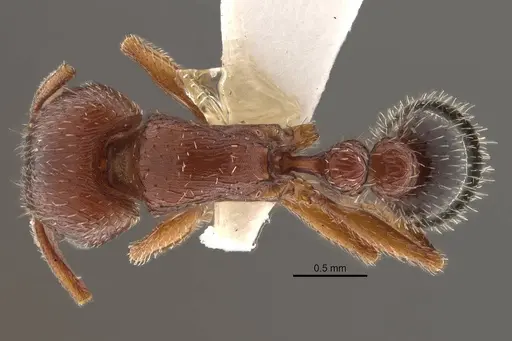
Literature
Loading distribution map...Loading products...