
Temnothorax oxynodis
- Sci. Name
- Temnothorax oxynodis
- Tribe
- Crematogastrini
- Subfamily
- Myrmicinae
- Author
- Mackay, 2000
- Distribution
- Found in 1 countries
Introduction
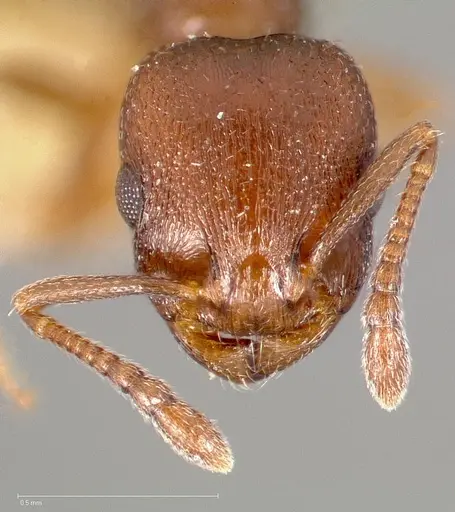
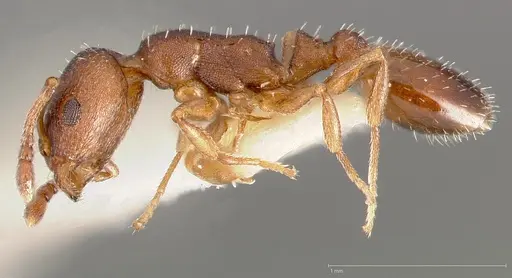
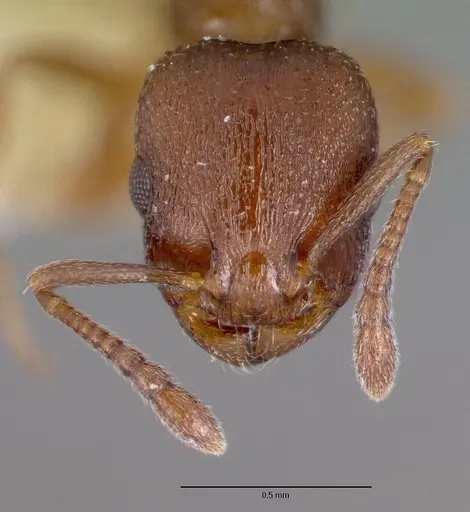
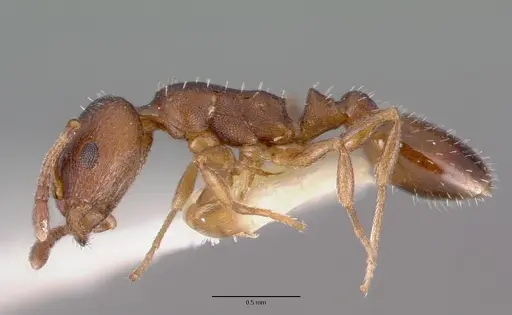
Temnothorax oxynodis is one of the rarest ant species in North America, known only from a handful of collections in Santa Cruz County, California. Workers are very small (total body length unknown) and can be identified by their sharply pointed petiolar node,11-segmented antenna, and blunt propodeal spines. The body is medium brown with a darker gaster. This species belongs to the initens-group and lives in Pinus attenuata (knobcone pine) forests, where workers have been extracted from pine needle litter . Due to extreme rarity, almost nothing is known about its queen or colony biology, and all care recommendations must be extrapolated from related California Temnothorax species.
Quick Summary
- Difficulty: Hard
- Origin & Habitat: Endemic to Santa Cruz County, California, near Big Basin. Specimens have been collected from Pinus attenuata forest floor litter [1][2].
- Colony Type: Unknown, no queen or male specimens have ever been described. Related California species are typically monogynous, but this is unconfirmed [2].
- Size & Growth:
- Queen: Unknown, queens have not been described.
- Worker: Size data unavailable, only head and mesosoma measurements (0.76 mm head length,0.83 mm Weber's length) are recorded, which do not represent total body length [2].
- Colony: Unknown, only a few workers have been collected, but related Temnothorax species usually have small colonies (fewer than 100 workers).
- Growth: Unknown, likely slow based on related species.
- Development: Unknown, estimate 6-10 weeks based on related California Temnothorax, but no direct data exists. (Development time is temperature-dependent, no species-specific data.)
- Antkeeping:
- Temperature: No specific data, maintain at room temperature (20-24°C) as an estimate. Avoid extremes [2].
- Humidity: Provide moderate humidity. In nature, they inhabit pine needle litter which retains moisture. Keep nest substrate slightly damp but not wet [2].
- Diapause: Unknown, no data available. Based on the mild coastal climate, formal diapause may not be required, but this is unconfirmed. Keep at room temperature year-round if uncertain.
- Nesting: Likely nests in small pre-existing cavities (hollow acorns, twigs, under bark). Use a small Y-tong nest with tiny chambers or a test tube setup. Keep the nest dark [2].
- Behavior: These ants are extremely small and very passive. They use a modified stinger to smear venom onto enemies, but rarely do so. Workers are not aggressive. Due to their minute size, escape prevention is critical, standard fluon barriers may not contain them, use fine mesh and seal all gaps [2].
- Common Issues: extreme lack of biological data means all care advice is inferred from related species, expect uncertainty, escape prevention is difficult due to tiny size, even small gaps can lead to colony loss, no established captive breeding exists, wild-collected colonies are fragile and prone to stress, tiny colony size makes them vulnerable to any disturbance or care mistake, overfeeding can quickly cause mold in small setups
Rarity and Collection History
Temnothorax oxynodis is known from only three collections: the holotype worker from near Big Basin, Santa Cruz County, California (September 1957), additional workers extracted from knobcone pine litter (1958), and a few specimens collected by Phil Ward and Brian Fisher in Pinus attenuata forest. This extreme rarity means there are no studies on colony structure, queen morphology, or behavior [1][2]. All care recommendations must be adapted from better-known Temnothorax species like Temnothorax andrei, with significant uncertainty.
Identification and Distinguishing Features
Workers of this species are easily identified by their sharply acute (pointed) petiolar node, which gives them the name 'oxynodis' (Greek 'oxys' meaning sharp). They have 11-segmented antennae (unusual among North American Temnothorax), a finely rugose head, densely punctate mesosoma, and tiny, blunt propodeal spines. The mesosoma is depressed at the mesopropodeal suture. Body color is medium brown with a darker gaster (infuscated) and black eyes. No queens or males have been described [2].
Housing and Nest Setup
Given their tiny size and natural habitat, use a very small nest. A Y-tong (AAC) block with the smallest available chambers or a small test tube (9 mm or 12 mm diameter) with a tight cotton plug works well. Keep the nest dark, as related Temnothorax prefer dim conditions [2]. Escape prevention is critical, these ants can pass through standard fluon barriers. Use fine mesh (e.g., tulle) on ventilation holes and seal all connections with aquarium-grade silicone or tape.
Feeding and Diet
No specific diet studies exist. Based on related Temnothorax, offer sugar water or diluted honey at all times and tiny protein prey such as fruit flies, pinhead crickets, or small pieces of mealworm [2]. Provide food in the outworld in small amounts every few days, and remove uneaten prey to prevent mold. Due to their minute size, even small prey may need to be cut or freshly killed.
Temperature and Seasonal Care
No temperature data is available for this species. Keep at room temperature (20-24°C) as a safe starting point. Avoid direct heat sources or cold drafts. Since it comes from a mild coastal climate, formal hibernation may not be necessary, but this is unconfirmed [2]. Maintain stable conditions without major fluctuations.
Frequently Asked Questions
How do I keep Temnothorax oxynodis ants?
Due to their extreme rarity and lack of data, this species is extremely difficult to keep. Use a tiny nest (Y-tong with small chambers or a test tube), maintain room temperature (20-24°C), provide constant sugar water and tiny protein prey, and ensure impeccable escape prevention. Expect to adapt protocols from related species [2].
What do Temnothorax oxynodis eat?
Likely a generalist diet: sugar sources (honey water, sugar water) and tiny protein prey (fruit flies, small insects). Prey must be very small due to worker size. Feed small amounts every few days and remove leftovers [2].
How big do Temnothorax oxynodis colonies get?
Unknown, only a few workers have ever been collected. Based on related species, colonies probably stay small (fewer than 100 workers) [1][2].
Do Temnothorax oxynodis ants need hibernation?
Probably not, the species lives in a mild coastal climate (Santa Cruz County). However, no data exists. Keeping them at room temperature year-round is likely safe [2].
Can I keep Temnothorax oxynodis in a test tube?
Yes, a small test tube (9 mm or 12 mm) with a tight cotton plug is a good starting nest. Keep the tube dark and provide a separate outworld for feeding. Seal all openings, their tiny size allows them to escape through barely visible gaps [2].
Are Temnothorax oxynodis good for beginners?
No. This species is one of the rarest ants in North America, with virtually no captive care knowledge. It is not recommended for any keeper, let alone beginners. Choose a more common and well-studied Temnothorax species instead [2].
How long does it take for Temnothorax oxynodis to develop from egg to worker?
Unknown, no development data exists. Based on related California Temnothorax, expect roughly 6-10 weeks at room temperature, but this is an estimate [2].
Do Temnothorax oxynodis ants sting?
They have a modified stinger that smears venom rather than piercing. However, they are not aggressive and rarely use it. Their tiny size makes any defensive action negligible [2].
Where is Temnothorax oxynodis found in the wild?
Only from Santa Cruz County, California, near Big Basin, in Pinus attenuata forests. Specimens were found in pine needle litter. This is an extremely restricted known range [1][2].
Why is Temnothorax oxynodis so rare?
It is known from only a few collections. It may genuinely be rare, or simply overlooked due to its tiny size and cryptic habits in forest litter. California pine forests have not been thoroughly surveyed for small ants [1][2].
Report an Issue
The current care sheet is based fully on literature. See inconsistencies, or something that's incorrect? Please , it will be resolved after review from an admin. Contributing to the blogs tab also helps providing information, to make us be able to further improve the caresheets. Thank you for your support!
References

This caresheet is licensed under CC BY-SA 4.0 .
Community Blogs
CASENT0005443
View on AntWeb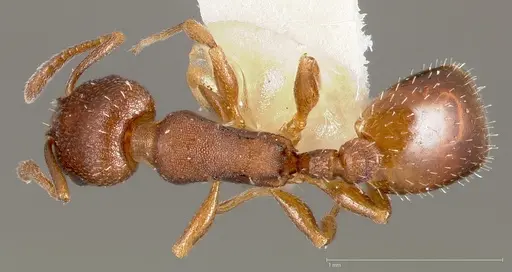
CASTYPE17706
View on AntWeb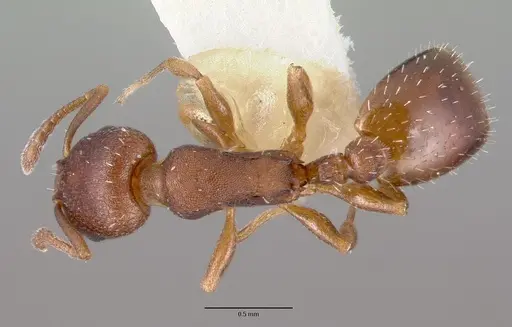
Literature
Loading distribution map...Loading products...