
Temnothorax normandi
- Sci. Name
- Temnothorax normandi
- Tribe
- Crematogastrini
- Subfamily
- Myrmicinae
- Author
- Santschi, 1912
- Distribution
- Found in 1 countries
Introduction
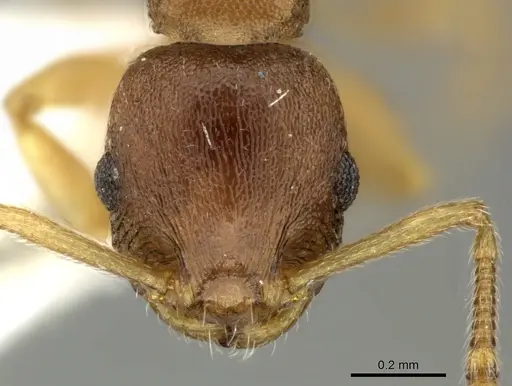
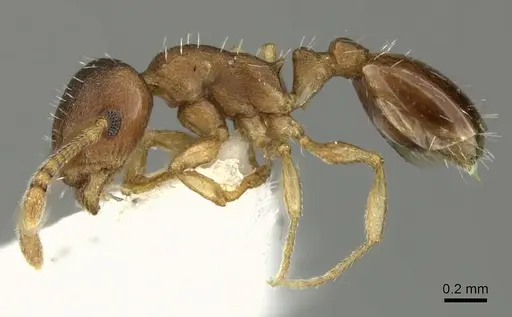
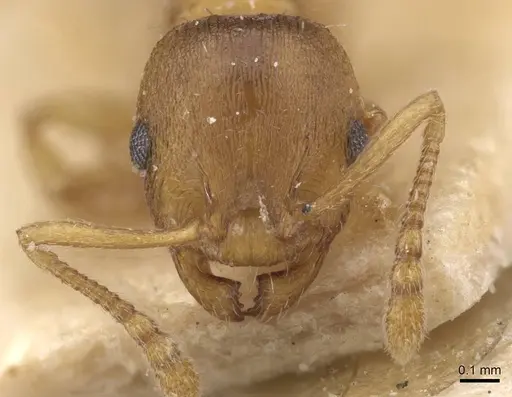
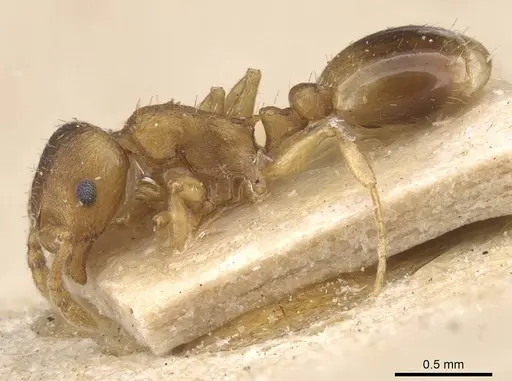
Temnothorax normandi is a tiny myrmicine ant described from Tunisia and also found in Morocco . Workers have striking coloration: head black, promesonotum bright red turning dark red on the epinotum, with a brownish-black gaster and yellowish-brown legs and antennae . Total body length is not published, but like other Temnothorax species they are very small, estimated at 2–3 mm [inferred from genus]. As a member of the tribe Crematogastrini, this species likely uses a modified stinger to smear venom onto enemies rather than piercing them. No behavioral observations specific to this species have been published.
Quick Summary
- Difficulty: Medium
- Origin & Habitat: North Africa (Tunisia and Morocco) – recorded in the Palaearctic region [2][1]. Natural habitat is not documented but likely includes Mediterranean scrub or open woodland.
- Colony Type: Unknown – no colony structure data published for this species. Based on related Temnothorax, it may be monogyne (single queen) with ergatoid replacement queens, but this is speculation.
- Size & Growth:
- Queen: Unknown – no measurements available. Queen morphology is undescribed in the literature.
- Worker: Unknown – total length not measured. The species is tiny, typical of Temnothorax (estimated 2–3 mm from genus patterns).
- Colony: Unknown – no colony size data. Related Temnothorax species often have 100–500 workers, but this is unconfirmed.
- Growth: Unknown – no published data on colony development rate.
- Development: Unknown – no data available for this species. Related Temnothorax may take 6–10 weeks at optimal temperature, but this is unconfirmed. (No reliable developmental timeline is published.)
- Antkeeping:
- Temperature: Unknown – no specific temperature data. As a North African species, it likely tolerates warmth (20–24 °C is a common starting range for Mediterranean ants) but this is inferred.
- Humidity: Unknown – no data. Keep the nest dry with a small moist area to create a gradient, typical for small cavity-nesting ants.
- Diapause: Unknown – region suggests a cool winter period may be beneficial, but no requirements documented. A 2–3 month period at 10–15 °C is speculative.
- Nesting: No nest site data published. Likely nests in small cavities under stones or in rotting wood, as is common for Temnothorax. Y‑tong (AAC) nests with tight, shallow chambers are recommended for captive care.
- Behavior: No behavioral observations published. As a Crematogastrini ant, it likely uses a venom‑smearing stinger. Extremely small – escape prevention is critical.
- Common Issues: tiny size demands meticulous escape prevention – use fine mesh (, no published care data means many parameters must be inferred from related species, increasing uncertainty., overheating is a risk – avoid temperatures above 28 °C and direct sunlight., test tube reservoirs can flood such small colonies – use narrow tubes and avoid overfilling.
Housing and Nest Setup
No published data exists on the natural nesting habits of this species. Based on related Temnothorax, they likely occupy tight cavities under stones or in rotting wood. For captive care, use a Y‑tong (AAC) or 3D‑printed nest with shallow, narrow chambers – these ants feel secure in confined spaces. Avoid large, open areas. The outworld must be sealed with fine mesh (0.5 mm or smaller) and fluon on edges because workers are tiny and adept at squeezing through gaps. A narrow test tube works well during founding, but transfer to a formicarium only after the colony has at least 20–30 workers (if using inferred guidelines).
Feeding and Diet
There is no dietary data for this species. Other Temnothorax are omnivorous, feeding on honeydew and small arthropods. Offer sugar water or honey water as a constant carbohydrate source, and small live prey such as fruit flies, pinhead crickets, or micro mealworms 2–3 times per week. Because the workers are tiny, prey must be no larger than they can handle. Remove uneaten food within 24 hours to prevent mold. This diet is inferred from genus patterns.
Temperature and Seasonal Care
No specific temperature or diapause requirements are documented. As a North African species, the ants likely prefer warm conditions around 20–24 °C, but this is speculative. Avoid prolonged temperatures above 28 °C or direct sunlight. A gentle gradient from one side of the nest to the other is helpful. A winter cooling period (approx. 10–15 °C for 2–3 months) may be beneficial to synchronize colony cycles, but this is unconfirmed. Observation is key – adjust based on colony activity.
Behavior and Colony Dynamics
No behavioral studies have been published. Based on tribe Crematogastrini, these ants likely defend by smearing venom from a modified spatulate stinger, rather than stinging painfully. Workers of related Temnothorax are active foragers and use tandem running to recruit nestmates, but this is not confirmed for T. normandi. Colony structure (queen number, founding method) is unknown. Escape risk is very high due to their tiny size.
Frequently Asked Questions
How long does it take for Temnothorax normandi to raise their first workers?
No published data is available. Based on related Temnothorax, the first workers may appear in 6–10 weeks at 20–24 °C, but this is an estimate. The queen likely seals herself in during founding and relies on stored reserves, but this is speculative.
Can I keep multiple Temnothorax normandi queens together?
Unclear – no colony structure data exists. Most Temnothorax are monogyne, so combining queens is not recommended unless you observe cooperation. House each queen separately unless evidence suggests otherwise.
Do Temnothorax normandi ants sting?
They possess a stinger, but it is modified for smearing venom (belonging to tribe Crematogastrini) rather than piercing skin. The venom may be irritating but not a true sting to humans. No recorded incidents.
What do I feed Temnothorax normandi?
No specific dietary data. By genus patterns, offer sugar water or honey water for carbohydrates, and small live prey like fruit flies or pinhead crickets for protein (2–3 times per week). Prey must be appropriately sized for these tiny ants.
How big do Temnothorax normandi colonies get?
Unknown. Related species range from 100–500 workers, but no information specific to T. normandi is published. Expect a small to moderate colony size.
Do Temnothorax normandi need hibernation?
No data confirms diapause. As a North African species, it likely experiences mild winters, and a cool period (10–15 °C for a few months) may be optional. If colony activity drops in winter, that is normal. Do not force hibernation without observation.
Why are my Temnothorax normandi escaping?
Their tiny size allows them to squeeze through gaps under 1 mm. Use fluon on outworld walls, fine mesh (0.5 mm or smaller) on ventilation, and seal all connections. Check water tubes and nest junctions regularly.
Is Temnothorax normandi good for beginners?
The difficulty is medium because their tiny size requires careful escape prevention and many care parameters are unknown. Experienced keepers comfortable with small myrmicines may enjoy them, beginners should start with a better‑studied species.
When should I move my colony to a formicarium?
No specific recommendation exists. By general antkeeping practice, wait until the colony has at least 20–30 workers and is actively outgrowing the test tube. Moving too early can stress the queen.
Report an Issue
The current care sheet is based fully on literature. See inconsistencies, or something that's incorrect? Please , it will be resolved after review from an admin. Contributing to the blogs tab also helps providing information, to make us be able to further improve the caresheets. Thank you for your support!
References

This caresheet is licensed under CC BY-SA 4.0 .
Community Blogs
CASENT0906699
View on AntWeb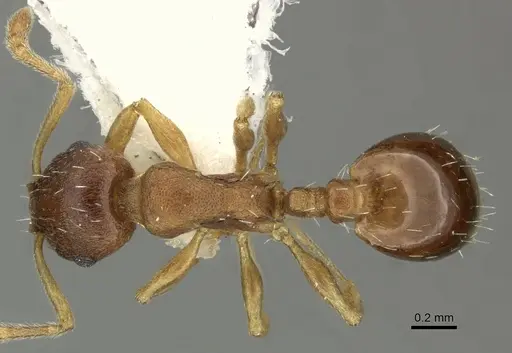
CASENT0912974
View on AntWeb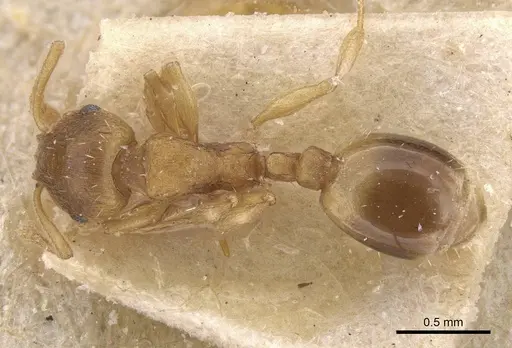
Literature
Loading distribution map...Loading products...