
Temnothorax isabellae
- Sci. Name
- Temnothorax isabellae
- Tribe
- Crematogastrini
- Subfamily
- Myrmicinae
- Author
- Wheeler, 1908
- Distribution
- Found in 1 countries
Introduction
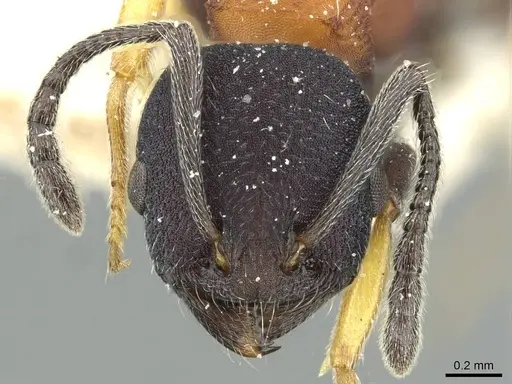
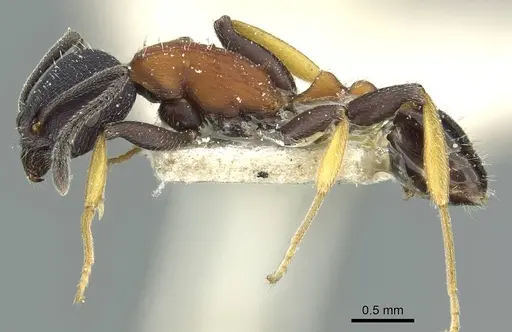
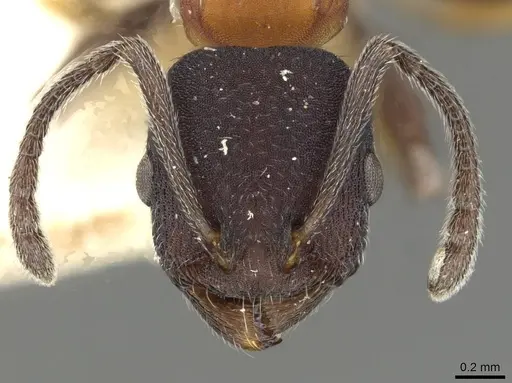
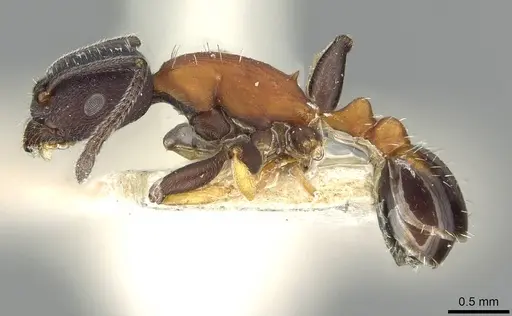
Temnothorax isabellae is a stunningly beautiful small ant native to Puerto Rico and the Virgin Islands. Workers measure 3.5-3.7 mm, and queens are slightly larger at 3.9 mm . Their coloration is extraordinary: the head, gaster, and limbs are a striking blue-black with a brilliant satiny blue reflection on the first gastric segment that only shows in certain lights, while the thorax and waist segments are a dull orange-red. Workers have sparse, snow-white erect hairs covering their bodies. This species was first described from colonies nesting under orchid roots and in hollow twigs at high elevations in Puerto Rico . These ants form small colonies of only a few dozen workers, making them a great choice if you prefer watching a compact, manageable colony rather than a massive supercolony. They are cavity nesters by nature, choosing pre-existing hollow spaces like twigs, under roots, or in old stumps. Workers move with a distinctive slow, deliberate gait, carrying their gaster tucked between their hind legs . This species rewards patient observation.
Quick Summary
- Difficulty: Easy
- Origin & Habitat: Puerto Rico and Virgin Islands. Found in mountainous areas at elevations from 800 to 3000 feet, typically in forested habitats. Nests in pre-existing cavities like hollow twigs, under epiphytic orchid roots, and in old stumps [1][2].
- Colony Type: Single-queen colonies (monogyne) based on observations of small colonies. Queens are the primary reproducers, no worker reproduction has been reported [1].
- Size & Growth:
- Queen: 3.9 mm [1]
- Worker: 3.5-3.7 mm [1]
- Colony: Up to a few dozen workers, colonies stay small [1]
- Growth: Moderate
- Development: Estimated 6-10 weeks based on typical Temnothorax development patterns (Direct development data for this species is unavailable, the estimate is from genus-level patterns for small cavity-nesting ants.)
- Antkeeping:
- Temperature: Based on their mountainous forest habitat, keep temperatures moderate and stable, roughly 20-24°C. Avoid temperatures below 18°C or above 28°C. A gentle heating cable on one side of the nest can create a gradient if needed, but it's not required.
- Humidity: Provide a moisture gradient. The nest substrate should be kept slightly moist but not waterlogged. Their natural habitat in Puerto Rico is humid but not saturated.
- Diapause: No, being from Puerto Rico, they do not require hibernation. Keep stable temperatures year-round.
- Nesting: Cavity nesters by nature. They do best in Y-tong (AAC) nests, test tube setups, or plaster nests with narrow chambers that mimic the tight spaces of hollow twigs and root cavities [1].
- Behavior: Workers are slow-moving and deliberate rather than frantic. They forage individually and collect small insects and honeydew. This species is not aggressive and is easy to handle. Their small size (under 4 mm) means that escape prevention is critical, you need fine mesh and tight-fitting barriers. They are peaceful colony members that won't trouble other ants if kept separately.
- Common Issues: small size means escapes are likely without fine mesh barriers, colonies stay small, which may disappoint keepers expecting rapid growth, slow movement can be mistaken for illness, this is normal behavior for the species [1], humidity that is too high can cause mold issues in nesting cavities
Housing and Nest Setup
Temnothorax isabellae does best in setups that mimic their natural cavity-nesting preferences. A Y-tong (AAC) nest works excellently because it provides the tight, enclosed chambers these ants prefer. Alternatively, a test tube setup with a cotton water reservoir is simple and effective. Plaster nests with narrow passages also work well. The key is giving them enclosed spaces, they are not a species that does well in large open foraging areas. The nest should have chambers sized appropriately for their tiny 3.5 mm workers, overly large spaces stress them. Connect the nest to a small outworld for foraging. Use fluon or another reliable barrier on the outworld because their small size means they can slip through standard barriers meant for larger ants [1].
Feeding and Diet
Like most Temnothorax species, these ants are omnivorous and will accept a variety of foods. Offer small protein sources like fruit flies, small mealworms, or other tiny insects. They also readily accept sugar sources, a small drop of honey water or sugar water will be collected. In the wild, workers forage on leaves and likely collect honeydew from aphids and other sap-sucking insects, plus small prey [1]. Feed them small prey items 2-3 times per week, and keep a sugar source available constantly. Remove any uneaten prey after 24 hours to prevent mold. Their small colony size means they don't need large quantities of food, a few small items is sufficient.
Temperature and Seasonal Care
No specific temperature data is available for this species. Based on their mountainous forest habitat in Puerto Rico, keep conditions warm and stable, aim for roughly 20-24°C. Avoid dropping below 18°C or climbing above 28°C. A heating cable on one side of the nest can create a gentle gradient but is not essential. Room temperature in most homes falls within their preferred range, so additional heating may be unnecessary. Stable temperatures are more important than exact precision, avoid drafts and sudden changes.
Colony Development and Expectations
Expect slow but steady growth. Colonies remain naturally small, a mature colony will only reach a few dozen workers, not hundreds or thousands [1]. This is normal for the species, not a sign of poor care. The queen will lay eggs, and after an estimated 6-10 weeks (based on typical Temnothorax development), the first workers (nanitics) will emerge. These first workers are smaller than mature workers. The colony will grow gradually over months and years. Patience is key, this species is a long-term project rather than a fast-growing showpiece. The reward is watching a beautiful, peaceful little colony thrive in a compact space.
Frequently Asked Questions
How long does it take for Temnothorax isabellae to produce first workers?
Expect 6-10 weeks from egg to first worker at optimal temperature (around 20-24°C). This is based on typical Temnothorax genus development patterns since specific data for this species is not available.
Are Temnothorax isabellae good for beginners?
Yes, they can be a good choice for beginners. They are small, peaceful, and form manageable colonies. They don't require hibernation and are forgiving of minor temperature variations. The main challenge is their small size requiring good escape prevention.
How big do Temnothorax isabellae colonies get?
Colonies stay small, typically only a few dozen workers even when mature. This is normal for the species and one of its defining characteristics [1].
Do Temnothorax isabellae ants sting?
Given their tiny size under 4 mm, they are incapable of delivering a meaningful sting to humans. They are completely harmless and handle easily.
What do Temnothorax isabellae eat?
They accept small insects like fruit flies and tiny mealworms, plus sugar sources like honey water or sugar water. They are omnivorous, like most Temnothorax species.
Can I keep multiple queens together?
This species is believed to be monogyne based on observed small colonies. Multiple queens would likely fight, so it's safest to keep only one queen per colony.
Do Temnothorax isabellae need hibernation?
No. Being from Puerto Rico, they do not require any hibernation or cooling period. Keep them at stable warm temperatures year-round.
What is the best nest type for Temnothorax isabellae?
Y-tong (AAC) nests or test tube setups work best. These ants are cavity nesters that prefer tight, enclosed chambers. Avoid large naturalistic setups with lots of open space [1].
Why are my Temnothorax isabellae moving so slowly?
This is normal behavior for the species. Workers are described as moving rather slowly with their gaster tucked between their hind legs, this is how they naturally move, not a sign of illness [1].
When should I move my colony to a formicarium?
You can keep them in a test tube setup indefinitely since colonies stay small. If you want to move them to a Y-tong or plaster nest, wait until the colony has at least 10-15 workers and is clearly established.
Report an Issue
The current care sheet is based fully on literature. See inconsistencies, or something that's incorrect? Please , it will be resolved after review from an admin. Contributing to the blogs tab also helps providing information, to make us be able to further improve the caresheets. Thank you for your support!
References

This caresheet is licensed under CC BY-SA 4.0 .
Community Blogs
CASENT0912950
View on AntWeb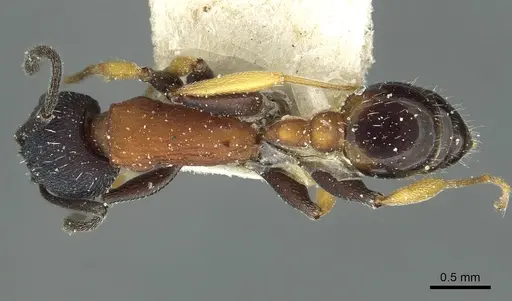
CASENT0915380
View on AntWeb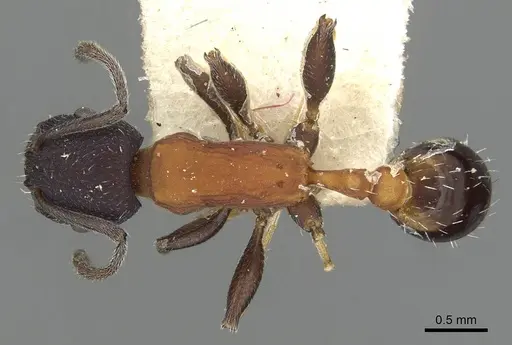
Literature
Loading distribution map...Loading products...