
Technomyrmex obscurior
- Sci. Name
- Technomyrmex obscurior
- Tribe
- Tapinomini
- Subfamily
- Dolichoderinae
- Author
- Wheeler, 1928
- Distribution
- Found in 2 countries
Introduction
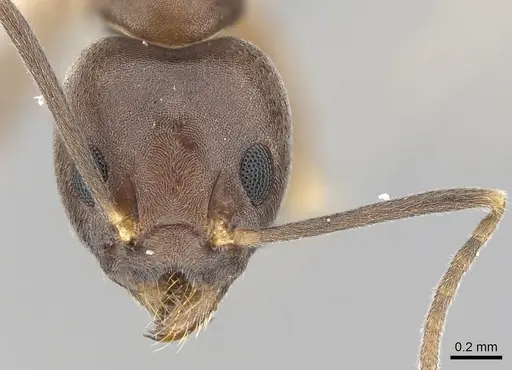
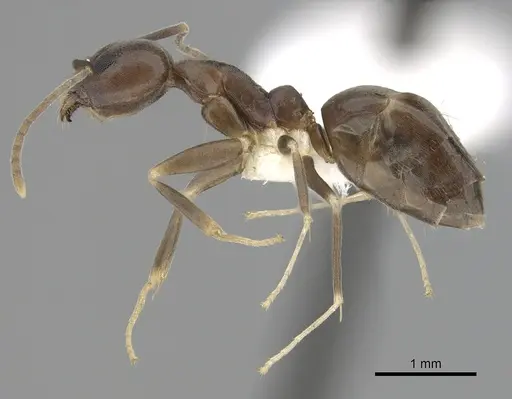
Technomyrmex obscurior is a small dolichoderine ant from Southeast Asia and southern China. Workers are 3.2-3.8 mm long and uniformly dark brown to blackish brown, making them look almost entirely black. The name 'obscurior' refers to this dark color. A key feature is the contrast between the brown forecoxae and the ivory-white to yellow middle and hind coxae . Unlike many ants, they lack hairs on the head, mesosoma, and first gastral segment, but the rear segments have long bristles . Queens are larger at 5.3-5.5 mm . This species belongs to the Technomyrmex bicolor group and is close to T. antennus, differing in propodeum shape and coxae color . These ants nest in rotting wood, dead twigs, and leaf litter in forests across their range . They are found in both primary forests (hill evergreen, dry evergreen, mixed deciduous) and disturbed areas in Nepal, Thailand, Vietnam, Myanmar, and China, including Hainan Island . A collection has also been made from under a stone in a Schima-Castanopsis forest .
Quick Summary
- Difficulty: Easy
- Origin & Habitat: Southeast Asia and southern China (Nepal, Thailand, Vietnam, Myanmar, China including Hainan). Lives in primary and disturbed forests (hill evergreen, dry evergreen, mixed deciduous). Nests in rotten wood, dead twigs, and leaf litter [1][3][4][2].
- Colony Type: Unconfirmed – no published data on queen number or colony organization for this species.
- Size & Growth:
- Queen: 5.3-5.5 mm [1]
- Worker: 3.2-3.8 mm [1]
- Colony: Unknown – no published colony size data.
- Growth: Moderate – inferred from typical dolichoderine development patterns.
- Development: Estimated 6-8 weeks at warm temperatures (24-26°C) based on typical Technomyrmex patterns. (Direct data unavailable – estimate based on related species in the genus.)
- Antkeeping:
- Temperature: Keep at 22-26°C. They come from warm subtropical to tropical forests. A gentle gradient is ideal [1].
- Humidity: Moderate to high. They naturally live in forest floor environments with decaying wood. Keep substrate moderately moist but not waterlogged. Provide some drier areas for self-regulation [1].
- Diapause: Unknown – no published data. Given their subtropical distribution, they likely do not require true hibernation. They may tolerate cooler temperatures with reduced activity [1].
- Nesting: Naturalistic setups with rotting wood, dead twigs, or leaf litter work best. Y-tong (AAC) or plaster nests with small, tight chambers are suitable. They need humid conditions with some dry zones [1].
- Behavior: Generally peaceful and non-aggressive. Like other dolichoderines, they lack a functional stinger and instead release a sticky, foul-smelling substance from an anal gland for defense. This is mild and not a concern for keepers. Workers are active foragers, likely collecting honeydew and small insects. Their small size (3.2-3.8 mm) means they can slip through tiny gaps – use fine mesh on ventilation and tight-fitting lids. They are not especially escape-prone but standard precautions apply [1].
- Common Issues: small size means escapes are possible without fine mesh barriers, no published colony data makes growth patterns hard to predict, humidity control is important – too dry causes mortality, wild-caught colonies may carry parasites or disease, limited availability makes this a specialty species
Housing and Nest Setup
Technomyrmex obscurior naturally nests in rotting wood, dead twigs, and leaf litter on the forest floor [1][2]. For captivity, set up a naturalistic nest using a mix of soil and rotting wood pieces, or use a Y-tong (AAC) or plaster nest with small chambers scaled to their size. They prefer tight, enclosed spaces with high humidity but need some dryer areas so workers can choose their microclimate [1]. Because workers are only 3.2-3.8 mm, make sure passages are appropriately sized. Use a small outworld for foraging. Fine mesh on ventilation prevents escapes [1].
Feeding and Diet
In nature, Technomyrmex obscurior are generalist feeders, collecting honeydew from aphids and scale insects, plus small dead insects [1]. In captivity, provide a constant source of sugar water or honey for energy, and offer protein 2-3 times per week. Good protein sources include flightless fruit flies, small mealworms, or pinhead crickets. Remove uneaten prey after 24-48 hours to prevent mold. Keep food small and appropriate for their size [1].
Temperature and Seasonal Care
Keep your colony at 22-26°C. This species comes from warm subtropical to tropical forests, so stable warmth is important [1]. Use a heating cable on one side of the nest to create a temperature gradient, allowing workers to self-regulate. Avoid temperatures below 18°C or above 30°C for long periods. No published data exists on diapause, but given their range in southern China and Southeast Asia, they likely do not need true hibernation. If you keep them cool in winter, expect lower activity and reduce feeding, but a full dormancy period is probably unnecessary [1].
Behavior and Temperament
Technomyrmex obscurior is a peaceful species that does well in captivity. Like all dolichoderine ants, they lack a functional stinger and instead defend by releasing a sticky, foul-smelling substance from an anal gland. This is mild and rarely bothers keepers. Workers are active foragers and will explore their outworld for food. Their small size (3.2-3.8 mm) means they can slip through small gaps – use tight-fitting lids and fine mesh on any ventilation. They are not particularly aggressive, making them good for observation [1]. Colonies likely grow at a moderate pace, though exact rates are unknown [1].
Colony Establishment
Since colony structure and founding behavior have not been documented for this species, we rely on patterns from related Technomyrmex species. Founding queens likely seal themselves in a small chamber and raise their first workers without feeding (claustral founding) [1]. The first workers, called nanitics, will be smaller than normal workers. Expect 6-8 weeks from egg to first worker at warm temperatures (24-26°C). Once established, colonies likely grow gradually over months to years. Because this species is not commonly kept, you may need to contact specialty breeders or collectors in Asia to obtain a colony [1].
Frequently Asked Questions
How long does it take for Technomyrmex obscurior to get their first workers?
Direct data is unavailable, but based on typical dolichoderine development, expect 6-8 weeks from egg to first worker at warm temperatures (around 24-26°C). The first workers (nanitics) will be smaller than full-sized workers [1].
What do Technomyrmex obscurior ants eat?
They are generalist feeders. Offer sugar water or honey constantly for energy, plus small protein sources like fruit flies, small mealworms, or other tiny insects 2-3 times per week. Remove uneaten prey after 24 hours [1].
Can I keep Technomyrmex obscurior in a test tube?
Test tubes work for a founding queen, but because they naturally nest in rotting wood and prefer humid forest floor conditions, a naturalistic setup or Y-tong nest with small chambers is better once the colony grows. Upgrade from a test tube as the colony expands [1].
Are Technomyrmex obscurior good for beginners?
They are rated as easy difficulty, but this species is not commonly available in the antkeeping hobby. Their care is straightforward – moderate warmth, humidity, and standard feeding – but obtaining a colony may be challenging. They are a specialty species [1].
How big do Technomyrmex obscurior colonies get?
Colony size data is not published. Based on their small worker size (3.2-3.8 mm) and typical Technomyrmex patterns, colonies likely reach several hundred workers over time, but exact maximum size is unknown [1].
Do Technomyrmex obscurior need hibernation?
Unknown – no published data exists. Based on their subtropical distribution in Southeast Asia and southern China, they likely do not require true hibernation. They may tolerate cooler winter temperatures with reduced activity, but a full diapause is probably unnecessary [1].
What temperature is best for Technomyrmex obscurior?
Keep them at 22-26°C. They naturally inhabit warm forests and prefer stable conditions. A heating cable on one side of the nest to create a gentle gradient works well [1].
Why are my Technomyrmex obscurior dying?
Common causes include: too dry conditions (they need moderate humidity), temperatures outside their 22-26°C range, escape through small gaps due to their tiny size, or parasites from wild-caught colonies. Ensure proper humidity, appropriate temperature, and use fine mesh for escape prevention [1].
When should I move Technomyrmex obscurior to a formicarium?
Move them when the test tube or founding setup becomes crowded. For this small species, a Y-tong or plaster nest with small chambers works well. Ensure the new nest maintains appropriate humidity and has properly sized passages [1].
Report an Issue
The current care sheet is based fully on literature. See inconsistencies, or something that's incorrect? Please , it will be resolved after review from an admin. Contributing to the blogs tab also helps providing information, to make us be able to further improve the caresheets. Thank you for your support!
References

This caresheet is licensed under CC BY-SA 4.0 .
Community Blogs
CASENT0249798
View on AntWeb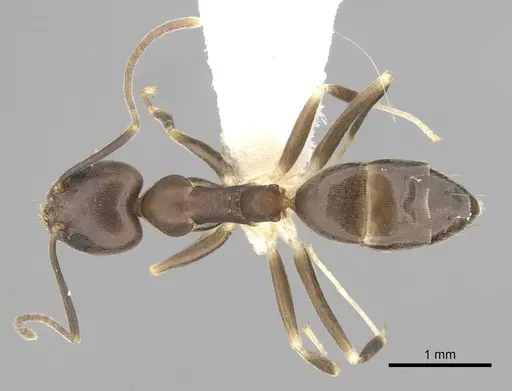
Literature
Loading distribution map...Loading products...