
Technomyrmex antennus
- Sci. Name
- Technomyrmex antennus
- Tribe
- Tapinomini
- Subfamily
- Dolichoderinae
- Author
- Zhou, 2001
- Distribution
- Found in 4 countries
Introduction
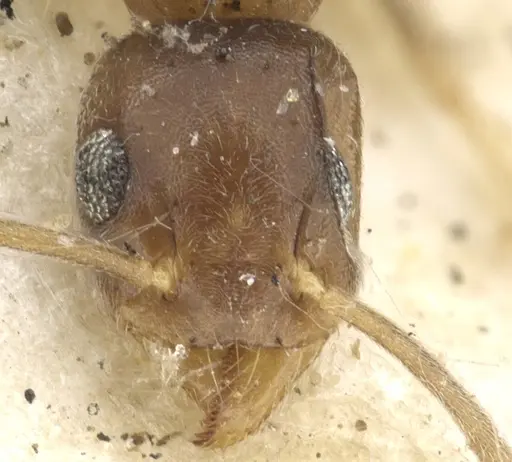
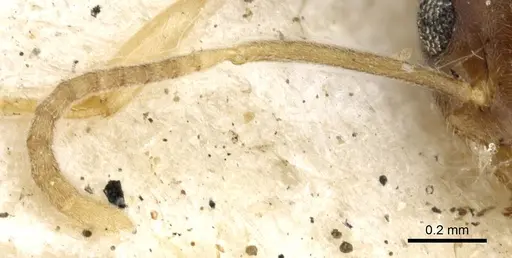
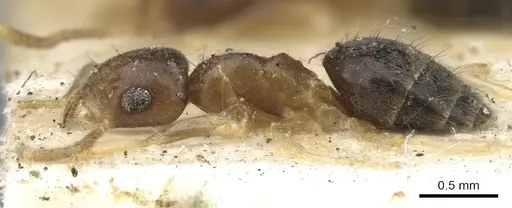
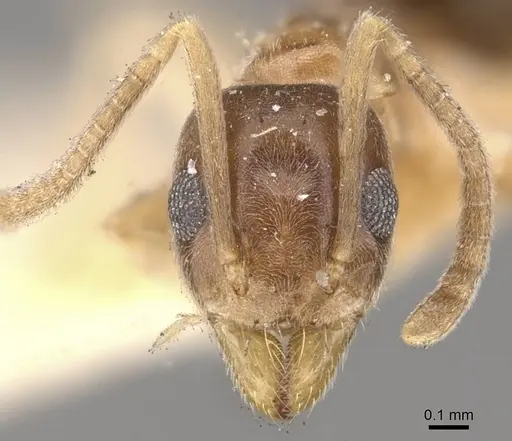
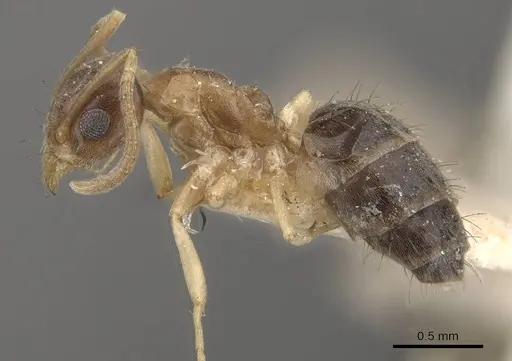
Technomyrmex antennus is a small, slender ant native to southern China. Workers measure 3.0-4.2 mm (total length) and have a heart-shaped head that narrows toward the mandibles, long antennae that extend well beyond the back of the head, and a convex gaster that hangs over the petiole . The body is uniformly brown with yellowish legs and antennae, and the surface has a finely reticulated (net-like) texture that gives it a slightly matte appearance. This species belongs to the Dolichoderinae subfamily, so they lack a stinger, instead, they exude sticky, foul-smelling chemicals from an anal gland to deter predators. This ant inhabits forested areas across southern China, including Guangxi Province and Hainan Island. It has been collected from conifer-broadleaf forest and Masson pine forest at elevations of 574-780 m , and it appears to prefer primary forest and rubber plantations over secondary forest . The species forages mainly on the ground surface and occasionally within soil . Nest sites have not been directly observed, but they are most often found in leaf litter samples .
Quick Summary
- Difficulty: Medium
- Origin & Habitat: Southern China (Guangxi, Hainan, Sichuan) in primary forest and rubber plantations at 574-780 m elevation, in conifer-broadleaf and Masson pine forests [2] [3] [4].
- Colony Type: Unconfirmed.
- Size & Growth:
- Antkeeping:
- Temperature: Based on subtropical forest origin, keep at 22-26°C. Provide a temperature gradient so ants can self-regulate. Protect from extremes.
- Humidity: Keep the nest substrate consistently moist but not waterlogged, mimicking a forest floor environment. Allow slight drying between mistings.
- Diapause: Likely required, the species experiences seasonal changes in its elevational range. If colony activity slows in winter, gradually reduce temperature to around 15°C for 2-3 months. Alternative: provide a milder rest period at 18-20°C. Exact requirements unknown, so observe colony behavior and adjust.
- Nesting: Y-tong (AAC) or plaster nests work well, as they hold moisture. These ants naturally inhabit leaf litter and soil, so provide a nest with moist substrate. Acrylic nests are not recommended.
- Behavior: Workers are peaceful, non-aggressive foragers that search the ground surface and upper soil layers. They rely on anal gland secretions (not a sting) for defense. Since workers are 3-4 mm, use standard smooth barriers (e.g., fluon) on nest openings and outworld edges to prevent escapes. They are sensitive to disturbance, so place the setup in a quiet area away from vibrations.
- Common Issues: limited availability, this species is rarely offered in the antkeeping hobby., colony structure unconfirmed, careful observation needed to determine queen number and founding behavior., diapause requirements unclear, start with a mild winter rest and adjust based on colony response., primary forest habitat preference may mean they are sensitive to dry or disturbed conditions., dietary data limited, acceptance of different sugar sources and protein items may vary, experiment with small offerings.
Housing and Nest Setup
T. antennus does well in Y-tong (AAC) or plaster nests that maintain stable humidity. These ants naturally inhabit leaf litter and the upper soil layer in forests, so provide a nest chamber with a moisture-retenive medium and a small water reservoir. Avoid acrylic nests, as they do not hold humidity well. For a founding colony, use a simple test tube setup with a cotton water plug, do not disturb the queen until the first workers appear. Once the colony has several workers (not a specific count), you can connect a larger nest. Escape prevention is important: use fluon or a similar barrier on the rims of the outworld and nest openings, as workers are 3-4 mm and can squeeze through small gaps [2].
Feeding and Diet
Technomyrmex ants are generalist feeders. In nature, they consume honeydew from aphids and scale insects, as well as small invertebrates they find while foraging on the ground [2]. In captivity, offer a constant supply of sugar water (1:3 ratio of sugar to water) or honey water. Provide protein 2-3 times per week in the form of small insects like fruit flies, small mealworms, or pieces of cricket. Remove uneaten prey after 24 hours to prevent mold. Start with small amounts and observe what your colony accepts, food preferences may vary. Avoid overfeeding.
Temperature and Seasonal Care
Keep the nest at 22-26°C, which reflects the subtropical origin of this species. A slight temperature gradient (one part warmer, one part cooler) allows workers to self-regulate. During summer, room temperature may be sufficient, but in cooler rooms you may need a heating cable placed under part of the nest. When colony activity naturally decreases in winter, gradually lower the temperature to about 15°C for 2-3 months. This mimics the seasonal cooling they experience in their highland habitats (elevations of 574-780 m) [2]. Reduce feeding during this rest period. If your colony does not slow down, a shorter or milder diapause may be acceptable. Never let the nest freeze.
Behavior and Colony Dynamics
Workers are active ground foragers that search leaf litter and the soil surface for food [2]. They are not aggressive and lack a functional sting, instead, they rely on chemical secretions from their anal gland for defense. Colonies likely grow at a moderate pace, but direct data are absent. T. antennus appears to prefer stable, undisturbed habitats like primary forest and rubber plantations, and it is absent from secondary forest [3]. This suggests they may be sensitive to environmental changes, so keep the setup quiet, away from direct sunlight and vibrations. Workers are 3-4 mm and can escape through tiny gaps, so ensure all connections are tight and barriers are applied.
Frequently Asked Questions
How long does it take for Technomyrmex antennus to produce first workers?
The exact timeline is unknown for this species, no published data exist. Based on other small Dolichoderinae, it might take several weeks to months at 22-26°C, but this is speculative. Be patient and avoid disturbing the founding queen.
Can I keep multiple Technomyrmex antennus queens together?
This is not recommended and has not been documented. Colony structure is unconfirmed, but combining unrelated queens risks fighting and death. If a colony naturally develops multiple queens, observe for aggression, separation may be needed. Most Technomyrmex appear to have single-queen colonies.
What temperature range is best for Technomyrmex antennus?
Keep colonies at 22-26°C, reflecting their subtropical forest origin. Provide a slight gradient for self-regulation. When activity slows in winter, a rest period at around 15°C for 2-3 months is likely beneficial, but exact requirements are unknown. Adjust based on colony behavior [2].
Are Technomyrmex antennus good for beginners?
This species is rated as medium difficulty and may not be ideal for beginners due to limited availability and uncertain care requirements (colony structure, development, diapause). If you have experience with other forest-dwelling ants and are willing to observe and adapt, it could be manageable.
Do Technomyrmex antennus need hibernation?
A period of winter rest is likely needed. The species experiences seasonal cooling at its natural elevations [2]. If the colony slows down in winter, gradually reduce temperature to about 15°C for 2-3 months, with reduced feeding. If the colony remains active, a milder rest may suffice. Exact requirements are unconfirmed.
What do Technomyrmex antennus eat?
They are generalist feeders. Offer constant access to sugar water (1:3 ratio) or honey water, and provide small insects (fruit flies, small mealworms, cricket pieces) as protein 2-3 times per week. In nature they forage on the ground for small arthropods and honeydew [2].
How big do Technomyrmex antennus colonies get?
Colony size is unknown for this species. Related Technomyrmex species may reach a few hundred workers, but this is speculative. Established colonies are likely active but not huge.
When should I move Technomyrmex antennus to a formicarium?
Keep the founding colony in a test tube setup until the queen has raised her first workers and the colony has a small but growing workforce (several workers). At that point you can connect a Y-tong or plaster nest with a moistened chamber. Avoid moving them too early to reduce stress.
Why is my Technomyrmex antennus colony declining?
Possible causes: (1) Too dry, they need consistently moist substrate typical of a forest floor. (2) Temperature stress, keep between 22-26°C and avoid fluctuations. (3) Lack of protein, offer small insects regularly. (4) Disturbance during founding, minimize checking. (5) Escape, check seals and barriers, as workers can squeeze through tiny gaps. Adjust each variable and observe.
Report an Issue
The current care sheet is based fully on literature. See inconsistencies, or something that's incorrect? Please , it will be resolved after review from an admin. Contributing to the blogs tab also helps providing information, to make us be able to further improve the caresheets. Thank you for your support!
References

This caresheet is licensed under CC BY-SA 4.0 .
Community Blogs
CASENT0903051
View on AntWeb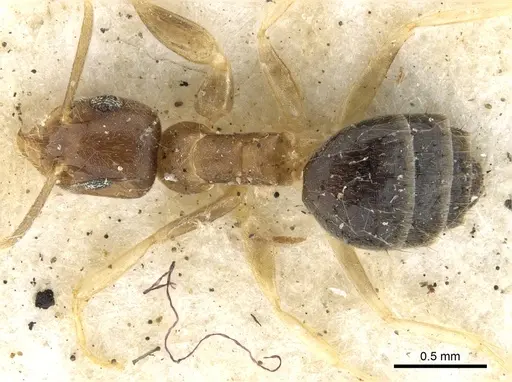
CASENT0909794
View on AntWeb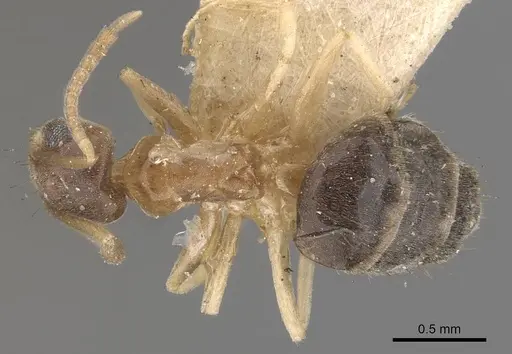
Literature
Loading distribution map...Loading products...