
Tapinoma kinburni
- Sci. Name
- Tapinoma kinburni
- Tribe
- Tapinomini
- Subfamily
- Dolichoderinae
- Author
- Karavaiev, 1937
- Distribution
- Found in 1 countries
Introduction
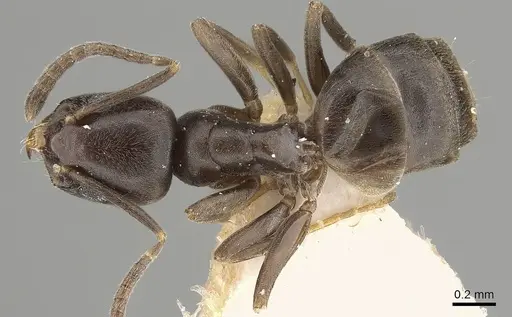
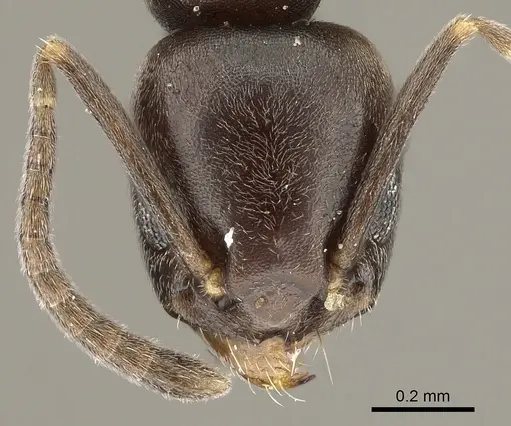
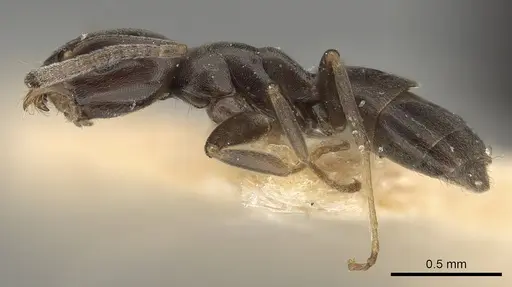
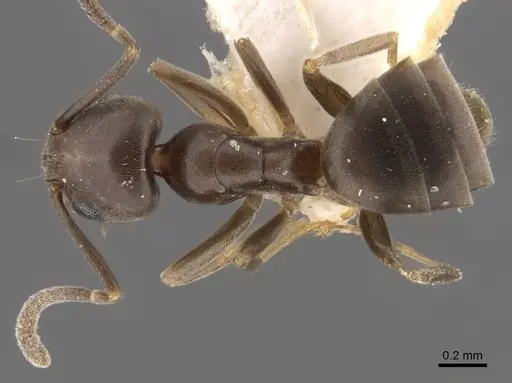
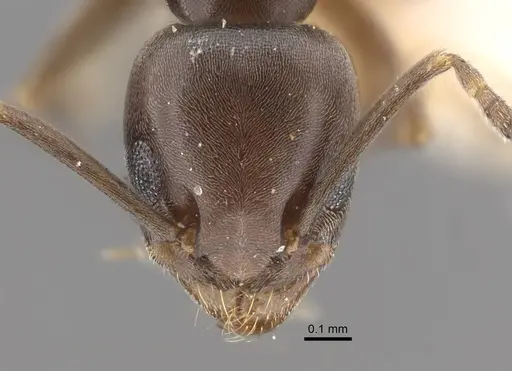
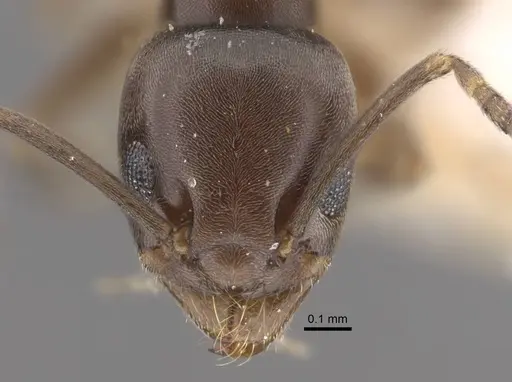
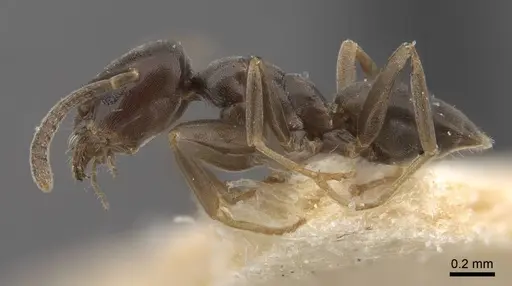
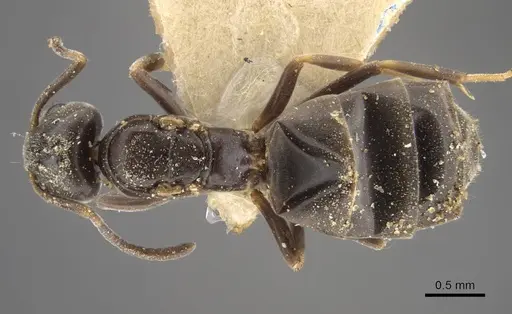
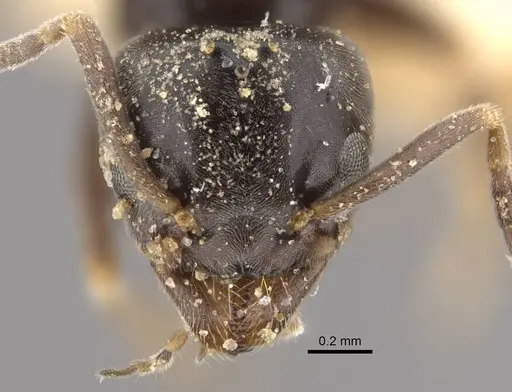
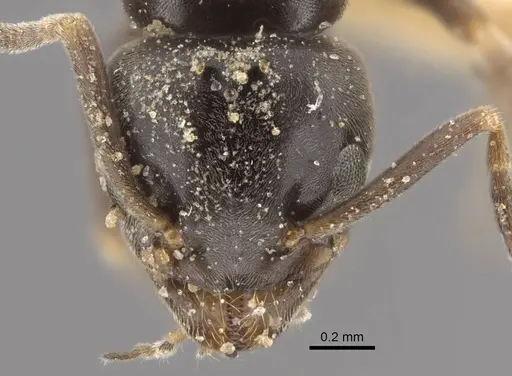
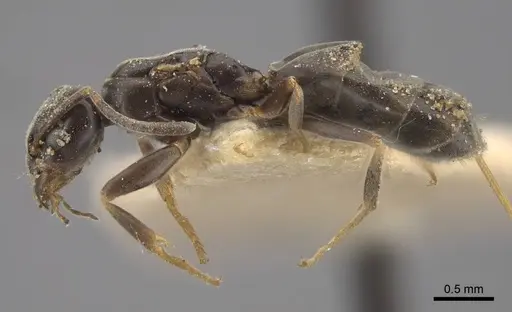
Tapinoma kinburni is a tiny dark brown ant endemic to the Black Sea sandy steppe region of Ukraine and adjacent Russia . Workers have a moderately elongated head, very short antennae, and a shallow notch in the face plate (clypeus). The whole body is uniformly dark to blackish brown, with pale yellowish-brown legs and often the tip of the antennae . They nest in sandy soil in semi-open areas with sparse vegetation, making entrance holes 2–4 mm wide surrounded by distinctive crater‑like sand ejections up to 8 cm across . This species was first described by Karavaiev in 1937 and was originally known only from Ukraine, with recent records from Belgorod Oblast in Russia . What makes this ant special is its extremely limited distribution – it's a sub‑endemic found only on the northern edge of the steppe zone . Foragers are active during the day but take a break during the hottest afternoon hours . As a member of the Dolichoderinae subfamily, they lack a sting and instead defend themselves with a foul‑smelling, sticky secretion from their anal gland (this is general taxonomic knowledge).
Quick Summary
- Difficulty: Hard
- Origin & Habitat: Black Sea sandy steppe of Ukraine and Belgorod Oblast, Russia. Semi‑open sandy areas with xerophile plants, small salt lakes, and relict oak/birch stands. Nests in soil with incomplete turf cover [1][2][3].
- Colony Type: Colony structure is not well studied. Based on related Tapinoma species, they likely have a single queen (monogyne), but this is unconfirmed.
- Size & Growth:
- Queen: ~3-4 mm – inferred from the genus Tapinoma (no specific measurements published).
- Worker: ~2-3 mm – inferred from the genus Tapinoma (no specific measurements published).
- Colony: Likely under 500 workers (estimated based on small worker size and related species).
- Growth: Moderate (estimated)
- Development: Unknown – no published data for this species. (Development times estimated from related Tapinoma species suggest 6–8 weeks at 24 °C, but this is unconfirmed.)
- Antkeeping:
- Temperature: Keep at 20–26 °C with a slight gradient. They come from a temperate steppe climate with warm summers. Avoid overheating – in the wild they stop foraging during the hottest afternoon hours [3].
- Humidity: Low to moderate. Native to sandy semi‑arid steppe. Keep the nest substrate lightly moist but allow drying periods. Do not waterlog.
- Diapause: Yes, a winter diapause of 2–3 months at 5–10 °C is recommended, based on their temperate steppe origin [1].
- Nesting: Y‑tong (AAC) or plaster nests with very small chambers work well. You can also use a soil‑based naturalistic setup. Because the ants are tiny, make sure chambers are small enough that they don't get lost.
- Behavior: Docile, non‑aggressive. They lack a sting and instead exude a sticky, foul‑smelling secretion from their anal gland when threatened. They are diurnal foragers, active during the day but taking a siesta during the hottest hours [3]. Escape prevention is critical – even though your eyes see them as small, workers are about 2–3 mm long and can squeeze through tiny gaps. Use fine mesh (≤0.5 mm) and tight barriers.
- Common Issues: escape prevention is critical – use fine mesh and tight barriers because ants can squeeze through tiny gaps., founding behavior is unconfirmed – you may need to experiment with different setups to get a queen to start laying., overheating danger – they avoid the hottest afternoon hours in the wild, so avoid temperatures above 30°C., colonies likely remain small (under 500 workers), don't expect huge populations., information on this species is scarce – many care details are inferred from related Tapinoma and may need adjustment.
Housing and Nest Setup
Because workers are tiny (about 2–3 mm), you need nest chambers that match their size. Y‑tong (AAC) or plaster nests with very small chambers work well. Their natural nests are in sandy soil, so a naturalistic setup with a sand‑soil mix is also suitable. Test tubes can be used for founding, but you'll need to modify them with a very small water reservoir so the space doesn't flood. Escape prevention is absolutely critical – gaps as small as 0.5 mm can be exploited. Use fluon or PTFE barriers on all edges and fine mesh on ventilation openings. A shallow foraging area (like a small plastic box) is better than a deep outworld, as these ants naturally forage on the soil surface [3].
Feeding and Diet
In the wild, Tapinoma kinburni likely collects honeydew from aphids and scale insects and captures small arthropods. In captivity, offer sugar water or honey water as a constant energy source. For protein, provide very small prey such as fruit flies (Drosophila), pinhead crickets, or tiny pieces of mealworm. Because workers are small, standard feeders may be too deep – use a shallow dish or place food directly on the foraging surface. Replace sugar sources every 2–3 days to prevent mold. Offer protein every 3–5 days depending on colony size [3].
Temperature and Seasonal Care
Maintain temperatures at 20–26 °C with a slight gradient so the ants can choose their preferred spot. This species comes from a temperate steppe region with warm summers and cold winters [1][2]. In the wild, foragers take a break during the hottest afternoon hours [3], so avoid overheating – keep temperatures below 30 °C. For winter, provide a diapause period of 2–3 months at 5–10 °C. This is important for colony health and likely needed for reproductive cycles. During diapause, reduce feeding and keep the nest cooler. Do not heat the nest during this time [1].
Colony Founding and Development
How queens start a colony is not known for this species – the research doesn't say whether they are claustral, semi‑claustral, or have a different strategy. If you catch a queen, you will need to experiment. Provide a small test tube setup with a dark chamber and a tiny water reservoir. Many Tapinoma species are claustral (queens raise the first brood without feeding), but this is only conjecture for T. kinburni. The time from egg to first worker is also unknown – related species take 6–8 weeks at 24 °C, but this is not confirmed. Be patient and avoid disturbing the queen's chamber until nanitic workers appear. Colony growth is expected to be moderate and final size likely under 500 workers [3].
Behavior and Handling
Tapinoma kinburni is a docile ant without a functional sting. As a Dolichoderinae, their main defense is exuding a sticky, foul‑smelling secretion from their anal gland (cyclopentanoid monoterpenes). This may smell bad but is harmless to you. They are diurnal foragers that are active during the day but stop during the hottest afternoon hours [3]. Workers are quick and small (about 2–3 mm), so handling requires care – always use strong barriers. They are not aggressive and will flee rather than fight. These ants are best watched from above with minimal disturbance. Because information on this species is limited, expect some trial and error in care [3].
Frequently Asked Questions
How long does it take for Tapinoma kinburni to get first workers?
This has not been studied. Based on related Tapinoma species, it may take about 6–8 weeks from egg to worker at 24 °C, but this is just an estimate. Patience is key – small species often have slower development.
Are Tapinoma kinburni ants good for beginners?
No – this species is rated as hard. While not aggressive, the lack of published information on founding, development, and specific care needs makes it challenging. Their small size also requires very careful escape prevention. It's better for experienced keepers who are willing to experiment and observe.
What size colony do Tapinoma kinburni reach?
Colony size is likely under 500 workers at maturity. This is estimated based on their small worker size and the pattern seen in related Tapinoma species. Don't expect a massive colony.
Do Tapinoma kinburni need hibernation?
Yes, a winter diapause of 2–3 months at 5–10 °C is recommended. They come from a temperate steppe region that has cold winters [1]. Simulating this rest period helps colony health and may trigger reproductive behavior in spring.
What do Tapinoma kinburni eat?
Offer sugar water or honey water as a constant energy source. For protein, provide very small prey like fruit flies, pinhead crickets, or tiny pieces of mealworm. Remove uneaten sugar sources after 2–3 days to prevent mold. This is based on general Tapinoma diet, as no species‑specific studies exist.
Can I keep multiple Tapinoma kinburni queens together?
Not recommended. The social structure is unconfirmed, but most Tapinoma species are monogyne (single queen). No data exists for this species, so it's safest to keep only one queen per colony.
Why are my Tapinoma kinburni escaping?
Even though workers are only about 2–3 mm long, they can squeeze through very tiny gaps. Use fine mesh (≤0.5 mm), apply fluon to all edges, and seal all connections between nest parts. Check for gaps in lids, tubing, and foraging area covers regularly.
When do Tapinoma kinburni alates appear?
In the wild, alates (winged queens and males) have been observed between June 16 and July 20 [3]. In captivity, if you provide a proper diapause and warm spring, you may see alates develop in late spring to early summer once the colony is large enough.
What is the best nest type for Tapinoma kinburni?
Y‑tong (AAC) or plaster nests with very small chambers are ideal. Their natural nests are in sandy soil, so a naturalistic setup with a sand‑soil mixture also works. Test tubes are fine for founding but need a tiny water reservoir. The key is to keep chambers small enough for these tiny ants.
Report an Issue
The current care sheet is based fully on literature. See inconsistencies, or something that's incorrect? Please , it will be resolved after review from an admin. Contributing to the blogs tab also helps providing information, to make us be able to further improve the caresheets. Thank you for your support!
References

This caresheet is licensed under CC BY-SA 4.0 .
Community Blogs
Literature
Loading distribution map...Loading products...