
Strumigenys hemidisca
- Sci. Name
- Strumigenys hemidisca
- Tribe
- Attini
- Subfamily
- Myrmicinae
- Author
- Brown, 1953
- Distribution
- Found in 1 countries
Introduction
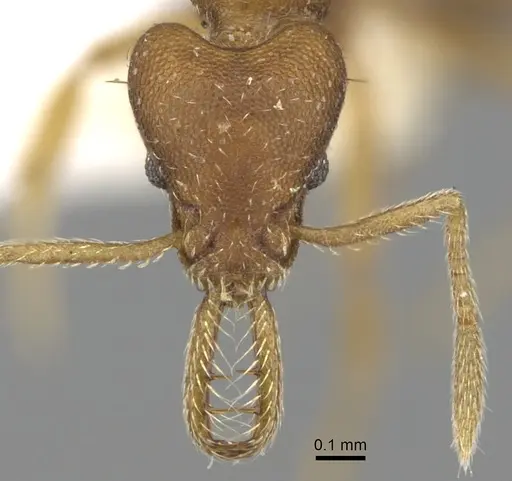
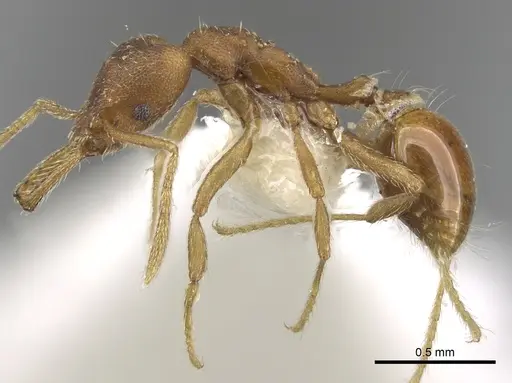
Strumigenys hemidisca is a tiny ant, with workers measuring 2.5–2.7 mm in total length . They have a distinctive deep rusty-brown body and a blackish-mahogany gaster, and their propodeal lamellae are uniquely rounded – a continuous semicircular disc without any teeth or lobes, setting them apart from all other known Strumigenys . Originally discovered from orchid plants intercepted at U.S. plant quarantine stations, this species likely nests among epiphytes in the mountain rainforests of Colombia and Venezuela . It is one of the smallest members of the Strumigenys mandibularis group and remains rarely collected, known primarily from a few quarantine interceptions.
Quick Summary
- Difficulty: Expert
- Origin & Habitat: Mountain rainforests of Colombia and Venezuela, nesting in epiphytic plants such as orchids in tree canopies [1]. Recorded from Putumayo and Quindío, Colombia [2][3].
- Colony Type: Unknown colony structure. Only known from a few worker specimens – no queens or colony data have been published.
- Size & Growth:
- Antkeeping:
- Temperature: No exact data. As a tropical species from mountain rainforests, likely needs warm conditions (roughly low-to-mid 20s °C). Start around 24°C and observe.
- Humidity: High humidity is essential based on their epiphytic habitat. Keep the nest substrate consistently moist but not waterlogged, and ensure good ventilation to prevent mold. Exact percentages are unknown.
- Diapause: No data – likely no true diapause given the tropical origin. Maintain stable warm conditions year-round.
- Nesting: Arboreal specialists. Provide small, tight chambers in plaster, Y-tong, or test tube setups that retain moisture. Epiphytic bark or moss can be added for structure. Avoid large open spaces.
- Behavior: These are very small, delicate ants. They are likely predatory, using their mandibles to capture tiny prey. Their minute size (2.5 mm) makes escape prevention critical. They have a functional sting (typical of the tribe Attini) but pose no serious threat to humans. Keep disturbances minimal.
- Common Issues: escape prevention is critical – they can slip through tiny gaps and standard ant barriers, high humidity requirements can lead to mold if ventilation is insufficient, feeding live micro-prey (springtails, fruit fly larvae) is necessary and may be challenging to provide regularly, this species is virtually unavailable in the hobby, so advice is based on limited data
Housing and Escape Prevention
Strumigenys hemidisca workers are extremely small (2.5–2.7 mm) [1], so escape prevention is your top priority. Use fine mesh (0.5 mm or smaller) on all ventilation holes and seal any gaps in test tube setups or nest boxes. These ants naturally nest in tight spaces among epiphytes, so provide snug chambers – for example, a test tube with a cotton plug and a narrow water reservoir, or a small plaster nest with multiple tiny cells. Avoid acrylic or large open enclosures. Cover nests to keep them dark and humid.
Feeding and Diet
Like other Strumigenys, this species is believed to be a predator of tiny soil invertebrates. In captivity, offer live springtails as a staple – they are the right size and provide necessary nutrients. Small fruit fly larvae, booklice, or mites may also be accepted. Do not rely on sugar water or honey, these ants are almost certainly carnivorous and need protein-rich prey. Feed every 2–3 days in small amounts, removing any uneaten prey after 24 hours to prevent spoilage. The exact dietary requirements are unknown, so observation is key.
Temperature and Humidity
No precise data exists for this species. In their native mountain rainforests in Colombia and Venezuela, they experience warm, stable temperatures and high humidity year-round [2][3]. Keep the nest area around 24°C as a starting point, and maintain a humidity gradient: one moist area (substrate damp) and one drier zone to avoid mold. Monitor moisture levels daily, and provide good airflow. If the ants cluster near water sources, increase moisture gradually, if mold appears, improve ventilation.
Natural History and Rarity
Strumigenys hemidisca has been collected only a handful of times, almost always from orchids or other epiphytes imported from Venezuela or Colombia to the U.S. in plant quarantine [1]. It is believed to be an arboreal dacetine ant, with uniquely shaped propodeal lamellae that are semicircular and lack any teeth or lobes [1]. Its natural colony structure, queen morphology, and founding behavior are completely unknown. Because so few specimens exist, almost every aspect of its captive care is guesswork. If you manage to obtain a colony, treat it as an experimental species.
Frequently Asked Questions
How long does it take for Strumigenys hemidisca to produce first workers?
No data is available. Development time is unknown – there is no published information on egg-to-worker duration for this species.
Can I keep Strumigenys hemidisca in a test tube setup?
A test tube can work, provided you seal all openings with very fine mesh to prevent escape. Maintain high humidity by keeping the water reservoir full and the cotton plug moist. This is untested for this species, but works for similar small Strumigenys.
What do Strumigenys hemidisca ants eat?
They are presumed to be predators of tiny arthropods. Live springtails are the best option, other small prey like fruit fly larvae or booklice may also be accepted. Sugar sources are not known to be consumed.
Are Strumigenys hemidisca ants good for beginners?
No. This species is rated Expert due to its extreme scarcity, lack of husbandry knowledge, tiny size (escape risk), and high humidity needs. It is not recommended for anyone without advanced antkeeping experience.
What temperature do Strumigenys hemidisca need?
Exact temperatures are unknown. They come from tropical mountain rainforests, so start with 24–25°C and adjust based on ant behavior. Avoid extremes.
How big do Strumigenys hemidisca colonies get?
Colony size is completely unknown. No natural colonies have been studied, only a few workers intercepted in quarantine.
Do Strumigenys hemidisca need hibernation?
No data, but because they originate from a tropical region with no cold season, they likely do not require a diapause. Maintain warm conditions year-round.
Why are my Strumigenys hemidisca dying?
Common suspected causes include: escape (check barriers), insufficient humidity, lack of suitable live prey, mold from excess moisture with poor ventilation, or stress from disturbance. Since little is known, careful observation is required.
Where does Strumigenys hemidisca live in the wild?
It inhabits mountain rainforests in Colombia and Venezuela, nesting in epiphytes such as orchids in tree canopies [1]. Additional records exist from Putumayo and Quindío in Colombia [2][3].
Report an Issue
The current care sheet is based fully on literature. See inconsistencies, or something that's incorrect? Please , it will be resolved after review from an admin. Contributing to the blogs tab also helps providing information, to make us be able to further improve the caresheets. Thank you for your support!
References

This caresheet is licensed under CC BY-SA 4.0 .
Community Blogs
CASENT0280718
View on AntWeb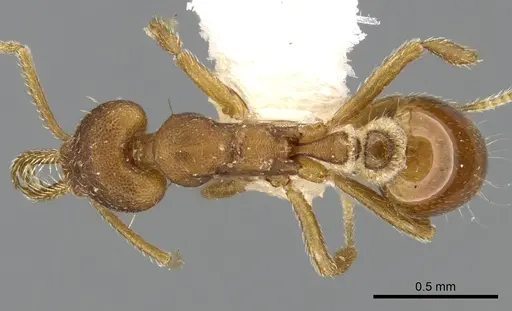
Literature
Loading distribution map...Loading products...