
Strumigenys dolichognatha
- Sci. Name
- Strumigenys dolichognatha
- Tribe
- Attini
- Subfamily
- Myrmicinae
- Author
- Weber, 1934
- Distribution
- Found in 1 countries
Introduction
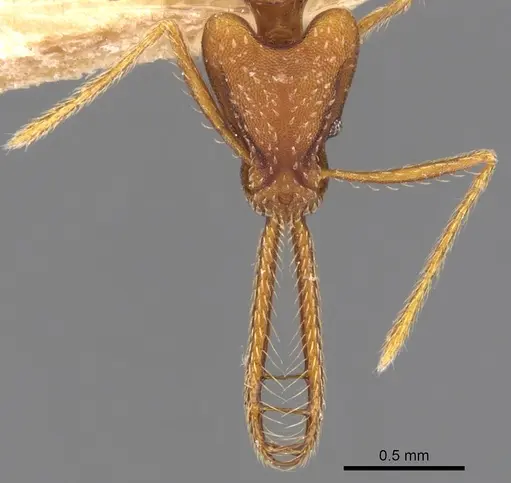
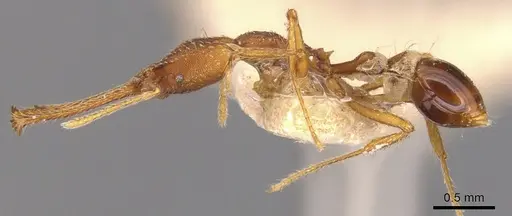
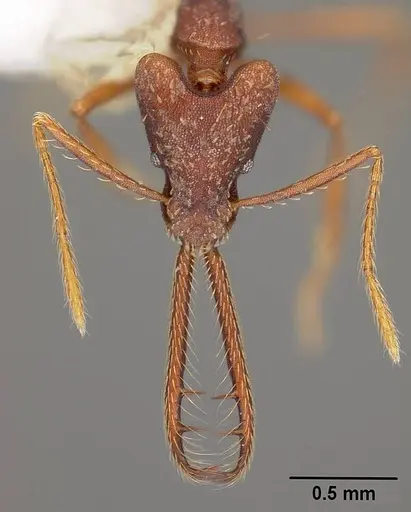
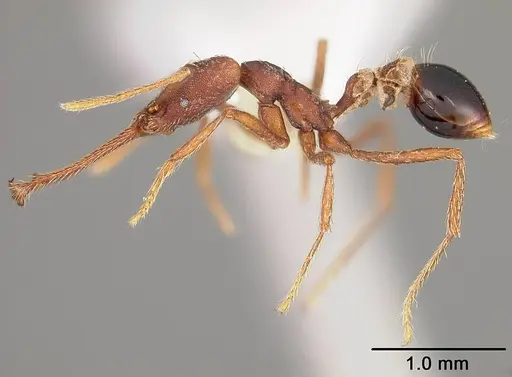
Strumigenys dolichognatha is a small predatory ant, part of the Dacetini tribe, with specialized mandibles for capturing tiny prey. Workers measure 3.7-4.8 mm and have notably long mandibles, a key identification feature . The species is found in the Neotropical region (Brazil, Colombia, Ecuador, Guyana), living in forest leaf litter and the suspended soil inside bromeliads . A distinctive trait is the placement of the preapical mandibular tooth, which is closer to the proximal tooth than to the apicodorsal one . They also possess femoral glands on the hind legs, appearing as small oval patches near the mid‑segment .
Quick Summary
- Difficulty: Hard
- Origin & Habitat: Neotropical region: Brazil, Colombia, Ecuador, and Guyana. Inhabits forest litter and bromeliad samples, especially plants with suspended soil and litter [1].
- Colony Type: Unconfirmed, social structure not documented. Based on related Strumigenys species, likely single‑queen colonies, but direct evidence is lacking.
- Size & Growth:
- Queen: Size data unavailable
- Worker: 3.7-4.8 mm (TL) [1]
- Colony: Unknown, no data available
- Growth: Slow (estimated from related Strumigenys)
- Development: Estimated 8-12 weeks at optimal temperature, based on related Dacetini species, unconfirmed for this species (Inferred from other Strumigenys, direct measurements are lacking.)
- Antkeeping:
- Temperature: Tropical species requiring warm, stable conditions. Estimated range: 24-28°C. Maintain a gradient so workers can self‑regulate.
- Humidity: High humidity needed, inferred from their bromeliad habitat. Keep nest substrate consistently moist but not waterlogged, good ventilation is essential to prevent mold.
- Diapause: No, tropical species, no hibernation required. Keep warm year‑round.
- Nesting: Prefer naturalistic setups that retain moisture: Y‑tong or plaster nests with small, tight chambers. Avoid acrylic or very open nests.
- Behavior: These are cryptic, slow‑moving ants that hunt tiny arthropods using their elongated mandibles. Workers are not aggressive toward humans and rarely sting (they possess a functional stinger as Myrmicinae). Escape prevention is critical due to their small size, use fine mesh. They are most active in dim conditions.
- Common Issues: high humidity needs can lead to mold if ventilation is poor, obligate predatory diet requires a steady supply of live micro‑prey (springtails, etc.), small size makes escape prevention critical, they can squeeze through tiny gaps, very slow colony growth can lead keepers to overfeed or disturb the nest, wild‑caught colonies may carry mites or pathogens that reduce survival
Housing and Nest Setup
Because Strumigenys dolichognatha naturally lives in bromeliad axils and leaf litter, a setup that mimics these conditions is ideal. A plaster or Y‑tong nest with narrow, interconnected chambers works well. Keep the nest substrate moist but not saturated, a water reservoir or moist sponge can help maintain humidity. Provide an outworld for foraging, but make sure all gaps are sealed, these ants can squeeze through openings under 1 mm. A cover of dark material (e.g., acrylic sheet) over the nest keeps the ants calm. Avoid tall enclosures, these ants are not strong climbers and prefer ground-level foraging [1].
Feeding and Diet
These ants are obligate predators of very small arthropods. Springtails (Collembola) are the ideal staple, they match the ants’ prey size and are readily taken. Other acceptable live prey include tiny isopods, booklice (Psocoptera), and small fruit flies (Drosophila). They generally ignore dead or motionless food. Offer prey twice a week, adjusting the amount so that nothing is left to rot. Do not offer sugar or honey, Strumigenys are exclusively carnivorous [1].
Temperature and Humidity
As a tropical species, Strumigenys dolichognatha needs warm conditions year‑round. An estimated temperature range of 24-28°C is appropriate. Use a heating cable or mat on one side of the nest to create a gradient. Keep humidity high: the nest substrate should feel damp, and condensation on the nest walls is a good sign. However, ensure some ventilation to prevent mold. Monitor moisture and adjust if the substrate dries out or becomes waterlogged. No hibernation is needed, so maintain these conditions throughout the year [1].
Behavior and Colony Life
Strumigenys dolichognatha is a cryptic, slow‑moving ant that spends most of its time in the humid nest. Workers forage individually, slowly exploring the outworld for prey. They use their long mandibles to snap up small arthropods, this is a typical trap‑jaw mechanism in Dacetini [3]. The colony is not aggressive and workers will flee rather than fight. They have a functional sting (as Myrmicinae), but it is very rarely used on humans. The queen stays within the deepest, most humid chamber. Colony growth is slow, and patience is essential. Based on related species, a small colony may take many months to reach even a dozen workers.
Growth and Development
There is no direct information on the founding behavior of Strumigenys dolichognatha. For most Dacetini, queens are believed to be claustral, but this is not confirmed for this species. The egg‑to‑worker period is unknown, estimates from related Strumigenys suggest 8-12 weeks at optimal temperature, but this may vary. The first workers (nanitics) are smaller than mature workers. Colony growth is very slow, and reaching even 30 workers may take a year or more. Keepers should avoid disturbing the nest during the founding stage. Once the colony has a few workers, provide small live prey regularly to support growth [1].
Frequently Asked Questions
Can I keep Strumigenys dolichognatha in a test tube?
A test tube can be used during the founding phase, but because founding behavior is unknown, it is unclear if the queen is claustral. If she requires foraging, a test tube would not be suitable. For a small colony, a naturalistic setup with moist substrate and an outworld is better. Monitor closely.
What do Strumigenys dolichognatha ants eat?
They are obligate predators of very small arthropods. Live springtails are the best choice. They will also take tiny isopods, booklice, and small fruit flies. They ignore dead food. Do not offer sugar or other plant‑based foods.
How long does it take for Strumigenys dolichognatha to produce first workers?
This is unknown for this species. Based on related Strumigenys, it is estimated at 8-12 weeks at warm temperatures. Direct data is lacking, so expect variation.
Are Strumigenys dolichognatha good for beginners?
No, this species is rated Hard. The requirements for live micro‑prey, high humidity, and the many unknowns about its biology make it unsuitable for beginners. It is best kept by experienced keepers who can maintain stable conditions and a springtail culture.
Do Strumigenys dolichognatha need hibernation?
No, this is a tropical species that does not require diapause. Keep them warm (24-28°C) all year round.
How big do Strumigenys dolichognatha colonies get?
Unknown, there are no reliable reports of colony size in the wild or captivity. Based on related Strumigenys, they likely remain small (e.g., under 200 workers), but this is speculation.
Why are my Strumigenys dolichognatha dying?
Common causes include: low temperature (below 20°C can be fatal), low humidity causing desiccation, lack of live prey (starvation), mold from poor ventilation and overfeeding, and stress from frequent disturbance. Check temperature and humidity first, then review feeding.
When should I move my colony to a formicarium?
Because growth is very slow, you may need to wait many months before the colony outgrows a test tube. Move to a small Y‑tong or plaster nest when the test tube becomes crowded (workers filling the tube). A nest with multiple small chambers is ideal.
Can I keep multiple Strumigenys dolichognatha queens together?
There is no data on this species. Related Strumigenys are typically monogyne, so it is not recommended to attempt pleometrosis. Keep only one queen per colony to avoid conflict.
Report an Issue
The current care sheet is based fully on literature. See inconsistencies, or something that's incorrect? Please , it will be resolved after review from an admin. Contributing to the blogs tab also helps providing information, to make us be able to further improve the caresheets. Thank you for your support!
References

This caresheet is licensed under CC BY-SA 4.0 .
Community Blogs
CASENT0900429
View on AntWeb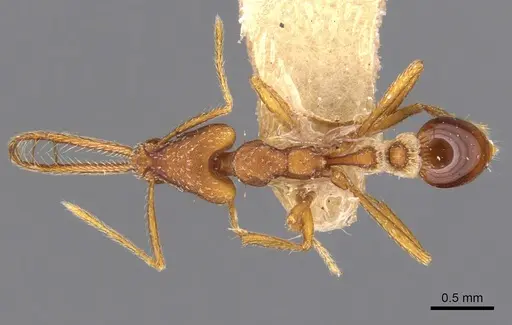
USNMENT00441719
View on AntWeb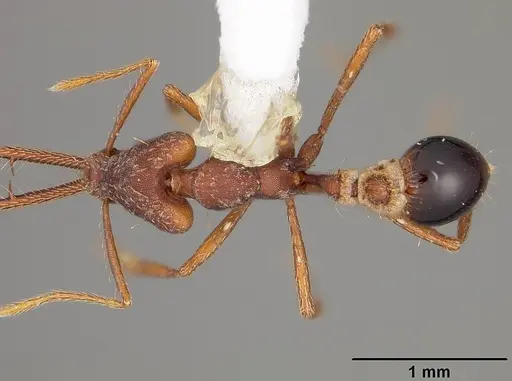
Literature
Loading distribution map...Loading products...