
Strumigenys dahlanae
- Sci. Name
- Strumigenys dahlanae
- Tribe
- Attini
- Subfamily
- Myrmicinae
- Author
- Sosa-Calvo <i>et al.</i>, 2010
- Distribution
- Found in 1 countries
Introduction
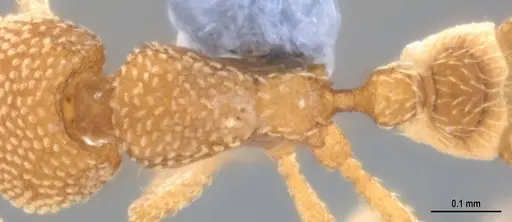
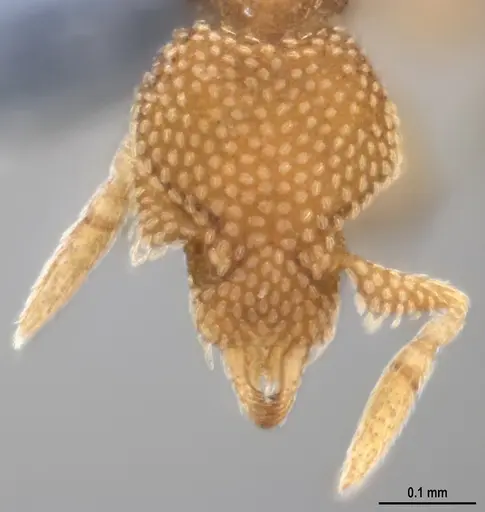
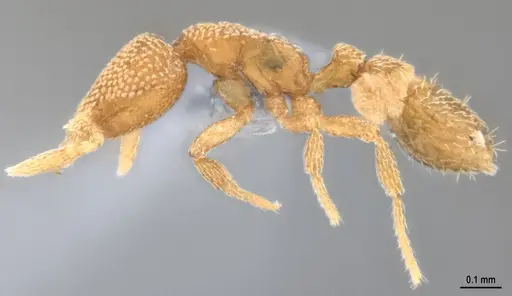
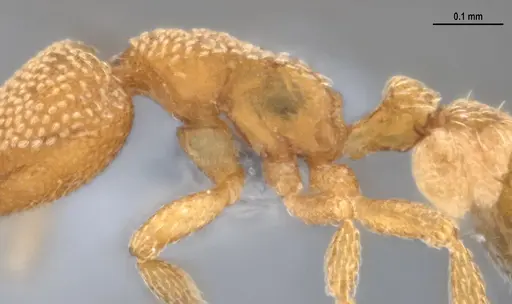
Strumigenys dahlanae is a tiny, predatory ant from Guyana, measuring just 1.38-1.42 mm in total length . Workers are light yellow to dark yellow, entirely blind (no eyes), and have distinctive linear mandibles with 10 teeth, the basal tooth sharp, the rest rounded and flattened . Their body is covered in scale-like (squamate) hairs on the head; the propodeum lacks spines and the petiole has no spongiform tissue . Named after Ms. Nor Faridah Dahlan, this species belongs to the dacetine group, known for hunting small soil arthropods like springtails using their specialized mandibles.
Quick Summary
- Difficulty: Hard
- Origin & Habitat: Guyana [1], specific microhabitat not documented, but dacetine ants typically live in leaf litter and rotting wood in tropical forests.
- Colony Type: Unconfirmed, based on the genus Strumigenys, likely monogyne (single queen), but no published data for this species.
- Size & Growth:
- Queen: No data available.
- Worker: 1.38-1.42 mm (total length) [1]
- Colony: No data, likely small, probably under 100 workers based on the very small worker size.
- Growth: Slow (inferred from related Strumigenys species)
- Development: No specific data, based on related dacetine ants, likely 8-12 weeks at warm temperatures. (Development data are absent for this species, typical dacetine development is slow and temperature‑dependent.)
- Antkeeping:
- Temperature: No specific data, as a tropical species, maintain stable warm conditions around 22-26 °C.
- Humidity: High humidity required, typical of leaf‑litter dwellers. Keep nest substrate consistently moist but not waterlogged.
- Diapause: Likely not needed (tropical origin), but no confirmed data.
- Nesting: Y‑tong (AAC) or naturalistic soil nests with tiny chambers (to match the 1.4 mm workers). Provide deep, humid substrate.
- Behavior: Specialized hunters of tiny soft‑bodied arthropods (e.g., springtails). Not aggressive toward humans, they flee rather than attack. Their minuscule size demands exceptional escape prevention, any gap larger than a fraction of a millimetre is a potential exit.
- Common Issues: escape prevention is critical, use fine mesh and tight seals because workers are only 1.4 mm long., slow colony growth can frustrate keepers, patience is essential., requires a steady supply of live micro‑prey (springtails, mites), they cannot survive on sugar or commercial ant food., dry conditions are lethal, the nest must stay consistently humid., mold from uneaten prey, feed small amounts frequently and remove leftovers promptly.
Housing and Nest Setup
Because workers measure only 1.38-1.42 mm [1], nest chambers must be very narrow, standard ant nest passages would be like highway tunnels to them. Use a Y‑tong (AAC) block with fine chambers, or create a naturalistic setup with damp soil, sand, and leaf litter. The nest should hold high humidity without standing water, a water tube connected to the nest helps. Place the setup in a warm area (22-26 °C) away from direct sunlight and drafts.
Feeding and Diet
Strumigenys dahlanae have linear mandibles armed with 10 teeth [1], ideal for snatching tiny, soft‑bodied prey. In captivity, provide live springtails (Collembola) as the staple, you can also offer booklice, very small mites, or fruit‑fly larvae. They are obligate predators and do not accept sugar or honey. Feed small amounts every 2-3 days, adjusting to consumption, and remove uneaten food to prevent mould.
Temperature, Humidity, and Seasonal Care
This species is from Guyana [1], a tropical country, so they need warm temperatures year‑round. Keep the nest at 22-26 °C, if your room drops below 22 °C, use a heating cable on top of the nest (not underneath) to avoid evaporating moisture. Humidity must stay high, the substrate should remain moist but not soggy. No hibernation is required, maintain stable conditions throughout the year.
Behavior and Temperament
Workers are completely blind [1] and rely on chemical trails and vibrations to navigate. They are calm and non‑aggressive, fleeing rather than stinging or biting when disturbed. Their hunting strategy is ambush: they use their specialised mandibles to snap up passing springtails. Because they are so tiny, excellent escape prevention is mandatory, any crack wider than 0.5 mm is a potential route out.
Colony Development and Growth
No specific development data exist for Strumigenys dahlanae, but based on related dacetine ants, colony growth is extremely slow. A founding queen may take 2-3 months to produce first workers under warm conditions. Even after establishment, colonies grow by only a few workers per month. This slow pace is normal and not a sign of trouble. Be patient, avoid overfeeding, and resist disturbing the nest frequently. [1]
Frequently Asked Questions
How long does it take for Strumigenys dahlanae to produce first workers?
There are no published data for this species. Based on related dacetine ants, expect at least 8-12 weeks from founding to first workers at a stable 24-26 °C. Development is very slow.
What do Strumigenys dahlanae ants eat?
They are obligate predators of tiny, soft‑bodied arthropods. Their linear mandibles with 10 teeth [1] are built for catching springtails and similar prey. Provide live springtails as the main food, they will not accept sugars or processed ant foods.
Can I keep Strumigenys dahlanae in a test tube?
A test tube setup can support a founding queen and her first few workers if kept humid and dark. Once the colony grows to 10-15 ants, you should move them to a Y‑tong or naturalistic nest with tiny chambers to allow proper foraging and humidity management.
Are Strumigenys dahlanae good for beginners?
No, this species is not recommended for beginners. They require live springtail cultures, consistently high humidity, extremely secure enclosures, and a lot of patience due to their slow growth.
How big do Strumigenys dahlanae colonies get?
No direct data are available. Given the very small worker size (1.4 mm), colonies are likely modest, probably under 100 workers at peak. This is typical for many dacetine ants.
Do Strumigenys dahlanae need hibernation?
No, as a tropical species from Guyana, they do not require hibernation. Keep them warm (22-26 °C) and humid all year round.
Why are my Strumigenys dahlanae dying?
The most common causes are: (1) dry air or substrate, check that humidity is very high, (2) lack of suitable live prey, springtails must be available at all times, (3) escape, they can slip through tiny gaps, (4) stress from excessive disturbance or vibrations.
When should I move Strumigenys dahlanae to a formicarium?
Wait until the colony has at least 15-20 workers and is actively foraging in the outworld. A Y‑tong (AAC) nest with fine chambers and a connected outworld works well for this tiny species.
Can I keep multiple queens together?
Not recommended. Colony structure has not been studied for this species, but most Strumigenys are monogyne (single‑queen). Combining queens is risky and may lead to fighting or one being killed.
Report an Issue
The current care sheet is based fully on literature. See inconsistencies, or something that's incorrect? Please , it will be resolved after review from an admin. Contributing to the blogs tab also helps providing information, to make us be able to further improve the caresheets. Thank you for your support!
References

This caresheet is licensed under CC BY-SA 4.0 .
Community Blogs
ANTWEB1053702
View on AntWeb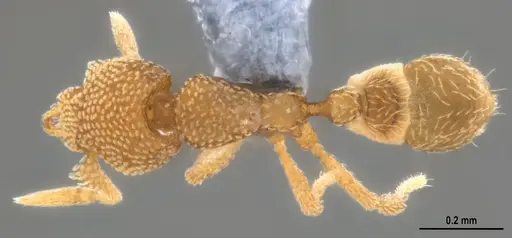
Literature
Loading distribution map...Loading products...