
Strongylognathus afer
- Sci. Name
- Strongylognathus afer
- Tribe
- Crematogastrini
- Subfamily
- Myrmicinae
- Author
- Emery, 1884
- Distribution
- Found in 3 countries
Introduction
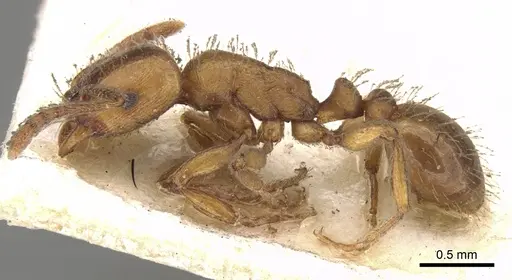
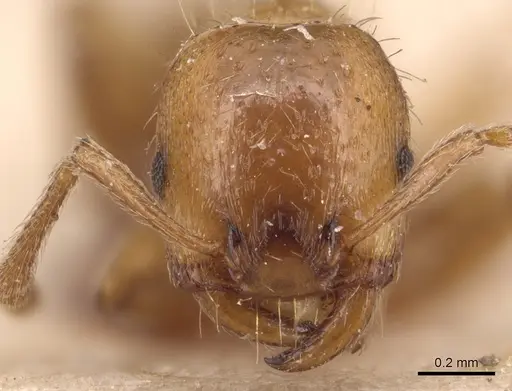
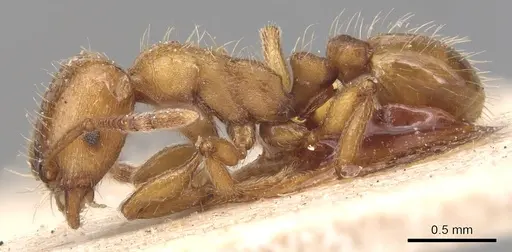
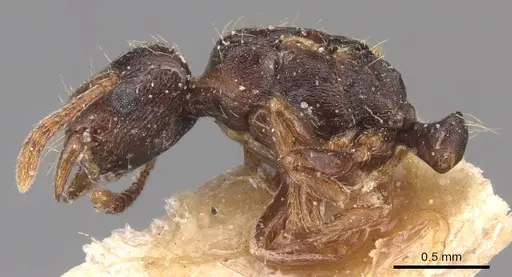
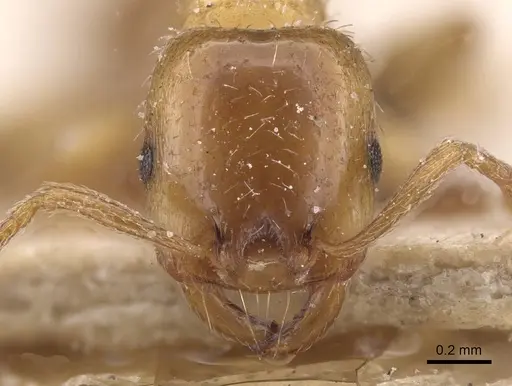
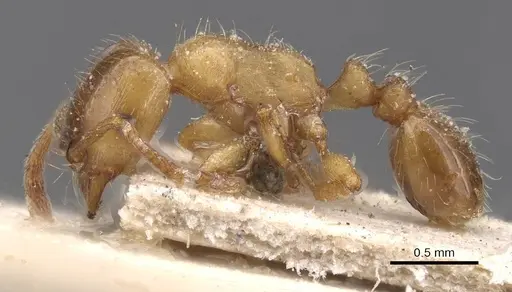
Strongylognathus afer is a tiny dulotic (slave-making) ant from North Africa. It raids colonies of its host species Tetramorium semilaeve to steal brood . Workers are very small - among the smallest in the huberi group - and the queens are also notably small . The species is found across Algeria, Morocco, and Tunisia at elevations of 300-1500m, living in varied Mediterranean habitats from olive-pistachio forest remnants to cedar-dominated woods . What makes S. afer particularly interesting is its specialized parasitic lifestyle. Unlike most ants that build their own colonies, this species relies entirely on host workers. Laboratory observations have documented slave raids where S. afer workers use chemical pheromone trails to coordinate attacks, sometimes transporting adult host workers back to their own nest - a behavior called eudulosis . The host queen may be killed, though in one case a T. semilaeve queen was adopted and survived for over half a year . This dependence on a specific host makes S. afer a challenging species to keep, best suited for experienced antkeepers interested in specialized parasitic ants.
Quick Summary
- Difficulty: Expert
- Origin & Habitat: North Africa (Algeria, Morocco, Tunisia) at elevations of 300-1500m. Inhabits Mediterranean habitats including olive-pistachio forest remnants, olive orchard margins, maquis with holm oak and juniper, cedar-dominated woodland, and meadows with Asphodelus and Cistus [1].
- Colony Type: Dulotic social parasite, colony depends on host species Tetramorium semilaeve workers. Swarming season September to October [1].
- Size & Growth:
- Queen: size data unavailable, queens are notably small compared to other Strongylognathus species [1]
- Worker: size data unavailable, workers are among the smallest in the huberi group [1]
- Colony: Unknown, small colonies typical for dulotic species
- Growth: Unknown, dependent on host colony growth
- Development: Unknown, directly dependent on host Tetramorium semilaeve brood development (Development is tied to host worker development rather than being independent)
- Antkeeping:
- Temperature: Keep at typical Mediterranean room temperature, roughly 20-25°C. No specific thermal studies exist, but base conditions on their varied Mediterranean habitats [1].
- Humidity: Moderate humidity, the species inhabits sites from humid to arid [1]. Provide a gradient and avoid overly damp conditions.
- Diapause: Likely requires winter rest period (diapause) given North African Mediterranean distribution with cooler winters. Nuptial flights in September-October suggest a seasonal cycle [1]. Specific requirements unconfirmed.
- Nesting: Must be kept with host Tetramorium semilaeve colony. Requires a dual-colony setup with controlled connections for raids. Test tube setups with connecting bridges work well.
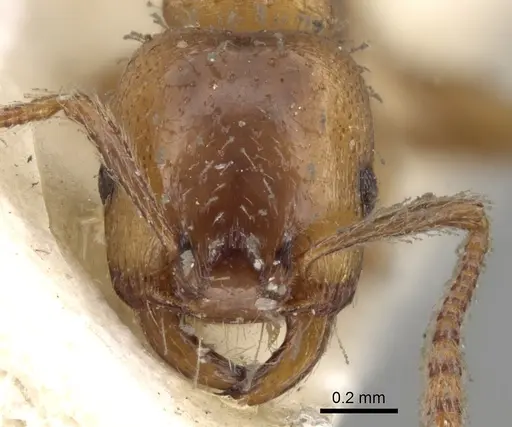
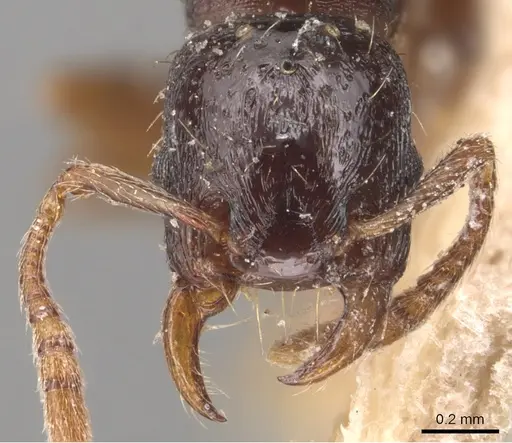
- Behavior: Extremely specialized parasitic ant. Workers are tiny, active, and conduct coordinated slave raids using pheromone trails [1]. They cannot survive without their host. Raids typically occur at dusk and last 1-2 days [1]. Workers have specialized saber-shaped mandibles for piercing head capsules of defending host ants [1]. Escape risk is high due to tiny size, fine mesh barriers are essential. Their defense mechanism is a modified stinger that smears venom rather than piercing, but workers are too small to affect humans.
- Common Issues: absolute dependence on host species, you must maintain both a healthy Tetramorium semilaeve colony and the S. afer colony, tiny size means escapes are likely without fine mesh barriers on all enclosures, slave raids can kill the host queen, potentially collapsing the host colony, balancing parasite and host populations is challenging, too many raids kills the host, too few starves the parasite, finding a legitimate host colony of Tetramorium semilaeve may be difficult depending on your location, dulotic ants should never be released due to ecological impact, this species is also listed as Vulnerable D2 [3]
Understanding Dulotic Ants: What Makes S. afer Unique
Strongylognathus afer belongs to a rare category of ants called dulotic species, true slave-makers. Unlike temporarily parasitic ants that only use a host colony to get started, dulotic ants are permanently dependent on host workers throughout their entire colony lifecycle [1]. The host workers do all the foraging, nest maintenance, and brood care while S. afer workers focus on raiding and reproduction. This makes S. afer fundamentally different from most ant species kept in captivity, you cannot keep one without the other. In the wild, S. afer specifically targets Tetramorium semilaeve as its host [1]. This extreme specialization means successful keeping requires maintaining two colonies simultaneously: the parasite and its host.
Housing Requirements: The Dual Colony Setup
Keeping S. afer requires a specialized dual-colony setup. You'll need to maintain a healthy Tetramorium semilaeve colony as the host, plus a separate enclosure for the S. afer colony, with controlled connections between them for raid events. The host colony should be housed in a standard setup (test tubes, Y-tong, or naturalistic) appropriate for Tetramorium, typically a dry to moderately humid nest with small chambers. The S. afer colony needs similar conditions but should be connected via tubing that allows controlled access for raids. Never house S. afer directly with the host colony full-time, this would allow continuous raids that would destroy the host. Instead, use a valve or removable plug system to allow periodic controlled raids. Both colonies need excellent escape prevention due to the tiny worker size of both species [1].
Feeding and Nutrition
In a proper dual-colony setup, the host Tetramorium semilaeve workers do all the foraging and feeding. You should feed the host colony a standard Tetramorium diet: protein sources like small insects (fruit flies, pinhead crickets, mealworms), and sugar sources like honey water or sugar water. The S. afer workers will steal food and brood from the host colony during raids. Focus your feeding efforts on maintaining a robust host colony, a healthy host means a healthy parasite colony. [1]
Slave Raids: Understanding the Behavior
The most dramatic behavior you'll observe is the slave raid. Laboratory observations show raids lasting one or two days, usually starting at dusk [2][1]. The S. afer workers lay chemical pheromone trails to recruit nestmates, and they're solely responsible for the chemical signaling, the host workers don't participate [1]. A unique behavior documented in this species is 'eudulosis', the transportation of adult host workers back to the S. afer nest in high frequency [1]. These raids occur in waves, with periods of brood transport alternating with adult worker transport, each period lasting about one to three hours [1]. During raids, S. afer workers use their specialized saber-shaped mandibles to pierce the head capsules of defending Tetramorium workers [1]. In some cases, the host queen is killed, though interestingly one study observed a T. semilaeve queen being adopted and surviving for over half a year [1].
Temperature and Seasonal Care
Given the North African Mediterranean distribution (Algeria, Morocco, Tunisia), S. afer experiences warm summers and mild winters with occasional cold periods at higher elevations (300-1500m) [1]. Keep both colonies at typical room temperature in the low-to-mid 20s Celsius range. A slight drop in temperature during winter months may help trigger reproductive behavior, as dealate females have been collected in early October, suggesting nuptial flights occur in September-October [1]. Both colonies should be protected from direct sunlight and temperature extremes. Given the elevation range they naturally occupy, they can likely tolerate brief cool periods but should be kept warm overall.
Legal and Ethical Considerations
Strongylognathus afer is a specialized parasite that depends entirely on another species. Before acquiring this ant, consider whether you can ethically obtain both the parasite and its legitimate host species (Tetramorium semilaeve). Additionally, dulotic ants should never be released into the wild, they can devastate native ant populations by raiding local Tetramorium colonies. In some regions, keeping parasitic ants may be regulated or discouraged. Always check local regulations. The conservation status is Vulnerable D2 [3], meaning wild populations face threats, so ethical sourcing from reputable breeders is important.
Frequently Asked Questions
Can I keep Strongylognathus afer in a standard ant setup?
No, S. afer is a dulotic species that cannot survive without its host Tetramorium semilaeve. You need a dual-colony setup with both the parasite and host colonies, connected by controlled access points for raids. This is significantly more complex than keeping a standard ant species.
What do Strongylognathus afer ants eat?
S. afer doesn't forage for itself, it raids host colonies to steal brood and food. You feed the host colony a standard diet (small insects and sugar water), and the S. afer workers obtain nutrition through raiding.
How long does it take for Strongylognathus afer to develop from egg to worker?
This is unknown and likely tied to host development rather than being independent. As a dulotic parasite, S. afer relies on host workers to raise its brood, so development time depends on how efficiently host workers care for the parasite brood.
Do Strongylognathus afer ants sting?
No, these ants have a modified stinger that smears venom onto enemies rather than piercing them. Because of this, they cannot sting humans. Their main weapons are saber-shaped mandibles used against other ants during raids [1]. They pose no threat to keepers.
Are Strongylognathus afer good for beginners?
No, this is an expert-level species. The dual-colony requirement, need to maintain a host species, specialized raid behavior, and tiny size make this one of the most challenging ants to keep. Beginners should start with easier species like Lasius, Tetramorium, or Camponotus.
Can I keep multiple Strongylognathus afer queens together?
It is unknown whether multiple queens occur naturally. Some dulotic species can have multiple queens, but this has not been confirmed for S. afer. It is not recommended to attempt combining queens from different sources.
Do Strongylognathus afer need hibernation?
Likely yes, given their Mediterranean distribution with seasonal temperature changes. The nuptial flight season is September-October [1], suggesting a seasonal cycle. Provide a cool period (around 10-15°C) during winter months, but ensure both parasite and host colonies are healthy before hibernation.
Why are my Strongylognathus afer dying?
The most likely cause is host colony collapse, without healthy Tetramorium semilaeve workers, the S. afer colony cannot survive. Other common issues include: host queen death during raids (causing host colony decline), escape due to tiny size, temperature stress, or improper humidity. Monitor both colonies closely.
How big do Strongylognathus afer colonies get?
Colony size is unknown but typically remains small for dulotic species. The dependence on host workers limits how many parasite workers the host can support. Unlike typical ants that can grow to thousands of workers, S. afer colonies will likely remain in the tens to low hundreds of workers.
Report an Issue
The current care sheet is based fully on literature. See inconsistencies, or something that's incorrect? Please , it will be resolved after review from an admin. Contributing to the blogs tab also helps providing information, to make us be able to further improve the caresheets. Thank you for your support!
References

This caresheet is licensed under CC BY-SA 4.0 .
Community Blogs
CASENT0280847
View on AntWeb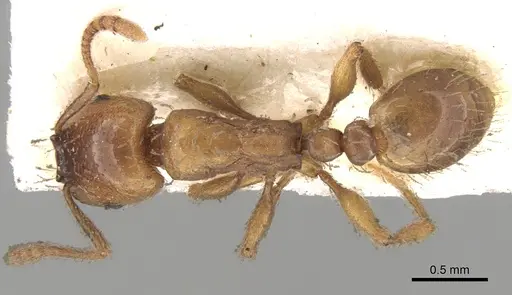
CASENT0904863
View on AntWeb
CASENT0904868
View on AntWeb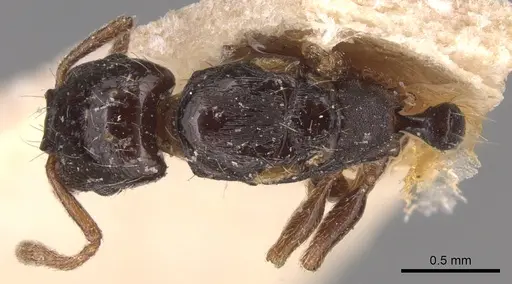
CASENT0913975
View on AntWeb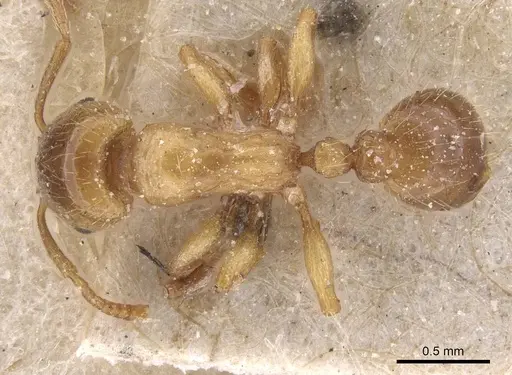
Literature
Loading distribution map...Loading products...